
Introduction
When a bridge saw goes down in a stone fabrication shop, production stops immediately. Jobs stall, revenue hemorrhages at approximately $1,500 per hour, and customers feel the impact as deadlines slip. In a commercial stone operation, no single piece of equipment determines whether a shop meets its commitments—or scrambles to explain delays—more than the bridge saw.
Bridge saw problems follow predictable patterns: blade wear, rail misalignment, water system buildup, electrical faults, and maintenance gaps are the usual culprits. The good news: most can be resolved in-house, provided the root cause is identified correctly before any repair attempt.
That's exactly what this guide is built to help with. It covers the most common bridge saw failures and their root causes, walks through a step-by-step diagnosis and repair process, clarifies when to fix versus replace, and outlines preventive maintenance that cuts unplanned downtime between scheduled service intervals.
TL;DR
- Inaccurate cuts, blade wobble, chipping, water system failures, and motor faults are the most common bridge saw problems
- Diagnosing the root cause before ordering parts prevents repeat failures and unnecessary costs
- Water system failures, alignment issues, and electrical faults are typically resolvable in-house
- Spindle bearings, CNC/PLC faults, and main motor failures require factory-trained technicians
- Reactive maintenance costs 3-9 times more than scheduled preventive maintenance
Common Bridge Saw Problems and Their Root Causes
Bridge saw failures typically originate from four systems: mechanical, electrical, water, and operational. Most fabrication shops run into the same five problems repeatedly — each with identifiable symptoms and predictable causes.
Problem 1: Inaccurate or Drifting Cuts
Symptoms:
- Cuts deviate from programmed dimensions
- Slab edges are not square
- Finished pieces require excessive grinding to fit
Likely Causes:
Bridge rail misalignment from cumulative vibration is the primary mechanical culprit. Even 1mm of deviation over 1 meter of travel produces visibly non-square countertop sections at seams. Other causes include worn blade flanges or arbor bearings that allow blade runout, and loose table mounting that shifts slab position mid-cut.
This matters because the Natural Stone Institute and Marble Institute of America specify maximum lippage of just 1/32" (0.8mm) for commercial installations—a tolerance that misaligned equipment cannot consistently achieve.
Problem 2: Blade Wobble and Excessive Vibration
Symptoms:
- Visible blade movement during cutting
- Surface chatter on cut face
- Unusual noise under load
Likely Causes:
Improper blade seating or debris trapped between blade and flange creates immediate wobble. Spindle bearing failure causes progressive vibration that worsens under load, destroying cut quality and risking blade detachment mid-cut.
To diagnose: hand-rotate the arbor with power off. Grinding, roughness, or noise points to bearing failure and requires immediate professional service.
Problem 3: Chipping and Rough Cut Edges
Symptoms:
- Material chips at cut entry or exit
- Rough cut face requiring additional finishing
- Edge quality deteriorates mid-production
Likely Causes:
Using the wrong blade type for the material is the most common cause. A marble blade on quartzite will always produce chipping regardless of feed rate. Worn or glazed diamond segments that hammer rather than grind stone create the same effect.
Feed rate mismatches also cause chipping—pushing too aggressively forces the blade to fracture stone rather than abrade it. Feed rate significantly impacts whether diamond segments cut cleanly or chip material.
Problem 4: Water System Failure
Symptoms:
- No water or low flow at blade
- Overheating blade
- Glazed or darkened diamond segments
- Burning smell during cuts
Likely Causes:
Water performs three critical functions: cooling the blade, lubricating the cut, and flushing stone slurry. When flow drops below the recommended 3-5 gallons per minute for 14"-16" blades, blades overheat rapidly, lose core tension, and experience segment loss.
Common flow restrictions include:
- Clogged nozzles from stone slurry buildup
- Failing water pumps
- Blocked intake filters
- Mineral scale inside supply lines
In hard-water regions, calcium deposits build rapidly and cause blade-killing thermal events.
Problem 5: Motor Overheating, Electrical Faults, or Machine Won't Start
Symptoms:
- Thermal shutoff mid-cut
- Burning smell from motor area
- Machine fails to start
- Error codes on control panel
Likely Causes:
Motor overloading from excessive feed rate is common, as are low supply voltage or loose electrical connections at control panels or motor terminals. Tripped breakers often result from electrical issues rather than true overloads.
In CNC models, stone dust infiltrating electrical enclosures causes controller faults. Control cabinets require IP54 or IP55 protection (NEMA 12/13 equivalent) in wet, dusty stone environments.
These problems compound when left unaddressed. A small misalignment wastes expensive slabs. A clogged nozzle takes out a $500 blade, and a loose connection can escalate into a failed $3,000 motor. Catching failures early always costs less than reacting late.

Step-by-Step: How to Diagnose and Fix Your Bridge Saw
Attempting repairs without confirming root cause is the most common—and costly—error fabricators make. This process ensures you fix the right problem the first time.
Step 1: Establish Safety and Observe the Problem
Lockout-Tagout is Mandatory
OSHA 29 CFR 1910.147 explicitly prohibits using Emergency Stop buttons as energy isolation for maintenance. Push buttons and control circuit devices are not energy isolating devices under the law.
Complete proper LOTO:
- Shut off the main breaker
- Lock it in the off position
- Tag it with your name and date
- Verify zero energy at the machine
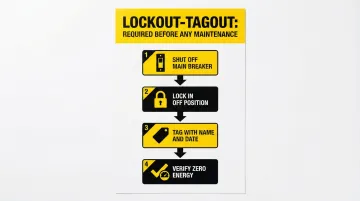
Skipping any of these steps carries real consequences: in 2018, LOTO violations in stone fabrication resulted in $148,308 in penalties. Only once the machine is fully de-energized should you move on to documenting what went wrong.
Document the Symptoms
With power safely off, observe:
- Where does the problem appear (cut face, axis movement, water delivery)?
- Under what conditions does it occur (startup, under load, specific material)?
- Is the issue consistent or intermittent?
Step 2: Confirm the Root Cause Category
Determine whether the issue is mechanical (alignment, blade, bearings), electrical (power supply, connections, sensors), or operational (feed rate, blade selection, water quality).
Rule Out External Factors First:
- Verify supply voltage is correct and stable
- Confirm water source pressure is adequate
- Check for obvious physical obstructions
Fixing internal components before eliminating external variables wastes time and parts.
Step 3: Apply the Correct Fix Based on Confirmed Cause
Mechanical Fixes:
Rail alignment: Re-align bridge rails using a precision square or level per manufacturer's procedure. Misaligned rails produce out-of-square cuts across every slab that follows.
Blade installation: Replace or re-seat the blade with the flange face and arbor completely clean. Even microscopic debris causes runout.
Blade bolt torque: Follow manufacturer specifications precisely. Industrial tooling standards typically call for 51 Nm (38 ft-lb) on M10 screws and 88 Nm (65 ft-lb) on M12 screws. Over-torquing deforms the blade core; under-torquing allows slippage.
Spindle bearings: Refer this to a qualified technician — improper installation destroys new bearings and voids the repair.
Electrical Fixes:
- Inspect and re-tighten all connections at control panel and motor terminals
- Check and reset the main breaker
- Clean stone dust from control panel enclosure with compressed air
- For persistent error codes on CNC models, do not attempt to clear parameters without manufacturer service documentation—call a technician
Operational and Environmental Fixes:
- Feed rate: Reduce feed rate and verify blade RPM matches manufacturer specification for the material being cut. Different stones require different cutting parameters.
- Water system: Clean nozzles with a wire brush, blow out supply lines with compressed air, and flush the full system with clean water.
- Hard water: In hard-water regions, monthly descaling restores flow. Mineral buildup constricts lines and drops flow below the critical 3 GPM threshold.
- Blade matching: Verify blade bond matches material. Granite requires soft-to-medium bonds; marble requires hard bonds. Using a marble blade on quartzite produces chipping regardless of other factors.

Step 4: Test and Validate the Repair
Before returning to production, run a test cut on scrap material of the same type:
- Measure cut for dimensional accuracy and squareness
- Inspect cut face for chipping or chatter
- Monitor machine for unusual noise or vibration
If the symptom recurs during the first production run, do not continue cutting. Return to Step 2 to re-evaluate root cause. If the problem persists after a second diagnostic pass, contact the machine manufacturer directly — some failures require factory-level service documentation to resolve correctly.
Fix vs. Replace: Making the Right Call
Repairs extend machine life and protect existing investment. But at some point, repair costs, downtime frequency, and parts availability shift the decision toward replacement.
Fix When:
- Failure is isolated to a single replaceable component (blade, nozzle, belt, seal, pump)
- Machine is otherwise in sound mechanical condition
- Parts are readily available
Machines built with accessible components reduce repair complexity and cost. When parts ship from domestic or near-shore suppliers — rather than requiring long international lead times — the fix decision becomes much easier to justify. That's a key reason equipment manufacturers like Crown Stone USA source primarily from the US, Americas, Korea, Japan, and Taiwan: so fabricators spend less time waiting and more time cutting.
When those conditions no longer hold, replacement becomes the stronger call.
Replace When:
- Multiple systems fail simultaneously or in quick succession
- Cumulative repair cost approaches 50-75% of replacement value
- Machine consistently causes unplanned downtime disrupting customer commitments
- Original manufacturer no longer supports the model with parts or service documentation
A well-maintained commercial bridge saw has a service life of 10-20 years. When machines reach end-of-life, newer equipment with warranties, reliable parts supply, and fabricator-focused design cuts total ownership costs more than continued repairs ever could.
Common Repair Mistakes to Avoid
Most bridge saw repairs that fail a second time trace back to one of three mistakes. Recognizing them before you reach for a wrench saves time, parts, and production hours.
Treating symptoms instead of root causes is the most costly pattern. Replacing the blade when rail misalignment is the real problem — or cleaning nozzles when the pump is failing — guarantees the issue returns. Diagnose before you act.
Skipping the test cut is equally common. A repair isn't complete until it holds under real cutting conditions. Run a full test cut on scrap material before returning the machine to production; a few extra minutes here prevents scrapped slabs and a second shutdown.
Using incompatible replacement parts creates new failure modes even as it fixes the original one. Match every component — blade flanges, belts, seals, pump parts — to your machine's manufacturer specifications. Generic substitutions can also void warranty coverage, turning a minor fix into a costly problem.
A quick checklist before closing out any repair:
- Root cause identified and confirmed (not just the visible symptom)
- Test cut completed on scrap material under production conditions
- All replacement parts verified against manufacturer spec for your model
Preventive Maintenance to Minimize Future Breakdowns
The ROI of prevention is substantial: reactive maintenance costs 3-9 times more than planned preventive maintenance. That math adds up fast — shops can justify hiring a part-time maintenance person at $26,000 annually by avoiding just 16 hours of unplanned downtime.
The tasks below are organized by frequency. Most take minutes — and each one addresses a specific failure mode that shows up repeatedly in bridge saw breakdowns.
Daily Tasks
- Inspect and wipe down bridge rails before the first cut — dried stone slurry accelerates bearing wear dramatically
- Visually inspect blade for segment loss or cracks
- Verify water flow and pressure to blade before cutting begins
Weekly Tasks
- Lubricate linear rails and bearings per manufacturer specs (typically Mobil Vactra #2 way oil or Mobil XHP222 grease)
- Flush water system with clean water to clear mineral and slurry buildup
- Inspect electrical connections at control panel for corrosion or looseness
- Run a test cut on scrap to verify dimensional accuracy and catch developing alignment issues early
Monthly Tasks
- Check rail alignment with a precision level and correct any deviation
- Inspect spindle bearings by hand-rotating the arbor with power off — listen for roughness or resistance
- Service the hydraulic system (if equipped) — check fluid levels, inspect hoses for wear, and bleed air from lines
- Test emergency stop circuits and safety interlocks — a mandatory safety check required at least quarterly under ANSI/NFPA 79

Frequently Asked Questions
What does a bridge saw do?
A bridge saw is a large-format wet-cutting machine used in stone fabrication to make precise straight cuts through granite, marble, quartz, and other stone slabs. It's the primary tool for cutting countertops, flooring tiles, and custom stone pieces to exact dimensions in commercial fabrication shops.
Is it worth repairing a bridge saw?
In most cases, yes — bridge saws are high-value capital equipment, and individual component failures (blades, water pumps, belts, nozzles) are far cheaper to fix than replacing the machine. Replacement makes more sense when multiple systems fail at once, parts are no longer available, or repair costs approach 50–75% of the machine's replacement value.
How do I know if my bridge saw blade needs replacing?
Watch for increased chipping on cut faces, a 40%+ drop in cutting speed with higher motor strain, and glazed or visibly worn diamond segments. Missing segments require immediate blade retirement — continuing to run creates dangerous imbalances and risks catastrophic failure.
What causes chipping when cutting stone on a bridge saw?
Three main causes produce chipping: using a blade not matched to the stone's hardness (wrong bond type), pushing feed rate faster than the blade and material can handle (especially at entry and exit), and running worn or dulled diamond segments that hammer stone rather than grind through it cleanly.
How often should a bridge saw be professionally serviced?
Schedule professional service at least once a year, covering spindle bearing inspection, rail alignment calibration, and motor electrical testing. High-production shops benefit from semi-annual intervals — technicians can catch wear in components that in-house teams can't easily assess.