
Introduction
When your bridge saw goes down mid-shift, every minute costs money. Unplanned downtime in stone fabrication averages $1,500 per hour, factoring in wasted labor, missed deadlines, and scrambled schedules. For many shops, the bridge saw is the heartbeat of production—and when it stops, everything stops.
The good news: most bridge saw failures follow predictable patterns with fixable root causes. This guide walks you through diagnosing common problems, applying the right fixes, knowing when replacement makes more sense than endless repairs, and building habits that prevent issues from coming back.
TL;DR
- Bridge saw problems cluster into four categories: cut quality, blade vibration, water system failures, and motor faults
- Most common issues can be diagnosed and fixed in-house without a service call
- Always confirm root cause before replacing parts: treating symptoms wastes time and money
- Recurring failures across multiple systems often mean replacement beats repair on cost
Common Bridge Saw Problems: Symptoms and Root Causes
Bridge saw failures aren't random—they follow recognizable symptom patterns tied to specific mechanical, electrical, or operational root causes. Knowing what to look and listen for gets you to a solution faster.
Problem 1: Inaccurate or Non-Square Cuts
Symptoms:
- Finished slabs show visible deviation from straight cuts
- Repeated cuts drift in the same direction
- Precision squares reveal gaps between blade path and reference edge
Likely Causes:
Heavy use and accumulated vibration knock bridge rails out of alignment over time. Worn arbor bearings or warped blade flanges fail to keep the cutting disc perpendicular—causing the blade to run off-angle. Stone dust buildup on rails creates inconsistent travel and worsens alignment issues.
When checking for this problem, use a machinist's square to verify blade perpendicularity to the table—Park Industries specifies alignment tolerances as tight as +/- 0.005 from zero for critical tool axes, showing how little deviation it takes to produce noticeable cut errors.
Problem 2: Excessive Vibration or Blade Chatter
Symptoms:
- Audible rattling or chatter during cutting
- Rough finish on stone surface
- Visible blade movement during operation
- Increased operator hand fatigue on manual controls
Likely Causes:
Improperly seated or loose blade flanges create wobble at the cutting edge. Blades must be seated flush against the inner flange and tightened in a star pattern to manufacturer torque specs—dropped blades or careless installation multiply this problem. Debris or sludge buildup on guide rails creates uneven contact that transfers vibration directly to the cutting head.
Worn spindle bearings fail to dampen movement under load. To diagnose bearing failure, hand-rotate the arbor with power off—any grinding or roughness indicates bearings need replacement. Wavy or curved cuts are almost always caused by blade vibration, not operator error.
Problem 3: Chipping and Poor Surface Finish
Symptoms:
- Visible edge chips or micro-fractures on granite, quartz, or marble
- Finish quality varies across the same slab
- Clean cuts deteriorate over a shift even with no parameter changes
Likely Causes:
The most common culprit is mismatched blade specification. Diamond blade selection follows an "opposites attract" rule: hard stones like granite require soft bonds that expose fresh diamonds quickly, while softer stones like marble need hard bonds that retain diamonds longer.
Three other causes account for most remaining cases:
- Diamond segment glazing — the metal bond wears too slowly, diamonds dull without being released, and the rim looks polished instead of gritty. The blade spins but doesn't cut.
- Feed rate too high — pushing faster than the stone hardness allows accelerates both glazing and edge chipping.
- Insufficient coolant — inadequate water flow causes heat-related surface damage that mimics material defects but is actually thermal stress.

Problem 4: Water System Failure and Blade Overheating
Symptoms:
- Visible scorch marks or blade glazing
- Steam during cutting
- Water pressure drops noticeably mid-shift
- Pump makes unusual noise or stops cycling
Likely Causes:
Common sources of water system failure include:
- Clogged nozzles — mineral or slurry deposits block coolant flow to the blade
- Blocked pump intake filters — restrict water volume before it reaches the cutting zone
- Failing pump motors — lose pressure capacity gradually, often mid-shift
- Hard water buildup — in mineral-heavy supply regions, deposits accumulate inside lines over time
Water filtration matters more than most operators realize. Park Industries requires water filtered to 50 microns at the spindle to prevent damage—a standard worth applying to any bridge saw.
When water flow fails, blade temperature spikes, segments glaze faster, and slurry accumulates in the cut. That combination causes binding, vibration, and accelerated silica dust exposure.
How to Fix Your Bridge Saw: A Step-by-Step Approach
Attempting repairs without confirming the exact problem leads to part replacements that don't fix anything. This four-step process ensures your fix addresses the root cause, not just the symptoms.
Step 1: Identify the Exact Problem
Observe before touching anything:
- Look for visible leaks around water connections
- Listen for unusual noises—grinding, rattling, whining
- Check cut quality on recent pieces
- Note whether the issue occurs at startup, under load, or continuously
Document the context:
- Time of day the problem appears
- Material being cut when failure occurred
- Depth of cut and feed rate settings
- Any recent changes to blades, parameters, or maintenance routines
This documentation matters most when a problem recurs. Patterns in timing or material type often point to root causes that aren't obvious on first inspection.
Step 2: Confirm the Root Cause Category
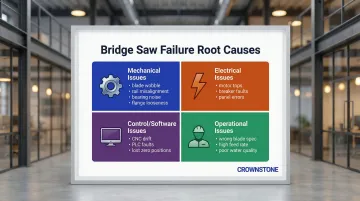
Determine whether the issue is mechanical, electrical, control/software, or operational.
Mechanical issues:
- Blade wobble, chatter, or vibration
- Rail misalignment or rough travel
- Bearing noise or spindle roughness
- Flange looseness
Electrical issues:
- Motor trips or overheating
- Breaker trips under load
- Control panel errors or unresponsive buttons
- Inconsistent motor behavior
Control/software issues:
- CNC parameter drift
- Position errors on automated cuts
- PLC faults or error codes
- Lost zero positions
Operational issues:
- Wrong blade specification for material
- Feed rate too high for stone hardness
- Inadequate water flow
- Poor water quality causing mineral buildup
Rule out external factors first: Confirm power supply voltage under load, check water line pressure at the source, and verify the correct blade is installed for the material before opening panels or removing components.
Step 3: Apply the Correct Fix
For mechanical issues:
Blade and Flange Check:
- Remove blade and inspect flanges for warping, cracks, or damage
- Clean flange surfaces thoroughly — stone dust between flange and blade creates wobble
- Reseat blade flush against inner flange
- Tighten outer flange in star pattern to manufacturer torque specs
- Hand-rotate arbor to verify smooth, centered rotation
Rail and Guide Maintenance:
- Clean rails and guide channels of accumulated sludge using degreaser
- Inspect guide bushings for flat spots or excessive wear
- Check guide wheels for smooth rotation — replace if rough or seized
- Verify bridge travels smoothly across full length without binding
Spindle Bearing Inspection:
- With power off and locked out, hand-rotate arbor
- Any roughness, grinding, or play indicates bearing replacement needed
- Spindle bearing failure requires professional service for most shops
For cut quality and blade performance issues:
Blade Specification Verification:
- Confirm blade bond hardness matches material being cut
- Check segment height — worn segments reduce cutting efficiency and increase chipping
- Inspect for segment glazing: shiny, smooth face instead of exposed diamond grit
Glazing Correction:
- Run dressing cuts through abrasive material (60-grit dressing stone or 1/8" limestone)
- Make short passes to re-expose diamonds and true the rim
- Monitor amp draw — should drop noticeably if dressing was successful
Parameter Adjustment:
- Reduce feed rate: Weha recommends 40"–60" per minute for quartzite, 60"–120" for quartz and granite
- Verify RPM: most 14" blades perform best between 2,800–3,200 RPM
- For 3cm granite, depth per pass should typically be 20–25mm
For water system problems:
Nozzle and Filter Service:
- Shut down and lock out power
- Remove nozzles and clean with wire brush and compressed air
- Inspect pump intake filter for slurry blockage
- Replace filter if material is embedded and won't flush clean
- Check all hose connections for cracks or looseness
Pump Diagnosis:
- Listen for unusual noise — grinding or squealing indicates bearing failure
- Check for pressure drop after clearing blockages
- If pressure remains low with clean filters and nozzles, pump replacement needed
Water Quality Management:
- In hard-water regions, flush water system weekly to clear mineral buildup
- Consider installing 50-micron filtration at minimum
- Recirculated water systems must include adequate filtration to prevent abrasive stone fines from destroying spindle bearings
For electrical and control-related issues:
Safety First:
- Follow full lockout/tagout (LOTO) procedures before inspecting any electrical components
- Never work on live circuits
- If you're not qualified, call a professional
Basic Electrical Checks:
- Look for visible loose connections, burned contacts, or tripped breakers
- Verify incoming voltage matches machine requirements under load
- For motor trips, check that feed rate isn't overloading the motor — back off parameters and listen for motor strain
Control System Issues:
- Check error log for specific fault codes
- Restore parameters from saved backup if parameter drift suspected
- Verify power stability — voltage fluctuations cause erratic behavior
- Persistent control issues require a qualified technician
Step 4: Test and Validate the Fix
Never skip the validation step. Run the machine through a test cut cycle on scrap material at normal operating parameters:
- Check for straight tracking without drift
- Verify clean surface finish without chipping
- Confirm consistent water flow throughout cut
- Listen for absence of unusual noise or vibration
Monitor for recurrence over the following shift before returning to full production. If the symptom returns, the root cause wasn't fully resolved and deeper inspection is needed.
Document what you tried and what happened. That record is the first thing a technician will ask for — and it significantly shortens diagnosis time if you need outside help.
When to Fix vs Replace Your Bridge Saw
The fix-vs-replace decision comes down to cost, risk, and capacity. The widely cited "50% Rule" holds that if repair costs exceed 50% of replacement cost, replacement is more economical. Modern asset management frameworks tighten this threshold—if anticipated repairs exceed 40-50% of replacement cost within a single year, replacement typically delivers better total cost of ownership.
Scenario: Isolated, Single-System Failure on a Well-Maintained Machine
Fix. A one-time failure—clogged pump, worn blade flange, blown fuse—on a machine with a strong maintenance history is almost always worth repairing. Parts are typically inexpensive, and the repair resolves the root cause cleanly. Machines with documented preventive maintenance schedules rarely develop cascading failures.
Scenario: Recurring Failures Across Multiple Systems
Replace. When the same machine repeatedly fails in different areas—bearings one month, water pump the next, rails the month after—it signals accumulated wear across the whole machine. At this stage, repairs become a cycle that never ends.
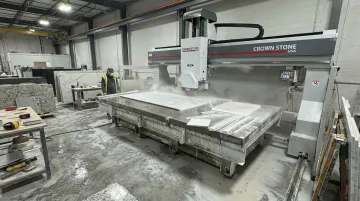
Transitioning from reactive maintenance to preventive maintenance reduces repair expenditures by 40%, but there's a point where the asset itself can't deliver reliability anymore. For fabricators at that point, the right replacement machine matters as much as the decision to replace. Crown Stone USA builds its bridge saws in the US with parts sourced primarily from North America, Korea, Japan, and Taiwan — meaning replacements are available quickly, not on a 6-week overseas backorder. Their 2-year warranty and globally available parts translate directly to fewer emergency repair cycles and more predictable ownership costs.
Scenario: Outdated or Unsupported Machine
Replace. When a machine's control system, software, or key components are no longer supported by the manufacturer and spare parts must be custom-sourced, ongoing maintenance becomes unpredictable in both time and cost. Every failure risks extended downtime while hunting for obsolete parts. A single week of unplanned downtime in a busy fabrication shop can cost more than the price difference between repairing an aging machine and replacing it outright.
Common Mistakes to Avoid When Troubleshooting
Even experienced operators fall into these traps under production pressure. Avoid them:
- Confirm the root cause first. Replacing the blade when the real problem is rail alignment — or cleaning nozzles when the pump is failing — wastes time and lets the underlying issue resurface.
- Always run a post-repair validation cut. Returning to full production without a test cut risks running an unverified repair under full production load. Monitor the next complete shift before clearing the machine.
- Verify parts before installation. Off-spec flanges, wrong-grade lubricants, or non-OEM fittings accelerate wear and create new failure points. Cross-reference specifications against the machine's manual or contact the manufacturer before swapping anything in.
Preventive Maintenance to Avoid Future Bridge Saw Issues
The cost of unplanned downtime exceeds the cost of structured preventive maintenance. The average manufacturer faces roughly 800 hours of unplanned downtime annually—more than 15 hours per week of paid non-productive time—with equipment failures accounting for 42% of incidents.
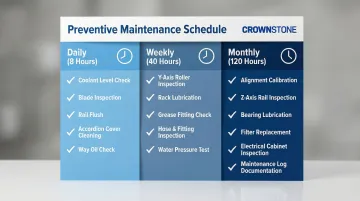
Basic Daily/Weekly/Monthly Schedule:
Daily (8 Hours):
- Check coolant level and nozzle flow
- Inspect blade for visible damage or wear
- Flush work table and rails with water
- Clean accordion covers
- Check way oil reservoir level
Weekly (40 Hours):
- Clean and inspect Y-axis rollers and guide rails
- Lubricate X-axis rack and pinion
- Check grease level in lubricator
- Inspect all hose connections for leaks or wear
- Verify water pressure consistency
Monthly (120 Hours):
- Perform alignment calibration check with precision square
- Clean and inspect Z-axis rails
- Lubricate all bearings per manufacturer specs
- Change water filter (50-micron minimum)
- Inspect electrical cabinet for dust, moisture, loose connections
- Document all observations in maintenance log
Operational Discipline That Prevents Premature Failures
Match blade to material hardness:
- Soft bond for hard materials (granite, quartzite)
- Hard bond for soft materials (marble, limestone)
- Never assume one blade fits all applications
Set feed rates within manufacturer limits:
- Monitor motor amp draw—sustained high draw indicates overload
- Back off feed rate if motor bogs or whines under load
- Your blade manufacturer's spec sheet provides feed rate starting points for each material type
Replace blades at wear indicators:
- Don't run blades past visible wear marks
- Segment height below minimum reduces cutting efficiency and increases motor load
- Worn blades require more power and generate more heat
Use filtered water consistently. Minimum 50-micron filtration prevents mineral buildup in lines and on segments. In hard-water regions, flush the system weekly to prevent scale accumulation. Fine stone particles in recirculated water act as an abrasive that destroys bearings over time.
Documentation and Training Cut Repeat Failures
Keep a running log of all maintenance performed, parts replaced, and symptoms observed. Patterns in that log often surface developing failures weeks before they cause downtime. An operator who understands why each check matters will catch what a checklist alone never will.
Frequently Asked Questions
How do I know if my bridge saw blade needs to be replaced or just resharpened?
Glazed (shiny, smooth) segments can often be re-exposed with a dressing cut through abrasive material like a 60-grit dressing stone or 1/8" limestone. Missing segments, visible cracks, or a blade that wobbles even when properly seated require immediate replacement — never run a damaged blade.
What causes a bridge saw to cut at an angle instead of straight down?
The three main causes are warped flanges or worn arbor bearings (blade not perpendicular), misaligned cutting head or bridge rails, or a warped blade itself. Check blade perpendicularity at multiple points using a precision machinist's square. Minor alignment adjustments are operator-level work; spindle bearing replacement needs a technician.
How often should I change or flush the coolant water in my bridge saw?
Recirculated water should be checked daily for slurry buildup and refreshed regularly based on cutting volume. A weekly water system flush is recommended to clear accumulated minerals and slurry, especially in hard-water regions where mineral scale builds up inside pipes and nozzles rapidly. Filtered water systems (50-micron minimum) reduce flushing frequency and prevent mineral deposits that clog nozzles and damage blade segments.
Can I fix bridge saw alignment problems myself, or do I need a technician?
Rail cleaning and minor alignment adjustments using a machinist's square are within reach of an experienced operator. However, spindle bearing replacement, major structural realignment after machine movement, or precision calibration requiring specialized measuring equipment typically requires professional service to achieve the tolerances needed for accurate cutting.
What's the most common reason a bridge saw motor trips or overheats?
The three main culprits are mechanical overload (feed rate or cut depth too aggressive), dull or glazed blades forcing the motor to strain, and low voltage or loose electrical connections that need a qualified electrician to diagnose. Back off your parameters first — if the motor still trips, check your power supply before assuming a mechanical fault.
How long should a diamond blade last on a bridge saw cutting granite?
Expect roughly 200–250 slabs from a quality granite blade under normal conditions, though harder material and poor coolant flow can cut that figure significantly. Matching blade specification to granite hardness (Mohs 6.5–7) and maintaining consistent, filtered water flow are the two biggest factors within an operator's control.