
Introduction
When a bridge saw goes down mid-job, you're not just losing a machine — you're losing the slab on the table, the deadline you promised, and the client who won't call back. Precision and reliability aren't optional when you're processing granite, marble, and quartz day after day. They're the baseline that keeps your shop profitable and your clients satisfied.
Stone fabrication is one of the harshest environments a machine can operate in. Abrasive silica dust, slurry buildup, and constant coolant exposure accelerate wear faster than most other trades. What's a minor issue in a clean, dry shop becomes a catastrophic failure when mixed with stone dust and water.
Unplanned downtime costs more than repair bills. It costs you production capacity, client relationships, and shop reputation.
This guide covers what every fabricator needs to protect their equipment investment:
- Why maintenance in stone fabrication is different from other industries
- The four core maintenance types and when to apply each
- Early warning signs to catch before they become breakdowns
- A practical maintenance schedule you can implement immediately
- The most common mistakes that turn small problems into expensive repairs
TL;DR
- Regular maintenance prevents costly unplanned downtime and extends machine lifespan in stone fabrication environments
- Stone shops face harsher conditions than general manufacturing—abrasive dust, water, and heavy loads demand more frequent upkeep
- Use all four maintenance types strategically: preventive, reactive, predictive, and overhaul
- Watch for early warnings—unusual vibration, inconsistent cut quality, water system issues—before they escalate
- Follow a structured daily/weekly/monthly/annual schedule to protect your equipment investment
Why Proper Maintenance Matters for Stone Fabrication Equipment
Stone fabrication equipment operates in one of the harshest industrial environments. Abrasive silica dust, constant water exposure, heavy slab loads, and high motor torque combine to accelerate wear on rails, blades, spindles, and seals far faster than standard manufacturing equipment experiences. The slurry created when water mixes with stone dust acts as a grinding compound that infiltrates bearings, corrodes metal surfaces, and breaks down lubricants—turning every component into a potential failure point.
How Maintenance Gaps Show Up in Your Work
Poorly maintained equipment produces substandard work. A bridge saw with worn rails produces chipped edges and uneven cuts. A CNC router that hasn't been calibrated drifts out of tolerance, increasing material waste and rework. An edge polisher with contaminated coolant delivers inconsistent finishes across the same slab.
Every quality issue traces back to a maintenance gap — and clients don't accept excuses. They expect precision.
The Cost of Waiting Until Something Breaks
Reactive maintenance costs 3 to 9 times more than preventive maintenance per repair event. For stone fabrication shops specifically, unplanned downtime runs roughly $1,500 per hour. When your bridge saw goes down unexpectedly, you're not just paying for emergency parts and labor — you're losing production capacity, missing delivery deadlines, and potentially paying overtime to catch up. The financial case for preventive maintenance is clear.

Worn blades, loose rail fasteners, and compromised water cooling systems also create hazardous conditions for operators. OSHA mandates integrated water delivery systems on stationary masonry saws to suppress respirable crystalline silica — and failure to maintain those systems exposes your team to silicosis risk. Maintenance is a safety and regulatory obligation, not just a performance concern.
Even the most durably built equipment — designed for easy serviceability with globally available parts — depends on consistent operator-level maintenance to deliver on that promise. A stone fabrication environment leaves no margin for neglect.
Types of Maintenance for Stone Fabrication Equipment
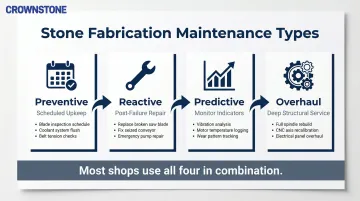
A complete maintenance strategy uses multiple maintenance types rather than relying on one approach. What changes is the trigger, frequency, and depth of each service event.
Routine / Preventive Maintenance
Preventive maintenance is scheduled upkeep performed regardless of whether a problem is visible. In stone fabrication, this includes:
- Daily blade inspections for chips and cracks
- Rail cleaning to remove slurry buildup
- Cooling water level and flow checks
- Lubrication of lead screws and guide rails
- Verification of guard placement before startup
When this approach is sufficient: For shops with predictable workloads and newer equipment in good baseline condition, a well-followed preventive schedule minimizes both reactive repairs and the need for early overhauls. For most stone shops, it's the single highest-return habit you can build.
Corrective / Reactive Maintenance
Reactive maintenance is work performed after a failure or performance drop occurs. Examples include:
- Replacing a bearing after it seizes
- Fixing a water pump after coolant flow drops
- Recalibrating alignment after a crash
- Swapping out a blade after it breaks mid-cut
The risk of over-relying on this approach: In stone fabrication, reactive repairs often cascade. A failed coolant line damages a spindle. A chipped blade produces a damaged slab that requires replacement. Waiting for failure before acting makes reactive-only maintenance more expensive than preventive strategies, and the top 25% of facilities relying on reactive maintenance experience 3.3 times more downtime.
Predictive / Condition-Based Maintenance
Predictive maintenance monitors specific indicators over time to service components before they fail. Examples relevant to stone equipment include:
- Tracking blade wear rates and replacement intervals
- Monitoring motor temperature trends
- Watching for gradual changes in vibration levels
- Logging water pH or contamination levels in recirculating systems
- Recording spindle bearing noise or play
Best suited for: Higher-volume shops that can track usage hours and have established performance baselines. This approach lets you schedule service at optimal intervals, avoiding both premature replacement and failure-driven damage.
Major / Overhaul Maintenance
Overhaul maintenance involves comprehensive deep-service events—rebuilding spindle assemblies, replacing linear rails, refurbishing the cutting table surface, or overhauling hydraulic and water management systems. Unlike routine upkeep, an overhaul touches the structural and mechanical core of the machine.
Triggers that indicate an overhaul is warranted:
- Persistent accuracy drift that routine recalibration cannot correct
- Repeated bearing failures in the same assembly
- Equipment approaching a manufacturer-defined service interval
- Noticeable decline in throughput despite regular preventive maintenance
- Visible wear on critical structural components (rails, table surfaces)
How to Check If Your Stone Fabrication Equipment Needs Maintenance
Most equipment failures don't arrive without warning. They show up first in the quality of your cuts, the sounds your machine makes, and the patterns your operators report. Knowing what to look for keeps a minor issue from turning into a day of lost production.
Performance and Output Changes
Watch for specific output signals in stone fabrication:
- Cuts that are no longer straight or chip unexpectedly
- Polishing results that are inconsistent across the same slab
- A saw that requires more passes to complete a cut that used to require one
- Edge profiles on a CNC router that vary in depth or shape
- Increased material waste or rework rates
Slow cuts often point to a dull or damaged blade. Inconsistent edge profiles on a CNC router typically signal runout or spindle bearing wear. These signals appear in the work before they appear as visible damage to the machine itself.
Unusual Noise, Vibration, or Physical Signs
Treat these abnormal behaviors as immediate maintenance triggers:
- Grinding or squealing sounds during operation (bearing or rail issues)
- Unusual vibration during cutting (blade imbalance or loose fasteners)
- Visible slurry buildup in sealed areas
- Water leaks from pump lines or spindle connections
- Rust forming on exposed rail surfaces
- Excessive heat from motors or spindles under normal load
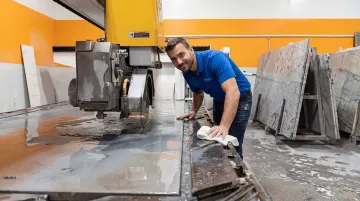
Daily visual inspections during cleaning catch physical signs before they escalate. Stone dust and water obscure small cracks, loose bolts, and early-stage corrosion that become major failures if missed. Make inspection part of your cleaning routine.
Recurring Issues and Resource Consumption
Identify patterns that signal a deeper problem:
- The same blade needs replacement faster than its typical wear interval
- The machine requires more frequent recalibration
- Operators are performing the same adjustment repeatedly
- A component fails, gets replaced, then fails again within a short period
Resource consumption tells the same story:
- A motor drawing higher current under the same load indicates bearing drag or misalignment
- A motor running 10°C hotter than normal cuts insulation life in half and signals ventilation blockage or overload
- A pump working harder to maintain pressure with a "marbles or gravel" sound indicates cavitation that will destroy impellers and seals
- A water-cooled spindle drawing more water to maintain temperature signals blocked coolant passages or contaminated fluid
Stone Fabrication Equipment Maintenance Schedule
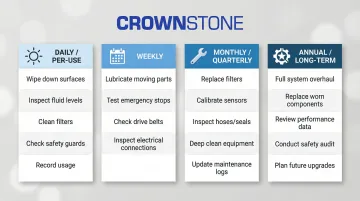
Maintenance frequency should be adjusted based on shop volume, equipment age, and whether operation is continuous (multiple shifts) or intermittent. The schedule below represents a general baseline for a single-shift fabrication shop.
| Frequency | Maintenance Tasks |
|---|---|
| Daily / Per-Use | Rinse table surface and cutting area to remove slurry buildup Inspect blade for chips, cracks, or segment wear Check cooling water level and flow Wipe down exposed rails Verify all guards are in place before startup |
| Weekly | Lubricate guide rails and lead screws per manufacturer spec Inspect rail fasteners and tighten as needed Check water pump filter and clean or replace Test blade alignment and verify cut accuracy on a test piece Inspect electrical connections in control box for dust accumulation |
| Monthly / Quarterly | Inspect spindle bearings for play or noise Check hydraulic fluid levels (if applicable) Verify machine calibration and squareness Inspect water recycling or filtration system Review blade wear logs to detect abnormal consumption patterns |
| Annual / Long-Term | Full lubrication system service Inspect and replace worn rail segments or bearing blocks Perform spindle runout check with dial indicator Overhaul water management system Review all safety interlocks and emergency stops |
Running multiple shifts or cutting harder materials like quartzite? Shorten every interval above:
- Daily tasks may need to repeat multiple times per shift
- Weekly tasks may need to happen every 2-3 days
- Track actual usage hours and adjust intervals to match your real workload
Conclusion
Maintenance in stone fabrication is not optional. The abrasive, wet, high-torque environment these machines operate in makes consistent upkeep the difference between a shop that delivers on time and one that loses production days to avoidable repairs. The $1,500-per-hour cost of unplanned downtime is real, and it adds up quickly when a critical machine goes down during a busy production week.
A structured maintenance plan pulls all four approaches together:
- Daily and weekly preventive tasks catch most issues before they escalate
- Predictive monitoring identifies trends before they become failures
- Annual overhauls protect long-term machine value and performance
- Parts availability determines how quickly you recover when something does need attention — Crown Stone USA machines are designed around globally sourced components to keep that window short
Each layer reinforces the others. Skip one consistently, and the gaps compound.
That structured plan only gets stronger with documentation. Track tasks completed, issues observed, and parts replaced — even a simple log builds the institutional knowledge needed to shift from reactive to predictive maintenance. Over time, that record drives smarter decisions on component replacement, overhaul timing, and when a machine has reached the end of its useful life.
Frequently Asked Questions
What are the 7 types of maintenance?
The seven commonly recognized maintenance types are preventive, corrective, predictive, condition-based, predetermined, total productive maintenance, and run-to-failure. Stone fabrication shops typically rely on a combination of preventive, corrective, and predictive approaches to balance cost, risk, and equipment availability.
What are the 5 basic maintenance skills?
The core competencies maintenance technicians need are mechanical inspection, lubrication, basic electrical troubleshooting, calibration/alignment, and documentation. For stone fabrication equipment specifically, water management systems knowledge is equally critical—neglected coolant and filtration are a leading cause of spindle and bearing failures.
How often should diamond blades on a bridge saw be inspected or replaced?
Blades should be visually inspected daily for chips, cracks, and segment wear, with replacement driven by cut quality rather than fixed hours. Harder materials like quartzite wear blades far faster than softer stones like marble, so intervals vary significantly by material mix.
What type of lubricant should I use on guide rails and lead screws on stone equipment?
Follow your equipment manufacturer's specifications, as some rails require grease while others use oil. In wet stone fabrication environments, use lubricants with high viscosity (approximately 68 mm²/s) and high emulsification resistance to prevent wash-off and contamination. Using the wrong lubricant in a wet environment attracts dust, creates buildup, and accelerates wear rather than preventing it.
How can I tell if my stone fabrication equipment needs a major overhaul versus routine service?
Persistent accuracy problems that recalibration cannot fix, repeated failures of the same component, or a noticeable throughput decline despite regular preventive maintenance are the clearest signals a deeper overhaul is needed. At that point, another surface-level service cycle won't solve the root cause.
What is the most common cause of unexpected downtime in stone fabrication shops?
Neglected water system maintenance—clogged filters, contaminated coolant that destroys spindle bearings, and degraded pump seals—and deferred blade or spindle inspections are among the most frequent triggers for unplanned downtime. Both are entirely preventable with consistent daily and weekly routines.