Introduction
Most fabrication shops that struggle with throughput, injuries, or equipment bottlenecks trace the problem back to the same source: a layout that was never properly planned. Mistakes at the setup stage are expensive and disruptive to fix once the shop is operational. Research points to a minimum 5,000 sq ft facility with 12-to-16-foot ceilings as the baseline for safe slab handling—and improper layout planning directly contributes to the severe injury risks associated with slab transport.
This guide covers the complete setup process for new shop owners, fabricators moving into a larger space, and established shops reorganizing for better efficiency. From building selection and utilities to equipment placement and workflow design, the goal is straightforward: build the shop right the first time.
TLDR
- Plan for at least 5,000 sq ft with 12-ft ceilings, 12-ft overhead doors, and ground-level concrete rated for heavy slab loads
- Confirm three-phase power (200+ amps) and a 100+ CFM air compressor before signing any lease
- Sequence equipment in production order: receiving → cutting → CNC/shaping → polishing → staging → dispatch
- Install water drainage and floor slope before placing any equipment — retrofitting later is costly
- Map your full equipment footprint on paper before committing to a space or floor plan
Building Requirements for a Granite Fabrication Shop
Space and Size
A minimum building size of 5,000 sq ft is essential, with 3,000–4,000 sq ft dedicated to the active shop floor. Growing fabrication shops outgrow smaller spaces rapidly, creating both safety hazards and throughput bottlenecks. Cramped production environments force workers and materials into constant interference, increasing injury risk and slowing production.
When planning space, consider what a doubled-capacity operation would look like. The shop that seems adequate for current needs may become dangerously cramped within the first year as production volume increases.
Ceiling and Door Clearances
Ceiling height requirements:
- Minimum 12 feet (required)
- 16 feet or higher (ideal for new builds)
These dimensions directly affect the ability to move full-size slabs (approximately 120" x 65") safely using forklifts or overhead cranes. As one industry expert notes, "You are going to have to lift the slabs up onto your saw table, and any ceiling height lower than 12 feet will make it difficult to move."
Overhead door dimensions:
- Minimum 12 feet high
- 16 feet high (recommended)
Undersized doors force labor-intensive material transfers and create bottlenecks during receiving and dispatch operations.
Floor Construction
The floor must be concrete slab-on-grade construction capable of bearing the combined weight of stone, equipment, and material handling machinery. Bridge saws and CNCs impose severe point loads — a mid-range bridge saw can exceed 13,000 lbs, while heavy production models top 19,000 lbs.
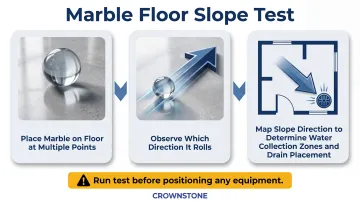
Floor slope assessment (simple marble test):
- Place a marble on the floor at multiple points
- Note which direction it rolls
- The slope direction determines where water will collect during cutting operations
- Run this test before positioning any equipment — drainage issues discovered after installation are expensive to fix
Location and Access
Essential location requirements:
- Ground-level building entry (no loading docks or stairs)
- Paved exterior yard of at least 100 x 100 feet
- Industrial zone with no truck weight restrictions
- Overhead clearance for large flatbed slab deliveries
Fabrication shops don't rely on foot traffic. What matters is whether a fully loaded flatbed can enter, maneuver, and exit your yard without restrictions — check turning radius requirements and local weight limits before signing a lease.
Water Supply
Confirm adequate water volume to the building before committing to a lease. Approximately 5 gallons per minute per active saw is required for wet-cutting operations. Inadequate municipal supply requires storage tank solutions, adding significant setup cost.
Equipment Placement and Shop Floor Planning
The shop floor must be mapped on paper—with accurate dimensions and equipment footprints—before any machine is ordered or positioned. Relocating a bridge saw after installation requires significant labor and often damages flooring and utility connections.
Saw Station
The bridge saw is the production anchor of the shop. Place it near the slab entry point with full clearance on all sides for slab maneuvering. Its position dictates where primary water supply, drainage channels, and electrical drops must be located.
Manufacturer clearance specifications:
- Park Industries SABER: 3-foot minimum wall clearance
- Park Industries TITAN 4700: 3-foot minimum clearance around the perimeter
- Breton Genya: 242.1″ x 275.6″ x 108.3″ footprint
Crown Stone USA's American-made bridge saws are designed by working fabricators who've cut, lifted, and installed stone themselves. The company refined their bridge saw table through 10 design iterations, building and testing two units per generation before advancing to the next.
The resulting table features CNC-machined rolling surfaces, moisture-resistant construction, and hydraulic lift capability up to 70 degrees. It's backed by a 2-year warranty and built to keep production running reliably.
CNC Router and Edge Polisher Stations
Position downstream processing equipment—CNC router, edge polisher, sink cutout stations—in sequential order after the saw, with sufficient clearance between each station and proximity to dedicated electrical outlets. Tight spacing between stations creates material handling bottlenecks.
Standard electric counterbalance forklifts require 10 to 13 feet of aisle width for safe material movement. The Material Handling Industry standard formula: Minimum Aisle Width = Right angle stack + Load length + 12 in. The 12-inch clearance accounts for operator error and load overhang.
Slab Storage and Receiving Zone
Set up the slab receiving area with A-frame storage racks positioned near the entry point, away from active production traffic. Maintain forklift clearance lanes and separation between incoming raw slabs and in-process material.
Indoor vs. outdoor storage trade-offs:
- Indoor storage protects slabs from weather exposure and thermal cycling
- Outdoor storage requires less building square footage but exposes inventory to elements
- Climate and slab volume determine the optimal approach
Finished Goods and Dispatch Area
A dedicated staging area for completed countertops must be positioned near the shop exit—physically separated from the production floor to prevent damage during fabrication activity and to streamline loading for delivery vehicles. A physical barrier or dedicated exit lane enforces this boundary and protects finished inventory from forklift traffic and cutting debris.
Utilities, Electrical, and Water Management
Three-Phase Electrical Setup
Three-phase power at minimum 200-amp service is required for granite fabrication. Single-phase systems cannot reliably power bridge saws, CNC routers, and air compressors under production load.
Typical equipment electrical demands:
- Bridge saw: 480V, 3-phase, 30–48 FLA (varies by model)
- CNC router: 480V, 3-phase, 20–35 FLA (varies by model)
- Rotary screw air compressor: 480V, 3-phase, 15–30 FLA
Cumulative amperage for a standard shop (saw, router, compressor, water system) easily exceeds standard commercial service. Confirm three-phase availability with an electrician before signing any lease. If a building lacks 3-phase power, utility line extensions can be expensive, often requiring the customer to pay a "Contribution in Aid of Construction" (CIAC) to cover the utility's installation costs.
Minimum electrical infrastructure needs:
- Dedicated cutoff switches for the saw
- Three-phase 220V outlets positioned near CNC and router stations
- Distributed 110V outlets throughout the shop for hand tools and polishers
Have a licensed electrician plan wiring runs only after the final equipment layout is confirmed. Premature electrical installation creates costly rework when equipment positions change.
Air Supply System
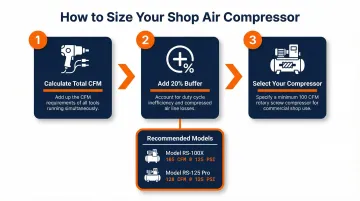
How to correctly size an air compressor:
- Total the CFM requirements of all tools running simultaneously
- Add a 20% buffer for duty cycle and line losses
- Specify a minimum 100 CFM rotary screw compressor for consistent output
Automotive-grade tank compressors are chronically undersized for stone fabrication. Rotary screw compressors deliver continuous duty performance—for example, the Kaeser CSD 130 delivers 469 cfm at 125 psig, and the Ingersoll Rand R160i delivers 985 cfm at 110 psig.
Placement options:
- Outdoors in a covered enclosure (reduces shop noise)
- In an indoor shed (easier maintenance access in cold climates)
Distribute compressed air via minimum 1-inch copper piping with retractable reels at each workstation. Undersized piping creates pressure drops that starve pneumatic tools.
Water Management and Drainage
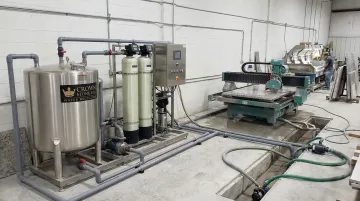
Water drainage planning is a pre-equipment task. Install floor drains and collection channels aligned with floor slope before any machine is placed. A water reclamation system does two things: it keeps you compliant and eliminates the cost of constant fresh water supply by filtering and recirculating slurry water.
EPA pretreatment standards strictly prohibit discharges with a pH lower than 5.0 unless the facility is specifically designed to accommodate such discharges. Wet-cutting operations produce alkaline slurry that requires treatment before discharge to municipal sewers.
Crown Stone USA manufactures water recycling systems specifically engineered for stone fabrication shops. The small version (40 GPM) supports one bridge saw, a polishing machine, and 2-3 hand polishers simultaneously, while the large version (70 GPM) can run three bridge saws, a polishing machine, CNC machine, and 4-5 hand polishers. These flocculant-based systems cause fine dust particles to aggregate into larger pieces for rapid settling, providing an endless supply of recycled water while minimizing waste and maintaining compliance.
Critical note: Drainage modifications to a leased building require explicit landlord approval in writing before work begins. Negotiate this during lease negotiations, not after signing.
Designing Your Workflow for Maximum Efficiency
The Assembly-Line Principle
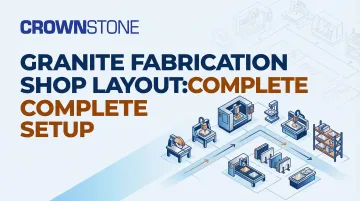
Material should travel in one deliberate direction through the shop—from slab receiving → cutting station → CNC/shaping → edge polishing → quality inspection → finished goods staging → dispatch—with no cross-traffic or backtracking between steps.
Many efficient fabrication shops use a linear or U-shaped production layout that moves materials through each stage in sequence. Deviating from this sequence leads to common inefficiencies: forklift traffic crossing worker paths, congestion between carts and machinery, increased labor costs, and handling risks.
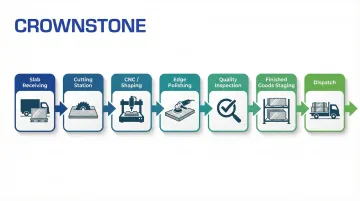
Walk the planned flow path on the shop floor map before finalizing any equipment position. Physically trace the route a slab will take from receiving to dispatch. Identify bottlenecks, tight turns, and cross-traffic points during this walkthrough, not after installation.
Identifying Production Bottlenecks
The bridge saw is typically the throughput constraint in most shops. All upstream and downstream stations should be sized and positioned to keep it continuously fed without creating pile-ups.
Common bottleneck symptoms:
- Saw sits idle waiting for material (upstream problem)
- Polisher backs up because it's too far from the saw (layout problem)
- Material queues between stations (insufficient staging space)
Correct spacing and sequencing between stations eliminates most of these issues before the first slab ever moves.
Practical Layout Tips
Before setup day, get the basics locked in:
- Label each zone clearly on the floor using tape or paint
- Plan aisle widths for forklift movement (minimum 8 feet for loaded forklifts)
- Position the quality check station before the dispatch area, with adequate lighting
- Document the final layout so future equipment additions don't disrupt existing flow
From there, build a scaled floor plan — paper or digital — that captures:
- Equipment footprints with manufacturer-specified clearances
- Forklift travel lanes
- Utility connection points (electrical, water, compressed air)
- Material flow arrows from receiving to dispatch
Shops that skip this step typically discover conflicts — a water line where the saw needs to sit, or a support column blocking the forklift lane — only after equipment is already in place.
Common Granite Fabrication Shop Layout Mistakes
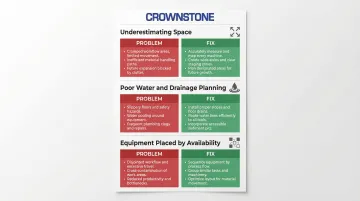
Most layout problems don't show up on day one — they show up six months in, when production stalls and fixes cost far more than they would have upfront. These are the three mistakes shops make most often.
Underestimating Space Requirements
Problem: Production volume outgrows the shop within the first year. Workers and materials constantly interfere with each other, and there's nowhere to expand.
Fix: Target a minimum of 5,000 sq ft and map what a doubled-capacity operation would look like before signing the lease. Find space for growth now, or pay relocation costs within 18 months. The smallest affordable building is rarely the cheapest option long-term.
Poor Water and Drainage Planning
Problem: Water from cutting operations pools across the floor, migrates under equipment bases, and creates slip hazards and corrosion — often because floor slope wasn't assessed and drains weren't installed until after equipment was already in place.
Fix: Run a marble test to check floor slope before setup, then install all drainage infrastructure first. Cutting drains after equipment is in place means relocating machines, cutting concrete, and eating days of downtime — all avoidable with upfront planning.
Equipment Placed by Availability Rather Than Logic
Problem: Cutting, CNC, and polishing stations end up scattered across the shop based on where space was open at the time, creating excessive material handling distance and worker fatigue.
Fix: Use a scaled paper or digital floor plan to position every machine before ordering or placing any of them. Anchor the entire layout around the bridge saw and work the sequence downstream from there. Never place equipment based on where it fits — place it where the workflow demands it belongs.
Frequently Asked Questions
What is the minimum building size for a granite fabrication shop?
A minimum of 5,000 sq ft is recommended, with 3,000–4,000 sq ft dedicated to the active shop floor and the remainder for office space. Faster-growing shops should plan for expansion capacity from the start to avoid costly relocation within the first two years.
What electrical setup does a granite fabrication shop require?
Three-phase power with a minimum 200-amp service is required to reliably run bridge saws, CNC routers, and air compressors under production load. Attempting to run heavy fabrication equipment on single-phase systems causes frequent breaker trips, equipment damage, and production delays.
How should granite slabs be stored in a fabrication shop?
Store slabs in A-frame racks near the receiving zone with adequate forklift clearance lanes. Indoor storage protects inventory from weather exposure, while outdoor storage reduces building square footage requirements—choose based on your climate and slab volume.
What does it cost to set up a granite fabrication shop?
Initial setup costs for a granite fabrication shop typically range from $150,000–$500,000+, covering equipment (bridge saw, edge polisher, CNC router), building buildout, utilities, and starting slab inventory. Equipment alone accounts for the largest share—budgeting $80,000–$250,000 for core machinery is realistic for a production-ready shop.
How long does it take to fabricate granite?
The standard timeline from templating to installation spans 2 to 4 weeks: 1-2 days for templating, 7-10 days for fabrication, and 1 day for installation. Shop layout and equipment efficiency directly affect turnaround time—poorly designed workflows add days to this timeline.
What slab inventory should a new granite fabrication shop stock?
New shops should prioritize high-volume neutrals: soft grays, earthy beiges and taupes, and bold black-and-white stones move consistently across both residential and commercial projects. Plan A-frame rack capacity around these core SKUs first, then add exotic slabs as order volume grows.