Understanding each axis's role, its travel range, and how cutting parameters interact with axis positioning is essential for correct machine selection, programming, and long-term reliability in stone fabrication. Operating a bridge saw without this knowledge leads to accelerated wear, inconsistent edge quality, and premature mechanical failure—problems that no amount of blade changes or water pressure adjustments can solve.
TL;DR
- A 5-axis CNC bridge saw uses three linear axes (X, Y, Z) and two rotary axes (A and C) to position and angle the blade for complex cuts
- Each axis has defined travel limits and speed ranges that set the boundaries of what the machine can cut
- Spindle speed, feed rate, and cutting depth must be matched to material hardness and blade spec — they don't operate in isolation
- Exceeding defined ranges accelerates blade wear, damages workpieces, and triggers mechanical faults
- Real-world performance depends on parameter setup and upkeep, not just the spec sheet
What the 5-Axis System Represents in a CNC Bridge Saw
A 5-axis CNC bridge saw combines three translational degrees of freedom (X, Y, Z) governing linear position of the cutting head over the slab, and two rotational degrees of freedom (A and C) governing blade orientation. Together, these form the machine's kinematic envelope—the complete range of positions and angles the blade can physically reach.
Per ISO 841 standards, the linear axes (X, Y, Z) are strictly defined, as are the rotary axes: the A-axis rotates around the X-axis, the B-axis around the Y-axis, and the C-axis around the Z-axis. Production stone bridge saws typically use an X, Y, Z, A, C configuration, though some specialized architectural profiling machines incorporate a B-axis (disc tilt about the Y-axis) for complex 3D work.
The bridge architecture is what makes this kinematic range possible. The overhead gantry spans the cutting table and carries the motorized cutting head unit, allowing the blade to traverse the full slab surface while the table remains stationary. This structural design provides rigidity under cutting load while enabling maximum flexibility in blade positioning.
There's a critical distinction between structural architecture and parametric system. Architecture defines what's physically possible—the gantry span, the table size, the head assembly. Parameters define how it's operated—axis travel ranges, spindle speed, feed rate.
A machine with excellent architecture but poorly tuned parameters will underperform a smaller machine with tighter parameter control. Both sides of this equation matter.
The cutting head unit is where all five axes converge. This assembly is where axis travel, blade tilt (A), blade rotation (C), and spindle drive converge to produce the cut. Understanding this convergence point is essential because every parameter adjustment—feed rate, spindle speed, tilt angle—affects how forces are transmitted through this single assembly.
Those forces start at the frame. Here's how each structural component supports the full range of 5-axis motion.
Structural Components That Enable 5-Axis Motion
The bridge/gantry is typically a rigid steel or welded-steel beam spanning the table width. It carries linear guides or rails on which the cutting head carriage travels (Y-axis). Bridge rigidity directly affects positional accuracy under cutting load—flex in the gantry translates to dimensional error in the finished piece.
High-quality machines use solid steel or cast iron monobloc frames that require no special foundations, while heavy-duty models incorporate cast iron sections to maximize vibration dampening.
The cutting table acts as the reference datum for all Z-axis depth measurements. It's a flat, precisely leveled surface, often with vacuum clamping zones for automated part handling. Table flatness tolerance is a direct input to cutting depth accuracy—if the table is out of flat by 0.5mm, your Z-axis accuracy cannot exceed 0.5mm regardless of servo precision.
Crown Stone USA developed their bridge saw table through 10 design iterations, testing and updating each generation before finalizing a design that holds precision while resisting the moisture trapping that accelerates wear.
Axis Definitions and Their Operating Ranges
Each of the five axes has a defined travel range, motion resolution, and positional accuracy specification—and these are not interchangeable between machine classes. Buyers should request these values per axis from any manufacturer, as published specs often reflect design-intent conditions rather than tested performance under cutting load.
Translational Axes: X, Y, and Z
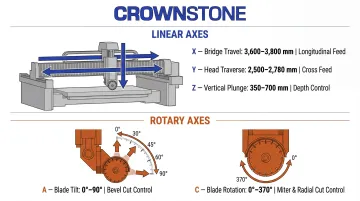
X-Axis (bridge travel, left-to-right or longitudinal): Controls the position of the bridge along the table length. Typical travel range for production-scale machines is 3,600mm to 3,800mm (roughly 142" to 150"). This axis determines the maximum slab length the machine can process. Machines like the Intermac Smart 625 offer 3,670mm X-axis travel, while the Donatoni Jet 625 extends to 3,800mm.
Y-Axis (cutting head traverse, front-to-back or transverse): Controls the position of the cutting head carriage along the bridge span. Its range determines maximum slab width capacity, typically 2,500mm to 2,780mm on production machines. Y-axis rigidity under lateral cutting forces affects edge squareness—a weak Y-axis will deflect during deep cuts, producing edges that are out of square.
Z-Axis (vertical plunge/depth): Controls the vertical descent of the cutting head into the stone. Typical Z-axis travel ranges from 350mm to 700mm depending on machine class. This axis governs maximum material thickness capacity and cutting depth per pass. Z-axis accuracy is the primary determinant of dimensional tolerance in thickness cuts.
The GMM Egil 700 CN2, with 700mm Z-axis travel, accommodates blades up to 825mm for architectural block shaping. Standard countertop machines with 350–450mm travel handle 625mm blades for cuts up to 200mm deep.
Rotary Axes: A and C
A-Axis (blade tilt): Tilts the cutting blade from vertical (0°) to horizontal (90°), enabling mitered edges, chamfers, and undercuts. The standard A-axis tilt range is 0° to 90°, with some advanced machines offering negative tilt for specialized applications. A-axis positioning accuracy is critical for miter angle consistency across repeated cuts—a 0.5° error in A-axis positioning produces visible edge misalignment on long miters.
C-Axis (blade rotation/yaw): Rotates the cutting head assembly, typically through 370° (not infinite continuous rotation as often assumed). This enables curved profile cuts, radius work, and arbitrary cut direction without repositioning the slab. C-axis resolution directly limits the smoothness of profile curves—machines with 0.001° C-axis resolution produce smoother arcs than those with 0.01° resolution.
Critical C-axis constraint: While manufacturers advertise "unlimited" rotation, the C-axis is typically hard-limited to -5° to 365° (370° total) to protect internal water and power lines. CNC programmers must account for C-axis "unwind" times in cycle estimates and avoid forcing continuous circular interpolations that exceed hardware limits.
Key Cutting Parameters and Their Technical Properties
Axis travel defines where the blade can go, but cutting parameters—spindle speed, feed rate, and depth of cut—define how the blade performs once positioned. These parameters must be matched to stone hardness, blade specification, and water cooling capacity. Mismatched parameters are the primary cause of blade failure, poor surface finish, and accelerated machine wear.
Spindle Speed and Power
Spindle speed (RPM) is the rotational speed of the blade at the cutting head motor. Typical operating RPM ranges for stone-cutting bridge saws span 1,000 to 8,000 RPM, controlled by Variable Frequency Drives (VFDs). However, RPM alone is meaningless—what matters is peripheral surface speed (m/s), calculated as: RPM = (Surface Speed in m/s × 60,000) / (π × Diameter in mm).
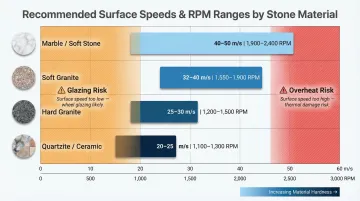
Recommended surface speeds by material:
- Marble/soft stone: 40-50 m/s (1,900-2,400 RPM for 400mm blade)
- Soft granite: 32-40 m/s (1,550-1,900 RPM for 400mm blade)
- Hard granite: 25-30 m/s (1,200-1,500 RPM for 400mm blade)
- Quartzite/ceramic: 20-25 m/s (1,100-1,300 RPM for 400mm blade)
Running below minimum RPM under load causes blade glazing—diamond segments fail to expose new cutting edges, leading to overheating and segment burnout. Overspeeding creates the opposite problem: excess heat warps the steel core and burns through diamond segments prematurely.
Spindle power (kW) determines how much material the blade can remove per unit time without stalling. Standard countertop machines feature 13-20 kW spindles; heavy-duty architectural saws reach up to 36 kW.
Spindle power must be sized against both stone hardness and blade diameter. Specifying power for blade diameter alone—without accounting for material abrasiveness—is a common error that results in underpowered cutting and motor overload.
Feed Rate and Its Interaction With Axis Motion
Feed rate is the programmed velocity at which the cutting head traverses through the material, typically expressed in mm/min or m/min. Typical feed rate ranges:
- Soft to hard granites: 1,500-5,200 mm/min (1.5-5.2 m/min)
- Ultra-hard quartzites: 1,200-3,000 mm/min (1.2-3.0 m/min)
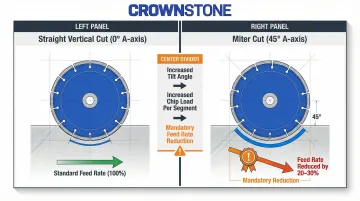
Critical interaction: Feed rate couples directly with A-axis tilt angle. At high tilt angles, the effective cutting arc changes—and feed rates must drop by 20-30% to keep blade loading within spec.
A 45-degree miter cut significantly increases the blade's contact arc and lateral stress. Skipping this adjustment causes:
- Blade deflection and core cracking
- Edge chipping on finished cuts
- Accelerated diamond segment wear
Cutting Depth Per Pass
Depth of cut is the Z-axis increment programmed for each pass. Most stone cutting on a bridge saw is completed in a single full-depth pass, but thick slabs or hard materials may require staged passes. While large blades (625mm) are mechanically capable of 200mm cutting depths, executing maximum depth in a single pass on hard materials is discouraged.
For cuts exceeding 50mm in depth, use a step-cutting (multi-pass) protocol. The recommended approach:
- Set pass depth to 50mm increments
- Allow cooling water to fully flush slurry between passes
- Continue until full depth is reached
Step-cutting reduces the blade-to-stone contact arc and prevents steel core undercutting—where abrasive swarf erodes the steel below the diamond segment before cooling water can clear it.
How Parameters Are Specified, Measured, and Validated
Parameters exist both as design specifications (published in machine datasheets) and as operational checkpoints (verified through calibration and test cuts). A machine that ships with correct spec values will drift out of tolerance if measurement and validation are not maintained.
Specification and Documentation
Axis travel, accuracy (typically expressed as positional accuracy ±mm over full travel), and repeatability values should appear in the machine's engineering documentation. Rated values are tested under no-load or light-load conditions. Buyers should ask whether specs are verified under actual cutting load — the difference matters in production.
Machines like the GMM Tecna and Lexta quote positional accuracy of 0.1mm (0.004") over a 3,657mm (12-foot) cut.
Crown Stone USA validates parameters against actual stone-cutting conditions. The company's founders bring decades of combined experience repairing, maintaining, and operating bridge saws — that hands-on background shapes how specifications are tested and confirmed under real cutting loads.
That validation is backed by a 2-year warranty, with parts sourced from the U.S., North and South America, Korea, Japan, and Taiwan for consistent availability and supply chain transparency.
Measurement and Verification Methods
Verifying parameters in the field requires different methods for different axes and outputs:
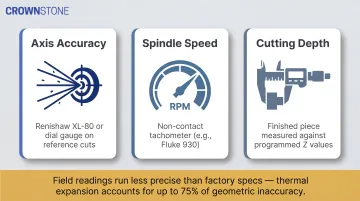
- Axis accuracy — laser interferometry (such as Renishaw XL-80 systems) or dial gauge on reference cuts, confirmed by test-piece dimensional inspection
- Spindle speed — non-contact tachometer (such as the Fluke 930)
- Cutting depth — finished pieces measured against programmed Z values
Field measurements will read less precisely than factory measurements. Thermal expansion of the machine frame during production operation is the primary reason — ambient temperature shifts and spindle heat generation together can account for up to 75% of total geometric inaccuracy.
Implications of Operating Outside the Recommended Range
Every operating parameter has a reason for its limit — and that reason is usually a component that fails when the limit is ignored:
- Spindle speed maximums: set by blade arbor bearing ratings and blade structural integrity
- Feed rate maximums: set by blade segment bond strength and motor torque limits
- A-axis tilt limits: set by head geometry and gearbox ratings
Performance loss mechanisms:
- Exceeding feed rate limits causes blade chatter and surface finish degradation (rough edge, micro-chipping)
- Running below minimum spindle speed causes the blade to load up and overheat
- Operating Z-axis beyond rated depth capacity strains the bridge structure and introduces positioning error
Accelerated wear and failure modes:
- Blade segment delamination: Excessive feed pressure bends and fatigues the steel core, causing cracks. Insufficient water or excess RPM overheats the blade — visible as blue/black oxidation — and melts the brazed bond
- Spindle bearing failure: High RPM under excessive load generates heat faster than cooling can dissipate it, causing thermal expansion, bearing wear, and eventual motor burnout
- Axis drive motor overload: Sustained operation beyond rated torque limits causes motor windings to overheat and fail
- Linear guide wear: Operating with insufficient lubrication or excessive cutting forces accelerates wear in recirculating ball guides, increasing positional drift
These failure modes also carry financial consequences. Most machines log operational data, and shops can present those records during warranty evaluations — but operating outside published parameters typically voids coverage. Staying within spec protects both the equipment and the warranty.
Common Misinterpretations of 5-Axis Parameters in Practice
Three misinterpretations come up repeatedly when operators and buyers work with 5-axis parameters — each one with real consequences for cut quality and machine longevity.
C-Axis Rotation Has Practical Limits
Many operators assume the C-axis can be programmed to rotate continuously in either direction without constraints. In practice, cable management, water line routing, and tool clearance geometry impose functional limits on consecutive rotation direction and speed.
Programming must account for these real-world constraints, not just the theoretical 360° specification. Most machines hard-limit C-axis to 370° total rotation to protect internal lines.
Feed Rates Must Be Adjusted for Miter Cuts
A feed rate proven reliable for straight vertical cuts is not automatically valid for A-axis tilted cuts. As the blade engagement arc changes with tilt angle, the effective chip load per diamond segment increases.
Operators who skip this adjustment will see accelerated segment wear and inconsistent edge quality. Reducing feed rates by 20-30% for miter cuts is mandatory, not optional.
Positional Accuracy Is Not Surface Finish Quality
Axis positional accuracy (±mm over travel) is a separate parameter from surface finish (Ra, edge chipping). A machine can hold tight positional accuracy while still producing poor surface finish if spindle speed, feed rate, or blade specification is wrong.
Treating accuracy spec as a proxy for cut quality is a common mistake during machine evaluation. ISO 230-2 guarantees the spindle arrives at the correct coordinate. Edge quality is dictated by blade vibration, segment bond hardness, and coolant flow — none of which that standard addresses.
Frequently Asked Questions
What is the C-axis on a CNC machine?
The C-axis is a rotary axis that rotates the cutting head or spindle assembly around the vertical (Z) axis, allowing the blade to be oriented in any horizontal direction. On a 5-axis bridge saw, this enables profile cuts and arbitrary cut directions across the slab without repositioning the material.
What are the AB and C axes?
The A-axis tilts the cutting head (typically 0°–90° from vertical), the B-axis (where present) provides a second tilt plane, and the C-axis rotates the head around the vertical axis. On most 5-axis bridge saws for stone, the rotary axes are A and C—B-axis configurations are more common in 5-axis milling than in stone cutting.
What is the A-axis range on a 5-axis bridge saw?
The A-axis on most stone-cutting 5-axis bridge saws tilts the blade from 0° (vertical, standard straight cut) to 90° (horizontal), with some machines offering negative tilt. This range enables standard miters, full 45° edge profiles, and compound angle cuts.
What does "5-axis" mean on a bridge saw?
"5-axis" refers to the machine's ability to move the cutting tool simultaneously in three linear directions (X, Y, Z) and two rotational directions (A and C), giving the blade the freedom to cut at any angle and any position across the slab in a single setup.
How do spindle speed and feed rate interact on a 5-axis bridge saw?
Spindle speed sets the surface speed of the diamond blade; feed rate controls how fast the blade moves through the material. The two must be balanced against stone hardness—too high a feed rate overloads the blade segments, while too low a feed rate causes the blade to glaze over.
What causes positional drift in a 5-axis bridge saw over time?
Drift comes from wear in linear guides, thermal expansion of the machine frame, and servo calibration loss over time. Re-calibrating against a known reference piece and following the manufacturer's guide maintenance schedule are the primary controls.