
Introduction
Bridge saws are the core workhorse in stone fabrication shops cutting granite, marble, and quartz. The machines that hold up for years share one thing in common: consistent, scheduled maintenance.
Letting maintenance slide creates compounding problems:
- Unplanned downtime mid-job
- Degraded cut quality on finished stone
- Shortened machine lifespan
- Inflated repair costs
- Safety hazards for operators handling large slabs
Emergency corrective repairs cost 3 to 5 times more than planned preventive work, once you factor in overtime labor, expedited parts, and lost production.
This guide covers the main maintenance approaches, early warning signs to watch for, and a practical scheduling framework to keep your saw running reliably.
TL;DR
- Bridge saw maintenance protects precision, operator safety, and your capital investment
- Four maintenance types (routine, corrective, predictive, and major overhaul) carry different cost and risk profiles — knowing the difference saves money
- Watch for inconsistent cuts, unusual vibrations, and visible wear — catching these early prevents costly failures
- A structured daily, weekly, monthly, and annual schedule prevents most reactive failures
- Equipment built for easy service with US-available parts cuts downtime when repairs are unavoidable
Why Bridge Saw Maintenance Matters
A bridge saw is one of the most significant capital investments a stone fabrication shop makes—commercial 3-axis CNC models range from $80,000 to $150,000, with 5-axis machines reaching $350,000. Your output quality—precision, consistency, surface finish—depends entirely on the condition of this machine.
The Safety Connection
A poorly maintained bridge saw can develop blade instability, rail misalignment, or electrical faults that create serious hazards for operators handling large stone slabs. Worn spindle bearings create vibration that transfers directly to the blade, worsening under load and destroying cut quality. Loose fasteners cause misalignment, and accumulated stone slurry on rails accelerates bearing wear and rail scoring.
The Financial Case for Prevention
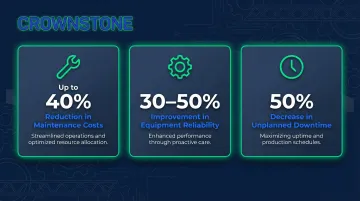
Unplanned machine downtime in stone fabrication costs an average of $1,500 per hour in lost throughput and schedule disruptions. Predictive maintenance programs cut those losses significantly:
- Reduce maintenance costs by up to 40%
- Improve equipment reliability by 30–50%
- Decrease unplanned downtime by 50%
Those costs trace back to specific failure chains that compound quickly once deferred:
- A glazed blade requires excessive downward pressure, generating heat that leads to blade binding or motor overload
- Insufficient water flow causes thermal glazing of diamond segments, triggering slurry buildup, vibration, and accelerated segment wear
Types of Bridge Saw Maintenance
Maintenance isn't a single activity—it spans a spectrum from daily upkeep to major overhaul. Knowing which approach applies when helps shop managers balance cost with reliability.
Routine / Preventive Maintenance
Routine maintenance is the foundation of bridge saw care: scheduled tasks performed regardless of whether a problem is visible. This includes:
- Cleaning stone dust and slurry from rails, cutting table, and water nozzles
- Lubrication of guide rails and moving components
- Blade inspection for segment wear or damage
- Water system checks for flow and pressure
- Electrical visual inspections for corrosion or loose connections

Routine maintenance is sufficient for shops with normal production volumes and no performance anomalies. Machines with easy-access service points and US-sourced replacement parts — a design priority Crown Stone USA applies across its saw line — make these tasks faster and more consistent to execute.
Corrective / Reactive Maintenance
Corrective maintenance is work triggered by a failure or detected problem: a seized bearing, a water pump leak, or a misaligned gantry that's already causing cut deviation.
The risk: Relying too heavily on reactive maintenance generates higher costs (emergency parts sourcing, lost production time) and can cascade into secondary failures if the root issue goes undiagnosed. A worn bearing that finally seizes can damage the spindle shaft, turning a $200 bearing replacement into a $3,000 spindle rebuild.
Predictive / Condition-Based Maintenance
Predictive maintenance monitors operational indicators — vibration levels, cutting speed consistency, motor temperature, water pressure — to service components based on actual wear rather than fixed time intervals.
Some modern CNC bridge saw controls log usage data to support this approach. Tracking spindle motor current, for example, can detect bearing wear before catastrophic failure occurs. In CNC machining applications, predictive maintenance has been shown to reduce downtime by approximately 40% compared to traditional preventive methods.
Major / Overhaul Maintenance
Overhaul maintenance involves deep servicing — spindle bearings, drive belts, rail inserts, hydraulic seals — typically performed annually or at manufacturer-specified hour intervals.
Skipping scheduled overhauls doesn't save money; it defers costs while compounding wear. Components stressed beyond their service life tend to fail together, meaning one overdue overhaul can trigger a chain of repairs that costs several times what the original service would have.