Introduction
The bridge saw you choose will shape your shop's throughput, profitability, and stress level for the next decade. Pick wrong, and you're staring at $1,500-per-hour downtime costs, weeks-long waits for overseas parts, and cuts that fail tolerance checks. Pick right, and you've got a workhorse that starts every morning and pays for itself in reliability.
The bridge saw market now spans three distinct tiers: American-made machines built for domestic parts access, European precision brands with premium CNC capabilities, and Asian-manufactured options trading cost for support infrastructure. Each comes with real tradeoffs in build quality, service response time, and total cost of ownership.
This guide breaks down five leading brands—Crown Stone USA, Park Industries, Intermac, Prussiani Engineering, and OMAG—so fabricators can match the right machine to their throughput volume, material mix, and tolerance for downtime.
TL;DR
- Bridge saws use a diamond blade on a horizontal beam to cut granite, marble, quartz, and porcelain slabs with precision
- Top brands reviewed: Crown Stone USA, Park Industries, Intermac, Prussiani, and OMAG
- CNC bridge saws (3-, 4-, or 5-axis) handle programmable miters and edge profiling; manual saws suit straight cuts at lower cost
- Key decision factors: parts availability in the US, spindle power for hard materials, axis count for miter/routing needs, and warranty terms
- Unplanned downtime averages $1,500/hour—prioritize service infrastructure over initial price
What Is a Bridge Saw Machine and How Is It Used in Stone Fabrication?
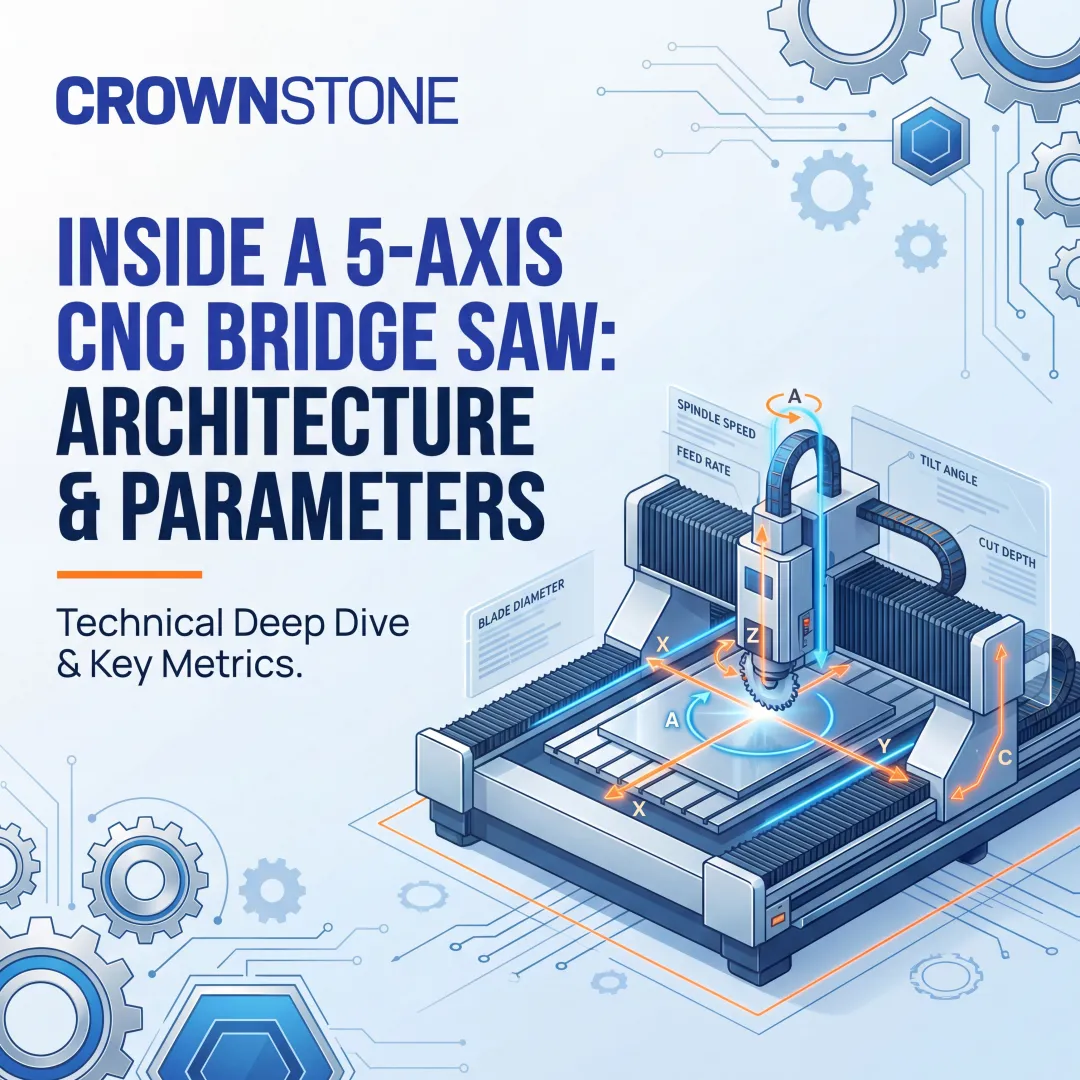
A bridge saw is a heavy-duty stone cutting machine where the saw head travels along a horizontal bridge (beam) over a fixed, rotating, or tilting table. The name comes from the gantry-style architecture: a horizontal beam spans the work surface, supporting a diamond blade cutting head that moves along two rails for precise, repeatable cuts in full-size stone slabs.
Bridge saws are the throughput engine of any stone fabrication shop. They handle primary slab breakdown, countertop sizing, miter cuts for waterfall edges, and—on CNC models—complex shapes, sink cutouts, and edge profiling.
The speed difference is significant: a skilled operator on a manual saw rarely exceeds 10 lineal feet per hour, while an automatic bridge saw can reach 120 lineal feet per hour, cutting cost per linear foot and freeing fabricators for quality control and finishing work.
Manual, Semi-Automatic, and CNC Bridge Saws
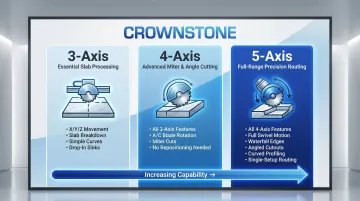
The axis configuration directly dictates cutting capability:
- 3-Axis — straight cuts and basic angles: X, Y, Z linear movement handles slab breakdown, simple curves, and drop-in sink jobs; ideal for shops focused on straight-cut granite
- 4-Axis — adds blade tilt: A or C rotation tilts the blade from 90° to 0°, enabling precise miter work without repositioning
- 5-Axis — full blade tilt and swivel: Both rotational axes unlock waterfall edges, angled sink cutouts, continuous curved profiling, and incremental routing—all in a single setup
Choosing between these configurations comes down to your shop's mix of work. Mid-sized shops processing 8–12 kitchens per week are increasingly moving from manual saws to 5-axis CNCs to offset skilled labor shortages — automating complex cuts and reallocating hand-fabricators to finishing and inspection tasks.
Top Bridge Saw Machine Brands: Reviews & Recommendations
Selection is based on machine reliability, build quality, axis capabilities, US market presence, parts availability, warranty coverage, and real-world fabricator feedback—not manufacturer marketing claims.
Crown Stone USA
Crown Stone USA is an American manufacturer headquartered in Clearwater, Florida, founded by experienced stone fabricators who designed their machines from hands-on shop experience. Unlike most bridge saw makers who treat the table as an afterthought, Crown Stone began with the table—refining it through 10 rigorous design iterations, building two tables with each generation, testing, and updating before moving forward.
What sets it apart: Built in the USA with a traceable supply chain (less than 2% of components by value sourced from China—primarily from the US, Korea, Japan, Taiwan, and the Americas), a 2-year parts warranty, and domestically stocked components that eliminate the overseas shipping delays that plague imported machines. The people behind it have actually cut, lifted, and installed stone. That shop-floor experience is built into every design decision.
| Key Features | Pricing & Warranty | Best For |
|---|---|---|
| Table: 126" × 77" (132" or 138" widths available) Motor: 20 HP blade motor Axis: Manual + automatic cutting with X/Y/Z controls Control: Kinco HMI touchscreen with AUTO-CUT preset functions Features: Hydraulic lift to 70°, air-cylinder indexing to 45°/90°, automatic water valve, remote control operation | Pricing: Available on request Warranty: 2-year parts warranty Support: US-made with domestically stocked parts for rapid service response | US-based granite, marble, and quartz fabrication shops that prioritize reliability, domestic parts access, and a machine built by fabricators who understand shop floor pressures |
For shops comparing domestic options against European imports, the next four brands represent the most established alternatives in the US market.
Park Industries
Park Industries is a Minnesota-based American manufacturer with decades in the stone fabrication equipment space. Founded in 1953 and headquartered in St. Cloud, Minnesota, Park is the largest stoneworking equipment manufacturer in North America. Their bridge saw lineup includes the manual SIERRA (15 HP), semi-automatic YUKON II (20 HP), and premium 5-axis VOYAGER XP CNC saw.
Why fabricators choose it: Strong dealer and service network across the US, robust machine construction, and product lines spanning entry-level to high-production CNC configurations. Park offers 24/7 customer service and a "Next Day or No Pay" parts guarantee, making them a familiar name in established US shops that can't afford extended downtime.
| Key Features | Pricing & Warranty | Best For |
|---|---|---|
| Models: SIERRA (manual), YUKON II (semi-auto), VOYAGER XP (5-axis CNC) Motor: 15 HP to 27 HP spindle (1,000-6,000 RPM) Axis: 3-axis to 5-axis configurations Control: Windows 10 OS with Alphacam and proprietary Park EZ Buttons Features: TightCut blade plunging (parts nested with <1" clearance, increasing yield up to 10% per Park Industries) | Pricing: Request a quote Warranty: Not explicitly published; "Next Day or No Pay" parts guarantee Support: 60+ field technicians across North America | Mid-to-large US fabrication shops seeking a domestic-brand machine with an established dealer support network and proven service infrastructure |
Intermac (Biesse Group)
Intermac, the stone and glass division of the Italian Biesse Group, is one of the most recognized names in CNC stone machining globally. Their Master series includes the 3-axis Master One and 5-axis Master 625 and Smart 625 models, with a wide install base in North American fabrication shops and distribution support through Biesse Americas.
Where it excels: High-precision Italian engineering, a broad product range from entry CNC models to fully automated machining centers, and strong integration with CAD/CAM workflows through EasyStone software. Intermac machines integrate with SOPHIA, an IoT platform that provides remote diagnostics—reducing diagnostic time and machine downtime significantly, according to Intermac—at a premium price point.
| Key Features | Pricing & Warranty | Best For |
|---|---|---|
| Models: Master One (3-axis), Master 625, Smart 625 (5-axis) Motor: 9.2 kW to 20 kW electrospindle Table: 3300x1500mm (Master One) to 3800x2400mm (Smart 625) Control: EasyStone CAD/CAM software Features: SOPHIA IoT remote diagnostics; per Intermac, 95% of downtime parts dispatched within 24 hours globally | Pricing: Contact for quote; premium European pricing tier Warranty: 12 months standard Support: Biesse Americas network; lead times for overseas parts apply | High-volume shops requiring tight integration with digital templating and automated production workflows, with budget for a premium European machine and tolerance for international parts logistics |
Prussiani Engineering
Prussiani Engineering is an Italian manufacturer with a strong presence in the North American market, known for producing reliable 5-axis interpolated CNC bridge saws used in both mid-size fabrication shops and larger production environments. Their lineup includes the Star XL, Champion 55/65, New Champion 5, and the dual-head Tango.
Key differentiator: Solid mechanical construction, a range of CNC configurations with spindle power from 14.3 kW (19.4 HP) to 28 kW (37.5 HP), and a US distribution and service presence through Prussiani North America LLC in Denver, Colorado. Prussiani's patented "Cut & Move" suction cup manipulator automatically displaces cut pieces on the working table, allowing the blade to execute remaining cuts without hitting adjacent pieces. Parts lead times from Italy, however, can be a factor for shops where uptime is critical.
| Key Features | Pricing & Warranty | Best For |
|---|---|---|
| Models: Star XL, Champion 55/65, New Champion 5, Tango (dual-head) Motor: 14.3 kW to 28 kW (19.4 HP to 37.5 HP) Axis: 5-axis interpolated CNC Control: Fagor / parametric software and advanced CAD/CAM Features: "Cut & Move" automatic suction manipulator for increased slab yield and reduced manual handling | Pricing: Available upon request; competitive within European segment Warranty: 3 to 5 years (mechanical, electric, electronic components) Support: Prussiani North America LLC (Denver, CO) | Fabrication shops seeking European-built CNC precision with reasonable pricing, extended warranty coverage, and US distribution support |
OMAG
OMAG SpA is an Italian stone machining manufacturer with a range of bridge saws and machining centers—less dominant in the US than Intermac or Prussiani but used by shops that prioritize specific cutting configurations or European build standards. Their flagship bridge saw is the Digitale5i, a 5-axis CNC saw with integrated milling, drilling, and polishing functions.
What it offers: Competitive pricing within the European-made segment, modular machine configurations, and massive 40.1 HP (S6) motor capable of handling dense quartzite and ultra-compact porcelain with disc diameters up to 850mm and cutting thickness of 290mm. Available through North American distributors, though after-sales support infrastructure in the US is less extensive than domestic brands.
| Key Features | Pricing & Warranty | Best For |
|---|---|---|
| Model: Digitale5i (5-axis CNC) Motor: 40.1 HP (S6) Table: 3600 x 2000 mm Axis: 5-axis with integrated milling, drilling, polishing Features: Maximum disc diameter 850mm, cutting thickness 290mm, high-rigidity machining center design | Pricing: Contact for quote; competitive European pricing Warranty: 36 months from installation Support: Exclusive North American distribution through Global Equipment Group (Grand Rapids, MI) | Shops evaluating European-made machines at a more competitive price point than premium Italian brands, where high-torque milling power is a priority and US service access is less critical |
How We Selected the Best Bridge Saw Brands
Each brand was evaluated across seven criteria — because a machine that can't be serviced quickly is a liability, not an asset:
- Build quality and structural rigidity
- Axis flexibility (3-, 4-, and 5-axis configurations)
- Motor and spindle specifications
- US market presence
- Parts and service accessibility
- Warranty terms
- Documented fabricator feedback
Common Buyer Mistakes
The most common mistakes fabricators make when buying bridge saws:
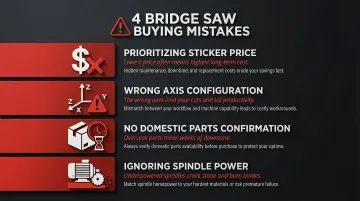
- Over-prioritizing sticker price while ignoring total cost of ownership: downtime, overseas parts delays, and limited service coverage often dwarf the initial savings
- Choosing an axis configuration beyond current shop needs. Paying for 5-axis capability when 90% of your work is straight cuts and drop-in sinks is money wasted
- Buying without confirming domestic parts availability. A $150,000 machine sits idle if a $200 sensor takes three weeks to ship from Italy
- Ignoring spindle power for material mix. Cutting ultra-compact porcelain and dense quartzite requires at least 20 HP to prevent blade glazing and material chipping
Why Country of Manufacture Matters
For US-based shops, country of manufacture and supply chain transparency directly affect parts lead times and long-term serviceability. Unplanned machine downtime costs an average of $1,500 per hour in lost throughput, schedule shuffling, and overtime.
Manufacturers like Park Industries and Crown Stone USA maintain US-based parts inventories to eliminate overseas shipping delays. European brands have responded by building out US distributor networks and offering remote diagnostics to resolve software and sensor issues without waiting on a field technician.
Conclusion
The best bridge saw brand is the one that aligns with your shop's actual production volume, material mix, CNC requirements, and—critically—your tolerance for downtime when something needs repair. A machine that cuts beautifully but sits idle for two weeks waiting on a control board from overseas will cost you far more than its purchase price.
Spec sheets don't tell the full story. Warranty coverage, parts availability, and whether the manufacturer has actual shop floor experience tend to predict long-term satisfaction better than spindle RPM or table dimensions ever will.
For fabricators who want a machine built in the USA by people who have actually cut, lifted, and installed stone—reach out directly to Crown Stone USA at crownstoneusa.com or call 727-239-9875.
Frequently Asked Questions
What is a CNC bridge saw?
A CNC bridge saw is a computer-numerically-controlled stone cutting machine where the saw head moves along a bridge over the work table. It's programmable to execute straight cuts, miters, curves, sink cutouts, and edge profiles with repeatable precision across granite, marble, quartz, and similar materials, eliminating manual measurement and reducing operator dependency.
What are the four types of sawing machines?
The main saw types used in stone fabrication are bridge saws (large-format slab cutting), tile saws (smaller format countertop and backsplash work), wire saws (quarry and large block cutting), and circular/disc saws (portable cutting). Bridge saws are the dominant tool in countertop fabrication shops due to their ability to handle full-size slabs with precision.
What is the difference between a 3-axis, 4-axis, and 5-axis bridge saw?
3-axis machines handle straight cuts and vertical plunges; 4-axis adds a rotating head for miter cuts; and 5-axis machines add full tilt and rotation capability, enabling complex geometries, sculpted edges, and angled sink cutouts. Each step up adds capability and cost—5-axis machines can cost $150,000 to $350,000+ compared to $80,000–$150,000 for 3-axis models.
How much does a bridge saw machine cost?
Manual and semi-automatic bridge saws typically start around $60,000; CNC 3-axis models run $80,000–$150,000; 5-axis configurations reach $150,000–$350,000+. Combination saw/waterjet machines can run $250,000–$400,000. Factor in total cost of ownership—downtime risk, parts availability, and warranty coverage—not just sticker price.
What materials can a bridge saw cut?
Bridge saws cut granite, marble, quartzite, engineered quartz, limestone, travertine, porcelain, and some glass. Blade bond must match material hardness: soft-bond blades for hard materials like granite and porcelain, hard-bond blades for softer materials like marble and limestone.
How do I reduce downtime on a bridge saw machine?
Routine maintenance covers most causes of unplanned stoppages: grease moving components every two months, inspect spindle bearings regularly, and monitor blade condition and water pressure. Equally important is choosing a machine with globally available parts and a manufacturer that offers responsive US-based support—both are worth weighing at purchase time.