This guide covers the top five categories of granite fabrication tools and equipment for 2025, with selection criteria focused on precision, reliability, and long-term serviceability at each stage of the fab process.
TLDR
- Bridge saws with rigid tables and sufficient motor power (15-30 HP) are the foundation of cut accuracy and throughput
- Match diamond blades and core bits to the stone type — wrong bond hardness causes glazing and premature wear
- Variable-speed wet polishers (500-3,500 RPM) paired with full 8-step grit progressions deliver consistent, sellable finishes
- CNC routers with 10+ HP spindles reduce manual finishing time and produce repeatable edge profiles at scale
- HEPA dust control, material handling equipment, and compliant PPE are required for OSHA silica compliance and crew safety
Overview of Granite Fabrication Tools and Equipment
Granite fabrication involves a defined sequence of operations—slab cutting, profiling, drilling, polishing, and handling. Each stage requires a dedicated class of tools, and using the wrong equipment at any stage creates bottlenecks or finish defects that compound downstream.
The U.S. countertop manufacturing market reached $22.1 billion in 2025, with growth stabilizing at 0.4% for the year. At that scale, equipment decisions carry real financial weight.
The industry average for material waste sits at 15-25%, and unplanned downtime costs manufacturers an average of $260,000 per hour—with equipment failure causing 42% of those incidents.
Selection criteria used in this guide:
- Performance on granite specifically (accounting for hardness and density)
- Reliability and serviceability in daily production environments
- Availability of parts and manufacturer support in the U.S.
- Total cost of ownership over time, not just upfront price
Top Granite Fabrication Tools and Equipment for 2025
Tools and equipment in this list were evaluated on precision output, durability under daily production use, U.S. parts availability, and direct applicability to granite, quartz, and marble fabrication workflows.
Bridge Saw
The bridge saw is the backbone of any granite fabrication shop—it handles full-slab rip cuts, miter cuts, and sink cut preparations. Motor power, table rigidity, and blade compatibility directly determine cut quality and daily throughput.
Leading bridge saws combine precise table construction, digital or CNC controls, and long-term serviceability. American-made options like Crown Stone USA's Avalanche Pro add value through fabricator-designed engineering and globally available parts—practical advantages over import alternatives that are harder to service domestically.
Leading Bridge Saw Options:
- Park Industries VOYAGER XP: 5-axis CNC with TightCut blade plunging technology that can increase material yield by up to 10%, 27 HP spindle, American-made
- Intermac Master 625: 9.2-20 kW motor, 5-axis capability, SOPHIA IoT remote diagnostics with EasyStone CAD/CAM integration
- Crown Stone USA Avalanche Pro: 20 HP blade motor, dual automatic and manual operation modes, one-touch miter switching with 150° cutting length, Made in USA with 2-year warranty
Bridge Saw Selection Specifications:
| Key Spec | Look For |
|---|---|
| Motor Power & Blade Size | Sufficient HP for granite density (15-30 HP); blade diameter matched to slab thickness (typically 16"-18") |
| Table Construction & Precision | Rigid, level work surface with verified repeatability; critical for miter and waterfall cuts |
| Serviceability & Parts Availability | Globally sourced or U.S.-available parts; manufacturer support responsiveness and warranty coverage |
Trade publications note that imported machines can experience parts lead times of two to three weeks, whereas domestic manufacturers like Park Industries and Crown Stone USA offer next-day parts availability or globally sourced components that reduce downtime.
Diamond Blades and Core Bits
Diamond blades and core drill bits make direct contact with granite, and their bond hardness, segment design, and diameter must be matched to the specific stone being cut. A mismatch causes glazing, chipping, or premature wear.
Silent-core bridge saw blades, turbo-segment blades, and vacuum-brazed core bits for faucet holes are now standard in production shops—each suited to different cutting demands.
Leading U.S.-Market Brands:
- Weha: Specialized "White Lion" contour and bridge saw blades focused on high-production shop efficiency
- Alpha Professional Tools: Known for the "Silencer III" series featuring noise-dampening cores and specialized blades for Dekton and crystallized glass
- Tenax: Premium Italian-engineered blades approved by Cosentino for Dekton; strong focus on quartz and ceramic/porcelain applications
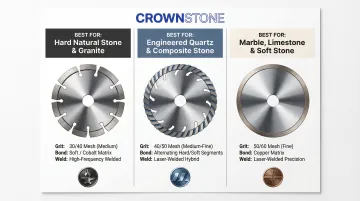
Blade Selection by Material:
- Granite: High-frequency welded segmented blades with medium grit (30/40 mesh) and soft/cobalt bonds to shed worn diamonds and expose fresh cutting edges
- Engineered Quartz: Turbo-rim blades with alternating segments and medium-fine grit (40/50 mesh) to cut quartz crystals without tearing the resin
- Marble: Laser-welded continuous rim blades with fine grit (50/60 mesh) and copper bonds for smooth, chip-free edges
Diamond Blade & Core Bit Specifications:
| Key Spec | Look For |
|---|---|
| Blade Type & Application | Silent-core for reduced vibration on hard granite; turbo for faster throughput; specify wet vs. dry ratings |
| Core Bit Bond Hardness | Softer metal bond for engineered quartz; sintered segments for dense natural granite to prevent blow-out |
| Diameter & Arbor Compatibility | Match blade diameter to saw spindle rating; confirm arbor size (common 50mm, 60mm, or 1"); check RPM rating against saw spindle (1,725-6,000 RPM) |
Variable-Speed Wet Polisher and Diamond Polishing Pads
A variable-speed wet polisher lets fabricators adjust RPM to match stone hardness—lower speeds for dark or soft stones to avoid swirl marks, higher speeds to remove scratches efficiently. That adjustability makes it the most versatile finishing tool in the shop.
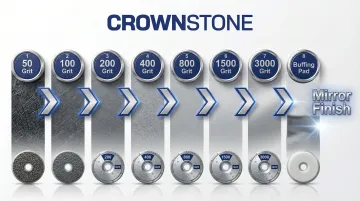
The industry-standard 7-step wet polishing sequence for granite runs 50, 100, 200, 400, 800, 1500, and 3000 grit, followed by a buffing pad—eight steps total. Skipping grits results in visible haze or inconsistent sheen at installation.
Leading Wet Polisher Models:
| Manufacturer | Model | RPM Range | Weight | GFCI Protected |
|---|---|---|---|---|
| Makita | PW5001C | 2,000-4,000 | 5.1 lbs | Yes |
| Alpha | VSP-320 | 700-2,500 | 7.3 lbs | Yes |
| FLEX | LW 1503 VR | 1,200-4,900 | 1.9 kg | Yes |
Leading Polishing Pad Brands:
- Slayer: Diamond Elite hybrid pads for aggressive cutting and high-gloss finishing
- Weha: Matrix and EX Premium pads for granite and engineered stone
- Alpha: Ceramica series for heat-sensitive materials
Granite typically requires 1,500-3,500 RPM, while marble must stay under 2,500 RPM to prevent overheating and stunning the stone.
Wet Polisher Selection Specifications:
| Key Spec | Look For |
|---|---|
| Speed Range | 500-3,500 RPM variable control; ergonomic body weight under 6 lbs for extended use |
| Pad Set Selection | Material-specific pads (granite vs. quartz vs. marble); wet vs. dry pad rating; full 8-step grit progression |
| Safety Features | GFCI-protected cord, sealed switch for wet environments, side handle for control on edges and sink reveals |
CNC Router and Edge Profiling Equipment
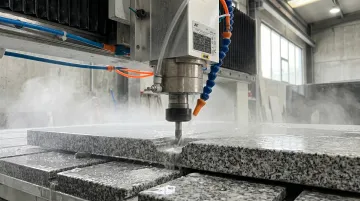
CNC routers and dedicated edge profilers eliminate hand-routing inconsistency by executing repeatable ogee, bullnose, bevel, and laminate profiles at scale. For shops handling high countertop volume, manual finishing creates a real bottleneck—CNC removes it.
Leading CNC Router Options:
| Manufacturer | Model | Spindle Power | Axis Configuration | Key Differentiators |
|---|---|---|---|---|
| BACA Systems | Paladin | 20 HP | 3-Axis | 24,000 lb monoblock steel frame, 44-position tool changer, FANUC controls |
| Park Industries | TITAN 4000 | 21 HP | 3-Axis | Up to 68 tool holders, 8'x16' work area, ArmorShield spindle coating |
| Comandulli | Speedy System | 4 HP per spindle | 4-Axis (X,Y,Z,A) | Edge polishing specific; automatic tool change; pneumatic slab holders |
A minimum of 10+ HP with water cooling is recommended for driving diamond tools through granite without stalling. Park Industries reports its TITAN CNC automation finishes parts with 90% less labor compared to manual routing.
CNC Router Selection Specifications:
| Key Spec | Look For |
|---|---|
| Spindle Power & Axis Configuration | Minimum 10-HP spindle for granite; 4+1 or 5-axis capability for miter and complex profile work |
| Tooling Compatibility | Support for finger bits, position wheels, zero-tolerance wheels, and polishing wheels in one machine |
| Software & Programming | Intuitive CAD/CAM interface; DXF/DWG import capability; compatible with digital templating outputs |
Material Handling Equipment, Dust Control, and PPE
Moving granite slabs without proper equipment—slab clamps, A-frame carts, and slab dollies—causes the most preventable shop injuries and slab breakage. Purpose-built stone handling gear is no longer optional for any shop processing more than a handful of slabs per week.
OSHA's silica dust standard caps respirable crystalline silica at 50 µg/m³ TWA, making HEPA-filtered dust collection and wet-cutting water systems compliance requirements—not optional accessories.
Material Handling Equipment:
- Wood's Powr-Grip: Below-the-hook vacuum lifters (PT10, MT8) with capacities up to 3,000 lbs, featuring individual pad shutoffs and vacuum loss warning buzzers compliant with ASME B30.20
- Abaco Machines: Slab clamps (Little Giant Lifter) and folding A-frame carts with rubber-lined surfaces and ratchet securing bars
- Weha: Single and double-sided A-frame storage racks and transport carts for granite and engineered stone
Dust Control and Slurry Management:
- Ruwac USA: Red Line series vacuums feature MicroClean filtration (99% efficient at 0.5 microns) with HEPA 2.0 upgrades (99.97% at 0.3 microns) compliant with OSHA silica standards
- Nilfisk/Pullman Ermator: S-Line extractors with EN1822-H13 HEPA filters (99.99% at 0.3 microns)
- SlurryMonster: Slurry separators and dehydrators that pass EPA Paint Filter Tests for compliant landfill disposal
Material Handling & PPE Specifications:
| Key Spec | Look For |
|---|---|
| Slab Handling Equipment | Rated slab clamps with vulcanized rubber pads; A-frame carts with load ratings matching heaviest slab weight; pneumatic wheels for shop floor mobility |
| Dust & Slurry Management | HEPA-filtered wet/dry vacuum; water feed systems for wet cutting; slurry solidification and disposal compliance |
| PPE Standards | N95 or half-mask respirator (NIOSH-approved), ANSI Z87.1 eye protection, EN388/ANSI A6 cut-resistant gloves, ASTM F2413 steel-toe footwear |
How We Chose the Best Granite Fabrication Tools and Equipment
A common mistake fabricators make is selecting tools based on upfront price alone. This ignores total cost of ownership, which includes blade life, downtime from equipment failure, parts lead times, and the cost of rework from imprecise cuts or finishes.
The tools and equipment in this guide were evaluated on five criteria:
- Direct performance on granite and hard stone materials
- Reliability under daily production conditions
- U.S.-based parts availability and manufacturer support quality
- Compliance with OSHA safety standards
- Long-term serviceability without dependence on difficult-to-source components
Maintenance costs for CNC bridge saws average 5–8% of the purchase price per year, and equipment failure accounts for roughly 42% of all unplanned downtime in manufacturing. For shops running consistent production volume, these numbers add up fast.
Prioritize equipment that delivers on:
- Verifiable uptime records — ask for real-world reliability data, not spec sheets
- Domestic or regionally based parts supply — shorter lead times mean less lost production time
- Responsive manufacturer support — fast answers to service questions prevent small issues from becoming expensive shutdowns
Conclusion
Equipping a granite fabrication shop for 2025 means investing in tools and equipment that hold up shift after shift. A reliable bridge saw, properly matched diamond tooling, a capable polishing setup, edge profiling equipment, and safe material handling systems form the complete production stack.
Before finalizing any purchase, evaluate the manufacturer's support infrastructure, parts availability, and warranty terms. A machine that sits idle waiting for an imported part is a cost no production schedule can absorb.
Crown Stone USA designs and builds American-made bridge saws and fabrication equipment for production stone shops, with parts sourced primarily from the US, Korea, Japan, and Taiwan—so replacements are available when you need them. The company was founded by fabricators who spent years cutting, lifting, and installing stone before building machines for people who still do. Reach the team at crownstoneusa.com or call 727-239-9875 to talk through your shop's equipment needs.
Frequently Asked Questions
What is the most important piece of equipment for a granite fabrication shop?
The bridge saw is typically the highest-priority investment since it determines cut accuracy, throughput, and material yield. A poorly performing saw creates problems at every downstream stage—from misaligned miters to wasted slabs.
What should I look for when buying a bridge saw for granite cutting?
Focus on motor power (15–30 HP for granite), table rigidity and precision, blade compatibility (16"–18" diameter standard), and serviceability. Ease of sourcing parts and manufacturer support responsiveness are as important as the specs themselves.
What is the difference between a bridge saw and a CNC router for granite fabrication?
A bridge saw handles straight and miter slab cuts, while a CNC router handles edge profiling, sink cut-outs, and complex shaping. Production shops typically need both—the saw for primary cutting and the router for detailed finishing work.
How do I stay OSHA-compliant with silica dust in my fabrication shop?
OSHA's respirable silica TWA limit is 50 µg/m³. Compliance requires a written exposure control plan, wet cutting methods or HEPA vacuums rated at 99.97% efficiency at 0.3 microns, and proper respirator use (NIOSH N95 or half-mask) for all crew members.
How often should granite fabrication equipment be serviced?
Bridge saws need spindle runout verified monthly, water systems flushed regularly, and blades inspected per linear footage cut. Follow the manufacturer's maintenance schedule to preserve warranty coverage; most bridge saw tables require greasing every two months.
What diamond blade grit or type should I use for cutting granite?
Harder bond segments are better for dense natural granite. Silent-core blades reduce vibration and chipping on hard stone. Make sure the blade is wet-rated and matched to your saw's RPM range (1,725–6,000 RPM) and spindle diameter (typically 50mm, 60mm, or 1").