Introduction
Edge finishing is one of the most reputation-defining steps in stone fabrication. A polished flat edge is often the first thing a customer touches—and judges. A clean, glossy finish signals craftsmanship; a scratchy or uneven one signals corner-cutting.
For high-volume shops cutting granite, marble, and quartz, consistency and speed in edge finishing directly affect both profitability and customer satisfaction. Automated flat edge polishers can process up to 325 linear feet per hour—a 16x improvement over the manual rate of 20–25 feet per hour. That throughput turns edge finishing from a bottleneck into a streamlined step, freeing your crew for templating, layout, and installation.
This guide compares the leading flat edge polisher categories on the market—covering motor configurations, spindle counts, material compatibility, and price-to-performance—so you can match the right machine to your shop's volume and finish requirements.
TL;DR
- Flat edge polishers automate the eased/flat edge finishing process—the most common countertop edge profile in residential and commercial fabrication
- Evaluate machines on polishing head count, belt orientation, material compatibility, throughput speed, and parts availability
- Top brands: Park Industries FASTBACK® II, Comandulli, CMG, Breton SpA, and Crown Stone USA
- The right machine matches your production volume, shop footprint, and material mix—not just brand name
- Prioritize domestic parts availability and manufacturer support to minimize costly downtime
What Is a Flat Edge Polisher and Why It Matters in Stone Fabrication
A flat edge polisher is a conveyor-fed, multi-head machine designed exclusively to grind, bevel, and polish the straight (eased or flat) edge of stone slabs. Unlike profiling machines that create bullnose, ogee, or custom decorative edges, flat edge polishers are purpose-built for volume production of the most widely specified edge type in countertop work. Industry data indicates that roughly 90% of modern countertop installations utilize simple edge profiles, with the eased edge dominating due to its clean, contemporary aesthetic.
Typical Machine Anatomy
A production flat edge polisher begins with a calibrating head at entry—typically 200mm to 250mm in diameter—that levels uneven slab thickness before polishing starts. This ensures consistent bevel depth and finish across the entire piece. After calibration, the slab passes through 7 to 9 frontal polishing heads running progressively finer abrasive grits (e.g., 50, 100, 200, 400, 800, 1500, 3000). Finally, 2 to 4 bevel heads (upper and lower) chamfer the top and bottom edges to the desired profile.
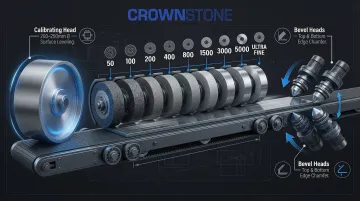
More heads translate to a finer finish in a single pass. Machines with fewer than 7 heads often require slower belt speeds or multiple passes to achieve equivalent gloss levels, which directly reduces the throughput advantage you bought the machine for.
Not All Flat Edge Polishers Are Built the Same
Beneath the spec sheet, several factors separate machines that perform from machines that cost you money:
- Belt orientation: Vertical polishers save floor space but require different loading workflows than horizontal bench models
- Motor power and PLC controls: Higher-tier controls improve repeatability and reduce operator error on long production runs
- Spindle type: Proprietary spindles lock you into expensive replacement parts; universal resin wheel compatibility gives you options
- Abrasive compatibility: Not all machines accept third-party abrasives, which affects your long-term consumables cost
These variables, not just horsepower and head count, determine the true total cost of ownership.
Top Flat Edge Polishers for Stone and Marble
The following machines were selected based on market presence, technical capability, fabricator-reported reliability, and relevance to U.S. stone shops processing marble, granite, and quartz at production volume.
Park Industries FASTBACK® II
Park Industries, headquartered in St. Cloud, Minnesota, has manufactured stone fabrication equipment since 1953. The company is North America's largest stoneworking equipment manufacturer. The FASTBACK® II is their dedicated flat-edge polisher for high-volume backsplash, countertop, and vanity work.
The FASTBACK® II delivers up to 65 inches per minute throughput with a 9-spindle configuration (1 calibrating, 6 polishing, 2 chamfer). It integrates with the optional SlabBACK® support system, enabling vertical processing of full countertop slabs and islands up to 96 inches tall. Park's U.S.-based service infrastructure includes a "Next Day or No Pay" parts guarantee, backed by over 500,000 parts in inventory and 24/7 technical support.
| Specification | Details |
|---|---|
| Spindle Configuration | 9 total: 1 calibrating, 6 polishing, 2 chamfer |
| Throughput Speed | Up to 65 inches per minute |
| Material Thickness | 1 cm to 6 cm |
| Power Supply | 240V or 208V, 3-phase, 60Hz (42.3–48.8 FLA) |
| Material Compatibility | Granite, marble, quartz, engineered stone |
| Support & Warranty | Next Day or No Pay parts, 24/7 support, U.S.-based service network |
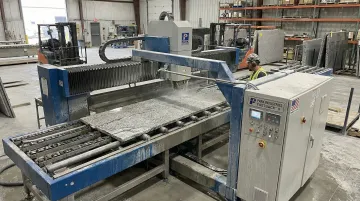
Comandulli Speedy System
Comandulli is an Italian manufacturer with a strong reputation in European and global fabrication markets. Their Speedy D series is a horizontal bench-style edge polisher designed for independent shops handling single pieces or small series.
The Speedy System uses kinematic motion — gears and levers for circular spindle movement — and features an automatic tool change magazine available in 6, 8, or 12 positions. The high-power 3 kW (4 HP) spindle runs up to 3,000 RPM and accommodates slab thicknesses from 10mm to 120mm. Parametric profile presets via a touch-screen control panel simplify operator setup.
| Specification | Details |
|---|---|
| Polishing Heads | Variable (6, 8, or 12 tool positions) |
| Belt Orientation | Horizontal bench style |
| Max Slab Thickness | 10mm to 120mm |
| Spindle Power | 3 kW (4 HP), up to 3,000 RPM |
| Notable Features | Kinematic circular motion, automatic tool changer, parametric touch-screen presets |
| Pricing Tier | Mid-to-premium; used models (2004-2006) listed $21,000–$39,000 in U.S. |
| U.S. Distribution | Comandulli North America, Sarasota, FL |
CMG Edge Polishers
C.M.G. Macchine S.r.l., founded in 1984, specializes exclusively in edge polishing machinery for natural and engineered stone. The company offers a range of flat edge polisher models from compact horizontal units to automated production lines.
Key Models:
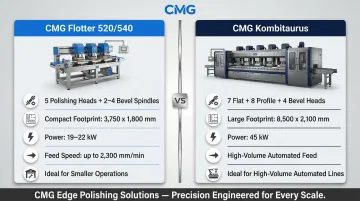
Flotter Series: Compact horizontal machine with 5 frontal polishing heads and 2 to 4 beveling spindles. Requires 19–22 kW max power and achieves feed speeds from 10 to 2,300 mm/min. Footprint: 3,750 x 1,800 mm.
Kombitaurus: Larger automated line with 7 flat polishing heads, 8 profiling heads, and 2+2 beveling heads. Requires 45 kW installed power and processes flat edges up to 100mm thick. Footprint: 8,500 x 2,100 mm.
| Model | Head Count | Belt Type | Material Compatibility | Footprint |
|---|---|---|---|---|
| Flotter 520/540 | 5 polishing + 2–4 bevel | Horizontal | Marble, granite, engineered stone | 3,750 x 1,800 mm |
| Kombitaurus | 7 flat + 8 profile + 4 bevel | Horizontal automated line | Universal resin/diamond wheels | 8,500 x 2,100 mm |
After-Sales Support: CMG's U.S. distributor network and replacement parts availability details are not widely published. Confirm domestic parts availability before purchase.
Breton SpA
Breton S.p.A., founded in 1963 and headquartered in Castello di Godego, Italy, is a technology group focused on stone processing equipment. The company serves high-production fabricators globally with advanced automation systems.
The Breton Kappa G series is a heavy-duty continuous polisher for granite and quartzite slabs, configurable with 6, 8, 10, 12, 13, 14, or 18 abrasive heads. It features 11 kW spindles and a gantry electronic axis beam drive.
Automation Features:
- Tetrix System: Simultaneous processing of slabs of varying widths without unloading, enabling continuous edge polishing
- Tango System: Controlled oscillating spindle motion to boost finish uniformity
| Specification | Details |
|---|---|
| Head Count | 6 to 18 abrasive heads (configurable) |
| Spindle Power | 11 kW |
| Automation Level | Tetrix (multi-width simultaneous processing), Tango (oscillating motion) |
| Target Shop Size | High-volume production facilities |
| U.S. Distribution | Breton USA Customer Service Corp., Sarasota, FL; dedicated Spare Parts portal |
Crown Stone USA
Crown Stone USA (Crown Stone Equipment, LLC) is an American manufacturer based in Clearwater, Florida. The company was founded by fabricators who spent decades cutting, lifting, and installing stone — which directly shapes how their machines are designed, sourced, and supported.
The Eversplash Flat Edge Polisher is engineered and assembled at Crown Stone's Tampa Bay facility.
Key differentiators:
- Up to 100 inches per minute throughput with 6 flat-edge polishing spindles and 2 beveling motors (45° top and bottom)
- Intuitive electro-mechanical controls and in-house cast aluminum spindles built for low downtime
- Less than 2% of components by value sourced from China; primary sourcing from the U.S., North and South America, Korea, Japan, and Taiwan
- 2-year warranty with quick customer response and globally available parts
| Specification | Details |
|---|---|
| Polishing Heads | 6 flat-edge spindles + 2 beveling motors |
| Throughput Speed | Up to 100 inches per minute |
| Material Thickness | 1 cm to 6 cm |
| Bevel Configuration | 1/16" top and bottom, 45° |
| Material Compatibility | Granite, marble, quartz |
| Power Requirements | 208–240V, 3-phase; 80–120 psi compressed air; 20 GPM water |
| Made in USA | <2% China-sourced components; U.S.-based parts supply chain |
| Warranty & Support | 2-year warranty; quick response customer service at 727-239-9875 |
For fabricators who want U.S.-made equipment backed by people who have run the same shops, Crown Stone is the only manufacturer on this list built from that starting point.
Key Features to Look for in a Flat Edge Polisher
Head Count and Grit Progression
A flat edge polisher's finish quality is directly tied to the number of polishing heads and the grit sequence they carry. Machines with 7–9 heads allow a full progression from coarse material removal (50–120 grit) through fine polishing (1500–3000 grit) in a single pass. Fewer heads often require multiple passes or leave a less refined finish.
Material-Specific Grit Considerations:
- Granite and Quartz: Harder stones require the full grit sequence. Quartz demands lower RPMs and white-resin pads to prevent the resin binders from burning or hazing
- Marble: Softer calcitic marbles chip easily. Start with a less aggressive grit (200-grit) and use softer resin bonds to prevent edge blowouts and deep scratches
Horizontal vs. Vertical Belt Orientation
Belt orientation affects shop floor space, operator ergonomics, and slab stability during polishing.
| Feature | Vertical Orientation | Horizontal Orientation |
|---|---|---|
| Floor Space | Compact longitudinal footprint; saves shop floor space | Requires longer, wider footprint |
| Slab Loading | Slabs loaded standing up; ideal for long, straight countertop runs | Slabs lay flat; easier for thick, heavy, or irregularly shaped pieces |
| Shop Size | Dominant in high-volume countertop production shops | Common in smaller shops, architectural fabrication, monument work |
Vertical polishers are preferred for high-volume countertop fabricators because they free up valuable floor space and allow rapid, continuous feeding of standard backsplashes and counters. Horizontal machines offer greater precision and stability for complex, heavy, or custom-shaped architectural pieces.
Calibrating Head and Thickness Control
A calibrating head at the machine's entry point shaves the slab edge to a consistent thickness before polishing begins. This is critical for slabs that vary slightly in thickness. Skipping this feature means inconsistent bevel depth and finish across a single piece, leading to rework and customer complaints.
PLC Controls and Automation Features
PLC (Programmable Logic Controller) systems reduce operator skill requirements and deliver consistent results across shifts. Look for machines that include:
- Stops automatically around cutouts or at a defined point
- Adjusts belt speed per stone type and finish requirement
- Stores preset programs for marble, granite, and quartz
- Tracks tool life and triggers maintenance alerts based on actual usage timers
Parts Availability and Serviceability
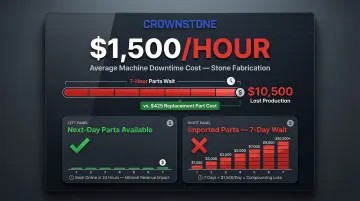
The total cost of ownership includes not just purchase price but the cost and speed of replacement polishing heads, abrasive wheels, and belts. Industry estimates place fabrication downtime costs at approximately $1,500 per hour. Waiting for imported parts can result in days of lost production—a simple $425 replacement part can incur over $10,000 in downtime costs if your shop waits 7 hours for overnight shipping.
Prioritize machines that offer:
- Replacement parts stocked and available in the U.S.
- Responsive manufacturer support with real response times
- Centralized automatic lubrication to reduce manual maintenance
- Accessible service points that don't require pulling tooling to reach
How We Chose the Best Flat Edge Polishers
Machines were evaluated based on their ability to handle the most common stone types in U.S. fabrication shops (marble, granite, quartz), documented throughput performance, polishing head configuration, quality of PLC/automation controls, and real-world serviceability.
Those technical specs only tell part of the story. Two purchasing mistakes consistently hurt fabricators more than any spec sheet ever will:
- A cheaper machine that runs $1,500/hour in downtime costs far more over its lifespan than a reliable one with domestic parts access
- Impressive specs mean nothing if replacement spindles aren't available in your region when you need them
Additional Evaluation Criteria:
- Market presence and fabricator feedback
- Manufacturer transparency about sourcing and service infrastructure
- Production uptime track record, which ultimately determines ROI for any edge polishing investment
One final note on scope: this comparison covers flat edge (eased edge) polishers only. Profiling machines and robotic arms designed for curved edge work are separate equipment categories with different production applications and are not included here.
Conclusion
The right flat edge polisher matches your shop's actual production volume, material mix, and floor space—not necessarily the most expensive or most well-known brand name. A vertical polisher makes sense for high-volume countertop shops with limited floor space. A horizontal bench model may be better suited for smaller operations handling architectural pieces or custom shapes. Seven to nine polishing heads deliver single-pass production quality, while fewer heads require slower speeds or multiple passes.
Evaluate serviceability and parts access as rigorously as you evaluate specs. A machine that delivers 100 inches per minute throughput but takes a week to get replacement spindles will cost you far more than a slightly slower machine with next-day parts availability. Those parts delays compound directly into your ROI—which is why the real calculation goes beyond sticker price.
When sizing up your return, factor in:
- Linear feet polished per hour at your production volume
- Labor hours saved per week versus hand or semi-manual polishing
- Reduction in rework from inconsistent finishes
Automated machines can polish up to 325 linear feet per hour—16 times faster than hand-polishing rates of 20–25 feet per hour. That throughput gap alone can pay for the machine in months, not years.
Crown Stone USA designs its edge polishing equipment from direct fabrication experience—built by people who ran the same shops their customers run today. If you want to talk through what the right machine looks like for your operation, reach out at crownstoneusa.com or call 727-239-9875.
Frequently Asked Questions
What is a flat edge polisher used for in stone fabrication?
A flat edge polisher is a conveyor-fed machine that automatically polishes the straight, eased edge of stone slabs—the most common countertop edge profile. It replaces hand-polishing each linear foot, dramatically increasing throughput for granite, marble, and quartz shops.
How many polishing heads does a typical flat edge polisher have?
Most production-grade flat edge polishers use 7–9 polishing heads running progressively finer abrasives, plus 2–4 bevel heads for chamfering the top and bottom edge. More heads generally mean a finer finish in a single pass.
What is the difference between a horizontal belt and vertical belt flat edge polisher?
Horizontal belt machines lay the slab flat on a conveyor (more traditional, easier for large slabs, requires more floor space), while vertical machines feed the slab upright (more compact footprint, preferred in smaller shops). Both can achieve equivalent finish quality.
Can the same flat edge polisher work on marble, granite, and quartz?
Most modern flat edge polishers are compatible with multiple stone types but require different polishing wheels or abrasive settings for each. Marble is softer and requires lower-aggression abrasives, while quartz and granite need diamond-bond or resin wheels rated for those materials.
How much faster is a flat edge polisher compared to hand polishing?
Automated machines polish up to 325 linear feet per hour, while manual hand-polishing averages only 20–25 feet per hour. That's a 16x efficiency gain—enough to turn edge finishing from a daily bottleneck into a non-issue.
What regular maintenance does a flat edge polisher need?
Routine maintenance covers four main areas:
- Daily: Remove slurry and stone dust from the conveyor and heads
- Every 200–300 hours: Replace polishing heads/wheels
- Per manufacturer schedule: Lubricate drive components
- Periodically: Check belt tension and calibrator alignment
Machines with automatic lubrication and accessible service points cut maintenance time considerably.