Introduction
Stone fabrication shops face mounting pressure: demand for precision countertops, custom architectural work, and intricate engravings continues to grow while manual processes strain under the load. The right CNC machine directly determines your throughput, scrap rate, and operator skill requirements. Choose poorly, and you'll face expensive downtime, hard-to-source parts, and minimal local support — problems that compound fast in high-volume shops.
This guide evaluates five CNC machines across different use cases and price tiers. For each one, we examine cutting capacity, software compatibility, support infrastructure, and total cost of ownership — giving fabricators a clearer basis for comparison than spec sheets alone.
TL;DR
- CNC machines for stone include bridge saws, sawjets, machining centers, and routers—each suited to different shop sizes and output types
- Top machines balance precision, multi-axis capability, material compatibility (granite, marble, quartz, porcelain), and reliable after-sales support
- American-made options like Crown Stone USA give US fabricators faster service, domestic parts, and 2-year warranty coverage
- Evaluate on axis count, spindle power, control ease, parts availability, and total cost of ownership—not sticker price alone
Overview of CNC Machines in the Stone Fabrication Industry
CNC stone machines are computer-controlled equipment that automate cutting, shaping, drilling, engraving, and polishing of stone slabs. These systems have transformed fabrication workflow from template to finished product, enabling precision and repeatability that manual processes cannot match.
Primary Machine Types:
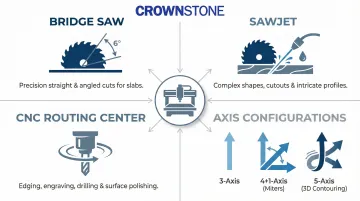
- Bridge saws – Execute straight and angled slab cuts, the backbone of countertop production
- Sawjets – Combine bridge saw and waterjet capabilities for complex shapes and intricate cutouts
- CNC machining/routing centers – Handle edging, engraving, profiling, and polishing operations
- Axis configurations – Determine shape and bevel capabilities:
- 3-axis: vertical cuts only
- 4+1-axis: adds tilting for miters, but not simultaneous movement
- True 5-axis: simultaneous movement for complex 3D contouring
That range of machine types reflects a fast-growing market. The global stone processing machine sector was valued at $8.76 billion in 2025 and is projected to reach $14.18 billion by 2034, growing at a CAGR of 5.50%. Driving that growth: manufacturers report material waste reductions of 15–20% when switching from manual to CNC processing.
Best CNC Machines for Stone Fabrication and Engraving
The following machines were evaluated on build quality, axis capability, material range, ease of use, parts availability, and fabricator support—not marketing claims or spec sheet length.
Crown Stone USA
Crown Stone USA is an American manufacturer founded by stone fabrication veterans who cut, lifted, and installed stone before designing their first machine. Their flagship CNC bridge saw underwent 10 design iterations before commercialization, with each version tested rigorously in real shop conditions.
What sets Crown Stone apart:
- Made in USA with less than 2% of components by value from China
- Parts sourced primarily from the US, North and South America, Korea, Japan, and Taiwan
- 2-year warranty with parts readily available domestically
- Intuitive controls designed for low operator learning curves
- Quick customer support response times from people with hands-on fabrication experience
| Machine Type / Best For | CNC Bridge Saw / US stone fabrication shops prioritizing uptime, reliability, and domestic parts support |
|---|---|
| Standout Features | American-made construction, fabricator-designed ergonomics, globally available parts, intuitive controls, durable build quality for daily shop use |
| Support & Warranty | 2-year warranty; parts readily available in US; responsive customer service; designed for easy self-service by shop technicians |
The Avalanche Pro specs at a glance:
- 20 HP blade motor with hydraulic lift to 70 degrees
- Air-powered brake and indexing for consistent positioning
- Kinco HMI touchscreen with physical button override for operators without CNC backgrounds
- Automatic and manual modes for full-slab cuts and miters
Park Industries
Park Industries, founded in 1953, is North America's largest stone machinery manufacturer with over 18,000 machines sold. Their full product ecosystem includes CNC sawjets, bridge saws, and routers, all backed by a "Next Day or No Pay" parts guarantee.
Key differentiators:
- 24/7 customer service with guaranteed next-day parts delivery
- Strong Made in USA identity with comprehensive training programs
- SABERjet™ XP and TITAN® router series are installed across high-volume North American countertop shops, backed by one of the industry's largest domestic install bases
| Machine Type / Best For | CNC Sawjets and Routers / High-volume North American countertop and architectural stone shops |
|---|---|
| Standout Features | 5-axis cutting, MiterJet technology, waterjet integration, high-speed router polishing |
| Support & Warranty | 24/7 support, "Next Day or No Pay" parts guarantee, comprehensive training programs |
Key specs worth noting:
- SABERjet™ XP: 27 HP arbor motor, 5-axis waterjet, blade miters 0–47°, waterjet miters 0–58°
- TITAN® router series: work areas up to 8' x 16', 24 HP spindle motors built for sustained production loads
Breton S.p.A.
Founded in 1963, Breton is an Italian manufacturer recognized globally for inventing Bretonstone® engineered quartz technology (first patent in 1975). Their cutting centers (Genya, Trinity) and CNC machining centers (Hawx, Forte) are built around deep materials science expertise.
Breton's differentiator:
- Material specialization optimized for engineered stone and ultra-compact surfaces from the ground up
- R&D investment backed by over 1,700 registered patents
- Presence in more than 100 countries worldwide
| Machine Type / Best For | CNC Cutting Centers and Machining Centers / Shops specializing in engineered quartz, ultra-compact surfaces, and high-volume production |
|---|---|
| Standout Features | Patented cutting technology, multi-material capability (stone, composites, light alloys), advanced automation options |
| Support & Warranty | Global service network across 100+ countries; dedicated support teams per product line |
Breton's Genya 5-axis monoblock cutting center and Hawx 5-axis milling center deliver precision engineered specifically for the thermal and structural characteristics of engineered materials, not just natural stone.
BACA Systems
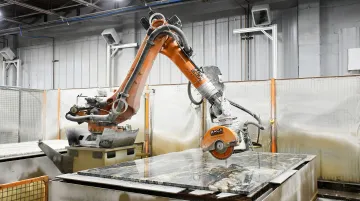
BACA Systems is a US-based company that automates stone fabrication through 6-axis KUKA robotic arms, replacing traditional gantry systems with technology borrowed from automotive and medical manufacturing. Their Robo SawJet line handles non-linear cuts, automated slab handling, and high-volume throughput within a single robotic cell.
How BACA addresses labor shortages:
- Robotic sawjet reduces reliance on skilled manual labor, addressing the construction industry's estimated 546,000-worker shortage in 2023
- Improves shop safety and scales production without proportional headcount growth
- "WaterJet Made Easy" quick-swap pump program simplifies maintenance with 15-minute on-site assembly swaps
| Machine Type / Best For | Robotic Sawjet / Shops investing in automation to reduce labor dependency and increase throughput |
|---|---|
| Standout Features | 6-axis KUKA robotic arm, automated slab handling options, high cutting flexibility, precision derived from automotive/medical robotics technology |
| Support & Warranty | "WaterJet Made Easy" maintenance program; US-based company with domestic service capability |
BACA reports that leveraging waterjet for non-linear cuts increases downstream CNC router output by 30%, while waterjet cutting eliminates blade overtravel, increasing yield by 10-20%.
CMS Brembana
CMS Brembana (part of the SCM Group) inherited the legacy of Brembana, which invented the world's first stone machining center in 1985. Their Maxima and Electa machining centers and Kosmos bridge saw target heavy-duty stone work in architectural and custom applications.
Niche advantage:
- While competitors focus on high-volume countertop production, CMS Brembana targets complex, high-margin projects (columns, sculptures, thick architectural cladding)
- The Electa equipped with new HITECO electrospindle delivers productivity increases up to 35%
- Monoblock Kosmos design requires no special foundation
| Machine Type / Best For | CNC Machining Centers and Bridge Saws / Fabricators pursuing high-margin architectural and custom stone projects |
|---|---|
| Standout Features | Heavy-duty block processing, thick slab capability, no-foundation monoblock design (Kosmos), versatile 5-axis machining |
| Support & Warranty | Customer care portal for online service and parts requests; global SCM Group support network |
For shops cutting columns, curved cladding, or slabs over 6 cm thick, CMS Brembana offers capabilities most countertop-focused machines aren't built for.
How to Choose the Right CNC Stone Machine for Your Shop
The most common mistake fabricators make is buying based on axis count or brand reputation alone. The right machine depends on your primary material (granite vs. engineered stone vs. porcelain vs. quartzite), your output type (straight-cut countertops vs. complex shapes vs. engravings), and your shop's current and projected volume.
Practical Evaluation Checklist:
- Axis capability vs. your most complex job type – 3-axis handles vertical cuts; 4+1-axis adds miters; true 5-axis enables complex curves and profiling
- Spindle power relative to your hardest material – Harder materials like quartzite and porcelain demand higher HP and specific blade types
- Parts availability and lead time in your region – Overseas components mean longer downtime; domestic availability keeps machines running
- Control system learning curve for your team – Intuitive interfaces reduce training time and operator errors
- Total cost of ownership – Factor in energy, water, maintenance, and expected machine lifespan, not just purchase price
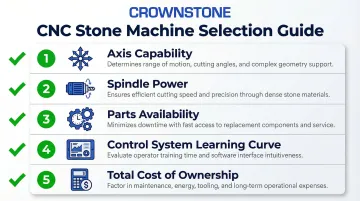
Of these five criteria, parts availability is the one most buyers underestimate until their machine is sitting idle.
Why Domestic Parts Matter:
Unplanned downtime costs mid-sized manufacturers approximately $25,000 per hour. A machine waiting on an overseas component is a machine losing money. For US-based fabricators, domestic parts availability and responsive service matter more than most buyers anticipate. Crown Stone USA sources less than 2% of its components by value from China, pulling primarily from the US, Americas, Korea, Japan, and Taiwan — which means replacement parts are reachable without international lead times when your shop needs to get back up and running.
Conclusion
The best CNC machine for stone fabrication is the one that fits your shop's actual workflow, material mix, and growth plans. Prioritize long-term factors: warranty coverage, parts availability, service responsiveness, and scalability over short-term price savings that disappear fast when downtime hits.
Fabricators looking for a machine designed from the shop floor up, built in America, and backed by founders who spent decades repairing, operating, and cutting stone themselves should explore Crown Stone USA's lineup. Contact the team at crownstoneusa.com or call 727-239-9875 to discuss the right fit for your operation.
Frequently Asked Questions
Which is better, CNC or VMC?
For stone fabrication, CNC bridge saws and machining centers are purpose-built for the wet, abrasive environment stone cutting requires, with waterproofing, appropriate spindle types, and bed configurations. VMCs (Vertical Machining Centers) are designed for metal and rarely used in stone shops — they simply aren't built for wet stone-cutting environments.
What type of CNC machine is best for granite countertop fabrication?
A 4+1 or 5-axis CNC bridge saw is the standard choice for countertop fabrication, efficiently handling straight cuts, miter joints, and sink cutouts. For shops also needing edge profiling and polishing in the same workflow, a CNC sawjet or machining center adds versatility without requiring separate equipment setups.
How much does a CNC stone fabrication machine typically cost?
Pricing varies widely by machine type: entry-level 4-axis bridge saws start around $18,000–$30,000, mid-tier 5-axis machines run $85,000–$350,000, and fully automated robotic sawjets can reach $650,000. Beyond purchase price, factor in total cost of ownership — parts, service, water, and energy costs add up fast.
What is the difference between a bridge saw and a CNC machining center for stone?
A bridge saw primarily executes straight, angled, and bevel cuts across stone slabs. A CNC machining center performs a broader range of operations including edge profiling, engraving, drilling, and polishing. Many shops use both, or a sawjet that combines saw and waterjet capabilities in one machine.
Can CNC stone machines process all types of stone, including quartzite and porcelain?
Most 5-axis CNC bridge saws and sawjets handle granite, marble, quartzite, engineered quartz, and sintered/porcelain surfaces. Harder and more brittle materials like porcelain require specific blade types, waterjet capability, and reduced feed rates. Fabricators should confirm material compatibility with manufacturers before purchasing.
How important is after-sales support when investing in a CNC stone machine?
After-sales support is critical — a single day of unplanned downtime can cost thousands in lost production. Before committing, evaluate parts lead times, local technician availability, warranty terms, and whether the manufacturer stocks components domestically.