
Yet many Chicago projects encounter delays, poorly matched seams, or unexpected costs because homeowners enter the process without understanding what happens at each stage—or why certain decisions lock in results that can't be changed later. In a city where 67% of kitchen remodels include countertop upgrades and fabrication lead times can stretch to 4 weeks during peak season, knowledge gaps cost time and money. Understanding the six distinct phases of granite fabrication helps you ask better questions, spot red flags early, and avoid the surprises that derail timelines and budgets.
TLDR
- Granite fabrication involves six sequential steps: slab selection, digital templating, CNC cutting, edge profiling, sealing, and installation
- Chicago installation typically takes 1 day on-site, but full timeline from template to install runs 2–4 weeks depending on complexity and shop backlog
- Equipment quality directly affects seam precision—precision bridge saws like those from Crown Stone USA produce tighter tolerances and less waste
- Plan ahead for Chicago-specific factors: freight elevator access, non-standard layouts, and cold-weather adhesive cure times
What Is the Granite Fabrication and Installation Process?
Granite fabrication is the shop-side work where raw stone slabs are cut, shaped, and polished according to your kitchen's exact measurements. Installation is the on-site phase where finished pieces are positioned, leveled, and permanently secured to your cabinets.
These two phases are sequential and interdependent. Errors during fabrication—such as miscalculated cutouts or poorly planned seams—cannot be corrected on installation day. The precision achieved at the shop level determines your final result, which is why vetting a fabricator's equipment and process matters more than price alone.
Granite vs. Quartz: Key Fabrication Differences
| Factor | Granite | Quartz |
|---|---|---|
| Material origin | Natural quarried slab; unique veining | Engineered composite; uniform pattern |
| Layout planning | Requires careful seam and pattern matching | More forgiving — no pattern matching needed |
| Sealing | Periodic sealing required (porous surface) | No sealing needed (non-porous), per the Natural Stone Institute |
Step-by-Step: How Granite Fabrication and Installation Works in Chicago
The process moves through six distinct stages, each dependent on the accuracy of the last. Understanding each stage helps Chicago homeowners ask better questions, confirm details before it's too late, and avoid the delays that cascade from early mistakes.
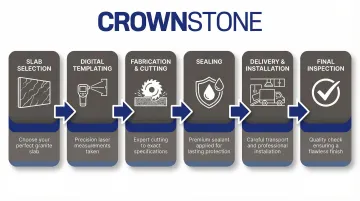
Step 1: Slab Selection
The process begins when you visit a slab yard or showroom to choose the actual physical slab that will become your countertop—not just a color sample or SKU number. Because granite is a natural material, every slab has unique patterning. The specific slab you select locks in the look of your finished countertop.
Granite slabs are graded Level 1 through Level 3+ based on rarity, origin, and visual complexity. Higher grades feature dramatic veining and rare colors but cost more. Standard countertop thickness is 3 cm (1¼ inches); some fabricators use thinner 2 cm stone to cut costs, which limits edge profile options and reduces structural strength.
Ask to see the full slab and confirm thickness before signing a contract. For slabs with bold veining, discuss how the fabricator plans to lay out cuts to maintain visual continuity.
Step 2: Digital Templating
A fabricator visits your home to capture precise measurements using laser or digital templating tools. Systems like the Laser Products Industries LT-2D3D achieve ±1/16″ accuracy up to 200 feet and output CAD files that feed directly into CNC cutting machines.
During templating, the technician records:
- Countertop dimensions and irregular angles
- Cutout locations for sinks and cooktops
- Overhang depth and radius corners
- Edge profile specifications
You must be present during templating to confirm these details. Changes after templating delay the project and may incur additional charges.
Older Chicago bungalows and greystones frequently have non-square corners or unlevel floors — decisions about those conditions have to be made on the spot.
Step 3: Fabrication (Cutting, Shaping, Polishing)
Back at the shop, fabricators use bridge saws and CNC machinery to cut the slab to exact template dimensions. The quality of this equipment directly determines seam tightness, edge consistency, and cut accuracy.
Industry standards set stone-to-stone seam widths at 1/16″ with a ±1/64″ tolerance. Shops running precision bridge saws — like those built by Crown Stone USA, designed by fabricators with hands-on shop experience — hold tighter tolerances and reduce material waste. Outdated or poorly maintained equipment produces wider seams, inconsistent edges, and higher scrap rates.
Edge profile is shaped during this stage according to your specification:
| Edge Profile | Description | Best For |
|---|---|---|
| Eased/Square | Straight 90° with softened corners | Modern kitchens; chip-resistant |
| Half Bullnose | Rounded top, flat underside | Family-friendly; prevents spills |
| Ogee | Decorative S-curve | Traditional/formal styles |
| Mitered | Two pieces joined at 45° for thick appearance | Waterfall islands; requires precision |
After cutting and shaping, fabricators polish the surface to the desired finish and inspect for imperfections.
Step 4: Sealing (Granite-Specific)
Because granite is porous (typically <0.40% water absorption per ASTM C97 standards), a sealant is applied at the shop or on installation day to protect against staining and moisture penetration.
Quality impregnating sealers act as repellents with a 10–15 year life expectancy, but they don't make granite stain-proof. Quartz countertops are non-porous and never require sealing.
Sealing frequency depends on stone density, color (lighter granites are often more porous), and usage. The "water drop test"—where you observe if water beads or soaks in—determines when resealing is necessary.
Step 5: Delivery and Installation
On installation day, the fabricated pieces are transported to your home. The installation crew:
- Dry-fits all pieces to verify alignment and seam quality
- Shims the countertop level (spaced maximum 2 feet apart) to account for uneven cabinets or floors—common in older Chicago homes
- Adheres the stone with silicone adhesive or epoxy
- Fills seams with color-matched polyester or epoxy resin for invisibility
- Secures undermount sinks with two-part epoxy and often reinforces with "rodding"—embedding a steel or fiberglass rod in the underside to prevent flexure

Seam placement is governed by slab size, transport constraints, and structural support requirements. Skilled installers position seams away from focal points and high-stress zones like sink cutouts. Plumbing reconnection requires a licensed plumber the following day, after adhesive cures.
Step 6: Final Inspection and Post-Installation Steps
Once all pieces are set, the installer conducts a final inspection for level, alignment, and seam quality. You should also inspect before the crew leaves—this is your opportunity to identify issues while they're still on-site.
Before the crew packs up, walk through these steps:
- Allow adhesive to cure 24 hours before heavy use or plumbing reconnection
- Avoid placing heavy objects on unsupported spans
- Plan for the first professional re-seal within 1–2 years based on stone density and usage
Full cure times vary by adhesive type: epoxies reach handling strength in 6–8 hours but take 7 days for maximum stability. Neutral-cure silicones require 7–14 days for complete cure.
What Affects Granite Fabrication and Installation Quality in Chicago?
Equipment at the Fabrication Shop
The type of saw and CNC machinery used by a fabricator determines how accurately each piece is cut. Shops running outdated or poorly maintained equipment produce wider seams, inconsistent edges, and higher material waste.
Fabricators running well-maintained bridge saws—machines with CNC-machined rolling surfaces, hydraulic lift systems, and moisture-resistant designs—maintain tighter tolerances over extended use. Crown Stone USA, an American manufacturer built by working fabricators, produces equipment specifically engineered for this level of consistency.
Stone Grade and Slab Thickness
Granite is sold in different grades (Level 1 through Level 3+) reflecting rarity, thickness, and visual complexity. Standard countertop thickness in the industry is 3 cm.
Some fabricators use 2 cm stone to reduce costs, which affects:
- Thinner slabs crack more easily under stress
- Unsupported overhang drops from 10″ (3 cm) to just 6″ (2 cm)
- Decorative edges like ogee aren't achievable with thinner material
Verify slab thickness before signing a contract. Ask to see the slab and confirm specifications in writing.
Fabricator Experience and In-House Teams
Fabricators who use in-house installation crews (rather than subcontractors) tend to deliver more consistent results because the team installing the stone is familiar with how it was cut. When evaluating fabricators, verify the basics before committing:
Vetting Checklist:
- Years in business and verifiable references
- Physical shop you can visit to inspect equipment
- Proof of liability insurance and workers' compensation
- Written contract detailing materials, timeline, and payment terms
- NSI (Natural Stone Institute) accreditation verifying quality standards

Seam and Layout Planning
For slabs with dramatic veining, the fabricator must plan the cut layout carefully to maintain visual continuity across seams. Poor layout planning is one of the most common sources of homeowner dissatisfaction—and something that's impossible to fix after cutting.
A well-planned seam layout accounts for:
- Avoiding cuts across prominent veining or focal points
- Using color-matched filler dyed to the stone's tone
- Positioning seams away from high-stress structural zones
Timeline and Scheduling Realities
In Chicago's active remodeling market, fabrication lead times typically run 2–4 weeks from template to installation. Peak season (spring/summer) can extend this.
Do not schedule plumbers, electricians, or cabinet painters until the installation date is confirmed. Template-to-install timelines depend on shop backlog, stone availability, and project complexity.
Chicago-Specific Considerations for Granite Countertop Projects
Condo and Multi-Unit Building Access
A significant portion of Chicago homeowners live in high-rise condos, courtyard buildings, or two-flats where elevator reservations, freight-only access requirements, and building management approvals add logistical complexity.
Before scheduling installation:
- Notify your building manager and request renovation guidelines
- Reserve the freight elevator 24+ hours in advance
- Confirm your fabricator carries required Certificate of Insurance (COI)
- Verify approved work hours (many buildings restrict weekend or evening work)
Failure to secure these approvals can delay installation or result in rescheduling fees.
Older Home and Non-Standard Kitchen Layouts
Many Chicago kitchens—especially in bungalows, graystones, and older two-flats—feature non-standard cabinet configurations, uneven floors, or pre-existing tile backsplashes that complicate template capture and countertop fitment.
In these situations, installers typically address common fitment challenges by:
- Using shims to level stone on uneven cabinet runs
- Caulking small gaps between the countertop and wall
- Scribing edges to match irregular or out-of-plumb walls

These are standard accommodations for Chicago's older housing stock, not signs of poor workmanship.
Winter Scheduling and Adhesive Performance
Chicago winters can affect material transport and adhesive cure times. Extreme cold can slow adhesive curing and cause stone to contract.
Homeowners scheduling winter installations should plan ahead:
- Discuss temperature considerations with their fabricator
- Ensure the workspace is adequately heated on installation day (minimum 50°F)
- Allow extended cure time before plumbing reconnection (48 hours vs. 24 hours)
Common Misconceptions About Granite Fabrication and Installation
A few persistent myths lead Chicago homeowners to make avoidable — and sometimes costly — mistakes. Here's what the reality actually looks like.
Myth #1: All Fabricators Produce the Same Result
Fabrication quality varies significantly based on equipment, team skill, and how carefully the slab layout is planned. Choosing a fabricator on price alone, without vetting their shop and references, is one of the most common mistakes homeowners make in this process.
Myth #2: The Countertop Is Ready to Use Right After Installation
Light use is generally fine the same day. However, adhesive and seam epoxy need 24 hours to cure before you reconnect plumbing or place heavy items. Rushing this step risks disrupting the seam bond or undermount sink adhesion.
Myth #3: Granite Sealing Is a One-Time Step
Sealing at installation is not permanent. Granite needs periodic re-sealing — how often depends on the stone's porosity and how heavily the surface gets used. Homeowners who skip re-sealing leave the stone vulnerable to stains and moisture damage over time.
Frequently Asked Questions
How much does it cost to fabricate and install granite countertops?
Prices vary based on granite grade, slab size, edge profile complexity, and whether tear-out of existing countertops is included. In Chicago, installed granite countertops typically range from $51–$83 per square foot, with entry-level options around $35/sq.ft. and premium stones exceeding $100/sq.ft.
How long does granite fabrication take?
The typical timeline from digital template to installation day runs 2–4 weeks. Project complexity, stone availability, and shop backlog all influence the actual lead time. Peak remodeling season (spring/summer) can extend this by 1–2 weeks.
What granite countertop colors are in for 2026?
2026 trends favor warm neutrals and dramatic dark stones. Alpine Valley and Salinas White offer creamy backgrounds with subtle veining, while Nero Mist and Titanium provide bold contrast. Honed and leathered finishes are also rising as alternatives to traditional high-gloss polish.
Do I need to be home during granite countertop installation?
Yes, a decision-maker should be present during both the templating appointment and installation day. Installers may need on-the-spot confirmation of details like seam placement, overhang depth, or sink positioning that can't be resolved remotely.
How long after installation can I use my granite countertops?
Light use is safe on installation day, but plumbing should not be reconnected and heavy use should be avoided for at least 24 hours to allow adhesive and seam epoxy to fully cure. Winter installations may require 48 hours.
Does granite need to be sealed after installation in Chicago?
Yes — granite is porous and needs periodic re-sealing. Most fabricators recommend the first re-seal within 1–2 years, depending on stone density and use. Run the water drop test annually to gauge whether it's time.