Introduction
Pick the wrong cutting method for a stone slab and you're looking at cracked material, poor edge quality, and a job you have to redo. Choose right, and the cut practically runs itself. According to NIOSH research, fabrication errors during cutting account for significant material loss and rework in commercial shops — which makes technique selection one of the fastest ways to protect your margins.
This article breaks down the five main cutting techniques used in professional stone fabrication, explains how to match each technique to stone type and project requirements, and outlines the practical steps that prevent cracking and rework. Whether you're cutting granite countertops or fabricating marble inlays, understanding the tradeoffs between them is what separates a clean cut from a cracked slab.
TLDR: Quick Reference for Stone Fabricators
- Bridge saws deliver straight, clean cuts for most countertop and slab work; CNC and waterjet handle custom shapes and detail work
- Match blade type and feed rate to stone hardness — what works on marble will damage a quartzite slab
- Default to wet cutting; dry cutting demands strict dust-control measures and respiratory protection
- Score a 1-2 mm shallow pass before full-depth cutting to prevent edge chipping
- Hard stones need soft-bond segmented blades; soft stones need hard-bond continuous-rim blades
The 5 Main Stone Slab Cutting Techniques
Gang Saw Cutting
Gang saws use multiple parallel blades mounted in a reciprocating frame to slice large stone blocks into uniform slabs simultaneously. This method forms the foundation of high-volume slab production at quarries and primary processing plants, where raw blocks are converted into slabs for distribution to fabrication shops.
Gang saws work best on softer materials like marble and limestone due to blade geometry and cutting speed constraints. Traditional gang saws create a 1.8 mm kerf, which results in 8-12% material loss on premium stones.
Key limitations to consider:
- Reciprocating motion can induce micro-cracks in fragile, high-value stones
- Output requires additional polishing and surfacing before installation
- Not suited for hard materials like quartzite or dense granite
- Less flexible than downstream cutting methods for custom shapes
Wire Saw Cutting
Where gang saws lose material, wire saws recover it. Wire saw cutting uses a looped diamond-embedded wire to cut through dense stone with minimal kerf loss. Modern multi-wire systems accommodate up to 120 diamond wires simultaneously, with wire diameters ranging from 0.35 mm to 1.0 mm — producing ultra-narrow kerfs of 0.5-0.6 mm and saving 10-25% of material compared to gang saws.
Wire sawing is a cold, water-cooled process that introduces significantly less thermal and vibrational stress than blade-based methods. Best applications include:
- Cutting irregular or oversized blocks at quarry sites
- Reducing material to slab thickness in primary processing
- Producing intricate architectural shapes where material integrity is critical
- Processing premium stones where maximizing yield is essential
Bridge Saw Cutting
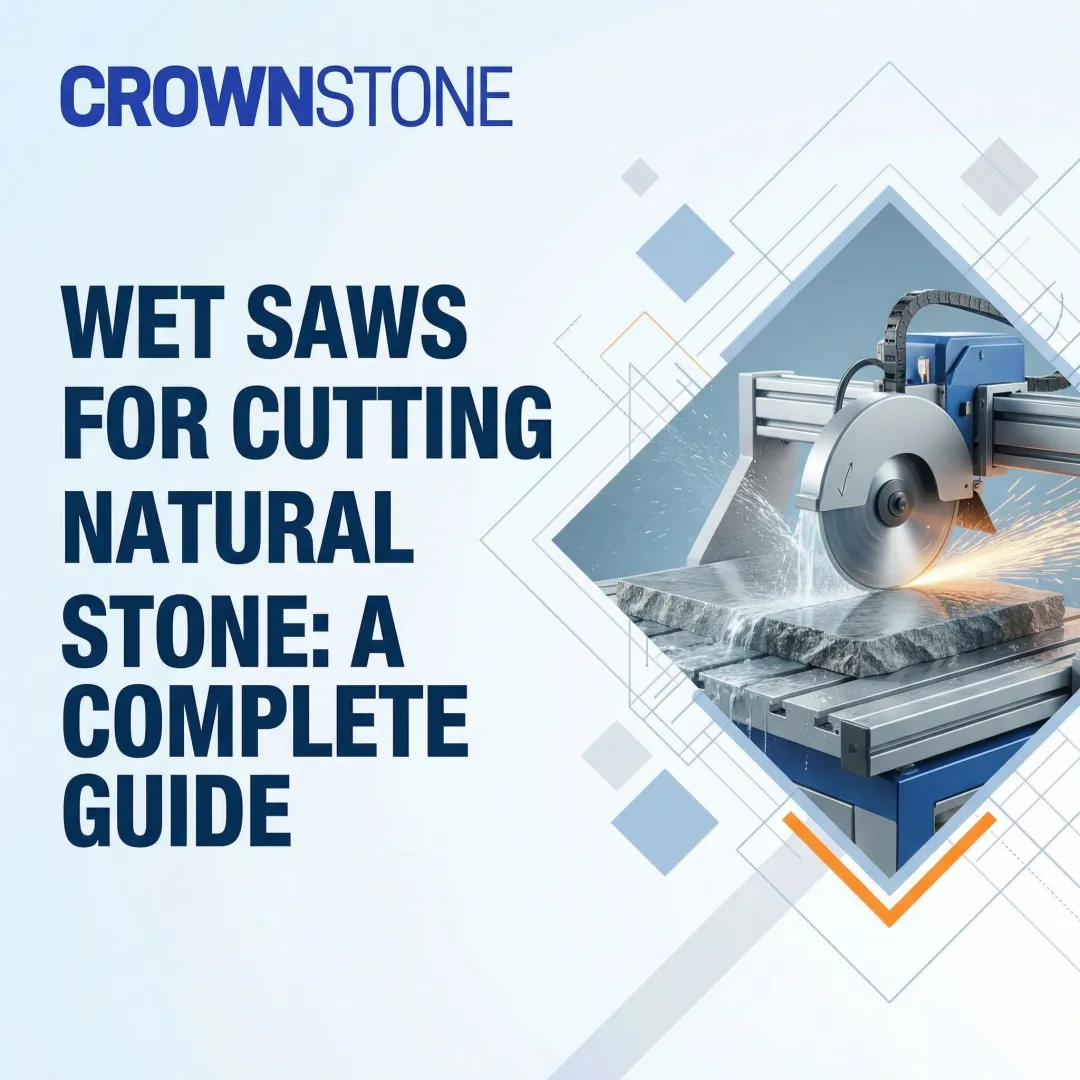
The bridge saw is the workhorse of stone fabrication shops. Bridge saws account for 40% of initial capital investment in startup fabrication shops — a reflection of how central straight-cut slab processing is to daily throughput.
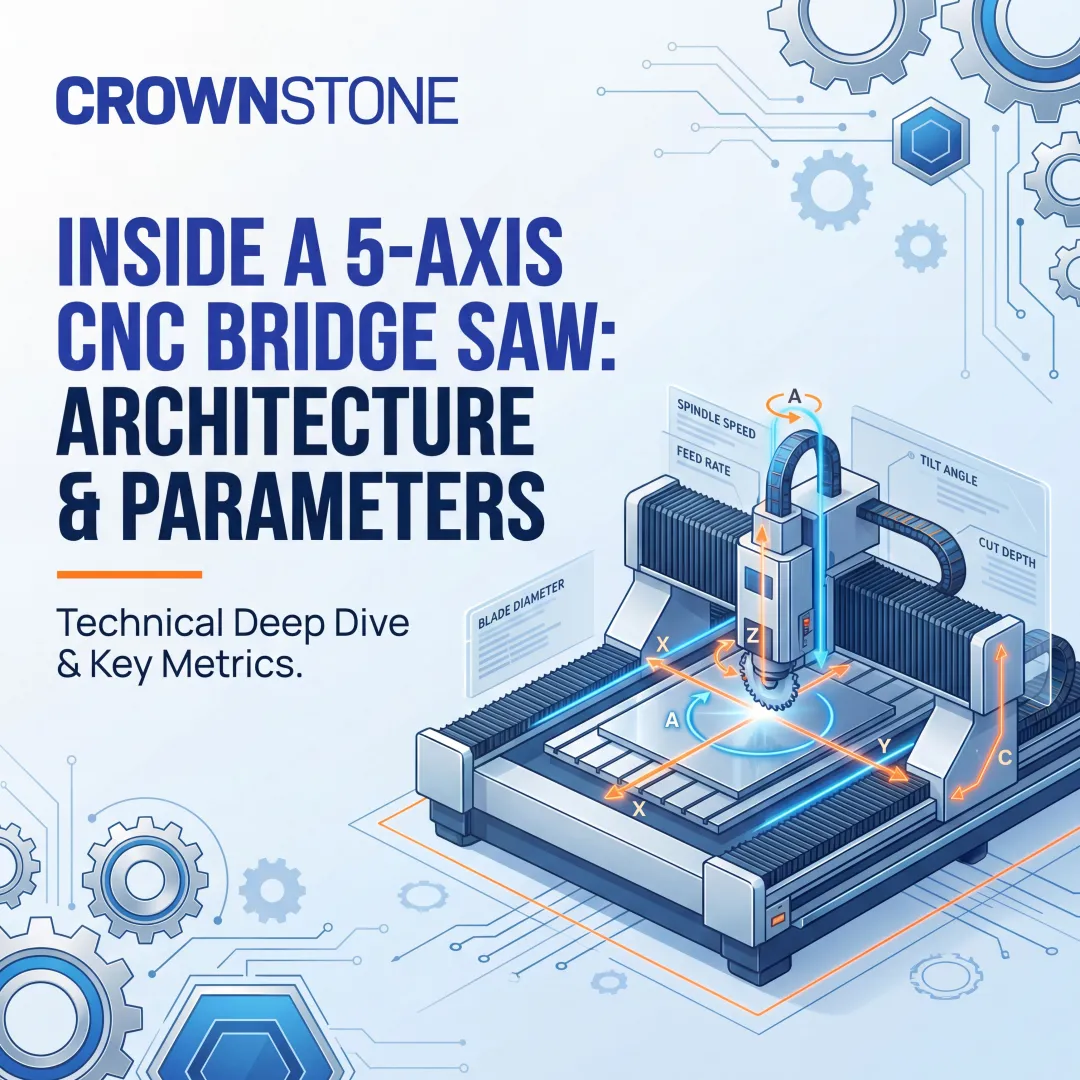
A bridge saw features a circular diamond blade mounted on a gantry that travels along a fixed bridge, producing straight, controlled, repeatable cuts. Modern 5-axis CNC bridge saws offer miter capabilities from 0-47° with bi-directional repeatability of ±0.001" (±0.025 mm).
Why bridge saws dominate fabrication shops:
- Handle granite, quartz, engineered stone, and marble at full slab thickness
- Allow for precise miter angles and repeated cuts
- Deliver consistent edge quality that minimizes hand polishing when properly maintained
- Accommodate full-size slabs (126" × 77" or larger)
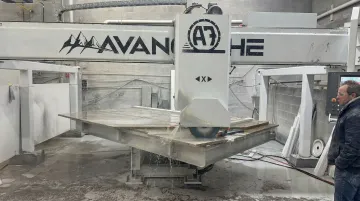
Crown Stone USA builds bridge saws with CNC-machined rolling surfaces, air-cylinder powered indexing to exact 90° and 45° angles, and hydraulic lifts capable of handling multiple slabs simultaneously — designed by fabricators who know what daily production actually demands.
Waterjet Cutting
Waterjet cutting uses a high-pressure stream of water mixed with abrasive particles to cut through stone without generating heat. Industrial waterjet systems operate at 60,000-90,000 PSI, achieving linear positional accuracy of ±0.025 mm with zero thermal distortion.
Best use cases:
- Intricate inlays and custom mosaic shapes
- Curved edges and tight internal radii
- Heat-sensitive stones where thermal cracking is a risk
- Premium applications requiring exceptional precision
The trade-off: Waterjets consume 1.0-1.5 lbs of garnet abrasive per minute, with operating costs ranging from $27.60/hr (60k PSI) to $34.60/hr (90k PSI). This makes waterjet better suited for custom or premium applications than for high-throughput straight cuts, where bridge saws deliver better economics.
CNC Machine Cutting
CNC (Computer Numerical Control) machines are digitally guided cutting and routing systems capable of executing complex edge profiles, sink cutouts, engravings, and curved cuts with repeatable precision across large production runs. High-end stone CNC machines demonstrate bi-directional repeatability of ±0.001" (±0.025 mm).
Practical advantages for fabrication shops:
- Near-zero operator variation across production runs
- Reduced need for hand finishing on complex profiles
- Compatibility with CAD/CAM templating workflows
- Automated tool changes and optimized cutting paths
CNC is particularly valuable for engineered stone and high-end natural stone projects where consistency across multiple pieces is essential. The workflow typically starts with digital templating hardware that captures field measurements as DXF files. Those files feed into nesting software to optimize layouts and generate the G-code the machine runs.
Matching Cutting Technique to Stone Type
Granite and Quartzite
Granite and quartzite rank Mohs 6-7 in hardness, with quartzite containing 90%+ quartz. These hard stones require specific tooling:
Use a soft-bond segmented or J-slot diamond blade. Hard stones are highly abrasive, so the soft metal bond wears away at a controlled rate, constantly exposing fresh, sharp diamonds. Using a hard bond on granite causes diamonds to dull without shedding, leading to blade glazing and a 50% loss in cutting speed.
Maintain steady water flow and stay within recommended feed rates of 5-17 ft/min for medium granite and 5-10 ft/min for hard granite. Equipment choice follows cut type:
- Bridge saws handle the bulk of straight cuts
- CNC routing works well for edge profiles
- Waterjet is effective where heat sensitivity or intricate shapes are required
Marble and Limestone
Marble and limestone are softer stones (Mohs 3-4) composed primarily of calcite. Their softer composition makes them vulnerable to edge blowout and micro-fracturing under aggressive feed rates.
Use a hard-bond continuous-rim blade. Because soft stones lack abrasiveness, a tough bond is needed to hold diamonds securely. Using a soft bond on marble causes premature diamond shedding and reduces blade life by up to 70%.
Run the bridge saw at a slower, controlled feed rate to reduce chipping. CNC works well for decorative profiles, but dial back RPM to prevent heat buildup and surface damage.
Engineered Stone and Quartz Surfaces
Manufactured quartz and ultra-compact surfaces (Dekton, Neolith) behave differently from natural stone. These materials are highly brittle and require specific blade formulations to avoid resin burn or delamination.
Key requirements for these materials:
- Use manufacturer-approved continuous-rim blade formulations
- Dekton requires feed rates of 0.7-0.9 m/min
- Neolith guidelines mandate reducing feed speed by 50% at entry/exit points to prevent shattering
- CNC and bridge saws are the standard; always cross-reference blade manufacturer specs with the specific material
Decision Framework for Fabricators
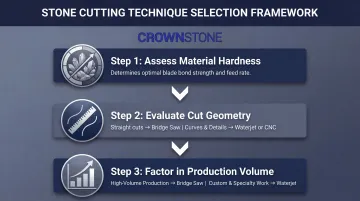
Once you know your material, run through this sequence to lock in the right approach:
- Start with material hardness — Determines blade bond type and feed rate range
- Consider cut geometry — Straight cuts favor bridge saws; curves and details require waterjet or CNC
- Factor in production volume — High-volume straight cuts go to bridge saws; custom work justifies waterjet operating costs
How to Cut Stone Slabs Without Cracking Them
Score a Shallow Pass First
Before committing to a full-depth cut, run the blade at 1-2 mm depth along the cut line. This creates a defined groove that prevents the blade from wandering and eliminates top-face chipping on brittle stones—this matters most on marble, limestone, and polished engineered stone surfaces.
Control Feed Rate
Pushing the blade too fast generates heat, increases lateral blade deflection, and induces micro-fractures along the cut path. Optimal feed rates vary by material:
- Medium Granite: 5-17 ft/min
- Hard Granite: 5-10 ft/min
- Miter cuts: Reduce feed rates by 20-30%
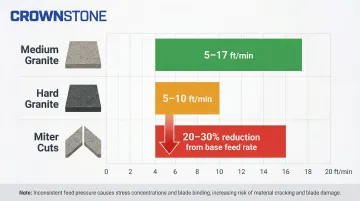
The feed rate should be consistent and material-appropriate. Inconsistent pressure creates stress concentrations that propagate into cracks.
Ensure Proper Slab Support
Unsupported overhangs flex under blade pressure, creating stress at the cut line that often results in cracking before the cut is complete. Use vacuum pods, support tables, and proper clamping that keeps the slab flat and stable—especially on slabs thinner than 2 cm.
The Natural Stone Institute limits unsupported countertop overhangs to 6 inches for 2 cm slabs and 10 inches for 3 cm slabs. Designs exceeding these limits require corbels or steel sub-frames to prevent cracking after installation.
Use Sharp, Properly Matched Blades
A glazed, dull, or mismatched blade is the leading equipment-related cause of cracking. Match segment type to stone hardness and dress the blade when needed rather than forcing more feed pressure. Watch for these warning signs of blade glazing:
- Noticeably slower cutting speed
- Burning smell during the pass
- Discoloration or heat marks on the stone surface
Wet vs. Dry Cutting for Stone Slabs
Wet Cutting: The Professional Standard
Wet cutting is the professional standard for shop fabrication. Water cools the diamond blade to prevent thermal damage to both the stone and the blade, flushes abrasive slurry from the cut, and suppresses respirable crystalline silica dust.
Regulatory context: OSHA's Permissible Exposure Limit (PEL) for crystalline silica is 50 µg/m³ (8-hour TWA). NIOSH data demonstrates that combining wet cutting with local exhaust ventilation reduces respirable dust and quartz exposures by over 90% compared to dry cutting.
Dry cutting is a controlled exception, not a routine choice.
When Dry Cutting Is Acceptable
Field trims and short cuts without water access are the narrow exceptions where dry cutting is permissible. When you do cut dry, these requirements are non-negotiable:
- Wear a P100 respirator (minimum APF 10 respiratory protection)
- Attach a dust shroud to the grinder with local exhaust ventilation
- Back out periodically to let the blade cool before continuing
- Expect a higher chip rate — plan for edge dressing after the cut
Blade Selection Matters
Wet-rated diamond blades rely on water for heat dissipation. Run one dry and it will overheat, lose its bond, and fail mid-cut — sometimes violently. Turbo or segmented dry-rated blades are engineered for airflow cooling instead.
Always verify blade rating before the cut. Swapping a wet blade into a dry-cut scenario is one of the most common causes of preventable blade failures in the shop.
Safety and Setup Essentials for Stone Fabricators
Core PPE and Workspace Requirements
Personal Protective Equipment:
- Eye and face protection: ANSI Z87.1-rated safety glasses plus face shield for grinder work
- Respiratory protection: P100 half-mask respirator (APF 10 minimum)
- Hearing protection: Earmuffs or earplugs rated at 28 dB NRR or higher; for extreme noise (100 dBA+), use dual protection (earmuffs over earplugs)
- Hand protection: Cut-resistant gloves with wet grip
- Foot protection: Steel-toe footwear
- Electrical safety: GFCI protection on all 125V, 15-20 amp receptacles near water
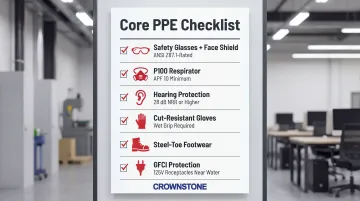
PPE covers the person — but a safe cut also depends on the machine being ready. Before the blade spins, run through these equipment checks.
Pre-Cut Equipment Checks
A 30-second check prevents blade failures that damage the slab, the machine, and the operator:
- Inspect the blade for missing segments, core cracks, or warping before every session
- Verify water flow reaches both sides of the blade rim
- Confirm fence or stop block is locked to the correct dimension
- Run a test spin to confirm the arbor is true and the blade runs without wobble
Frequently Asked Questions
How do you cut stone slabs?
Professional fabricators cut stone slabs using bridge saws for straight cuts, CNC machines for detailed profiles, and waterjet systems for intricate or heat-sensitive cuts. All methods rely on diamond tooling suited to the stone type, with water for cooling and dust control.
How do you cut stone slabs without cracking them?
Score a shallow 1-2 mm pass first to prevent edge chipping, maintain a consistent feed rate appropriate to the material's hardness, ensure the slab is fully supported without flexing overhangs, and use a sharp diamond blade with the correct bond type for your stone.
Is it better to cut stone slabs wet or dry?
Wet cutting is strongly preferred in professional fabrication because water controls blade temperature, extends blade life, and suppresses silica dust by over 90%. Dry cutting is only used when water access is unavailable and requires strict respiratory protection with P100 respirators and dust shrouds.
What is the best saw for cutting stone slabs in a fabrication shop?
A bridge saw is the industry standard for slab-level straight cuts, handling full-thickness granite, quartz, and marble with consistent edge quality and repeatable accuracy. It represents roughly 40% of a startup fabrication shop's capital investment and anchors day-to-day production.
What blade do you use to cut stone?
Diamond blades are universal for stone cutting. Use continuous-rim blades for soft, chip-prone stones like marble and segmented or J-slot blades for hard stones like granite and quartzite — and always pair blade bond hardness to the material (soft-bond for hard stones, hard-bond for soft stones).
Can you cut stone slabs with an angle grinder?
An angle grinder with a diamond blade handles on-site trims, curved cuts, and sink knockouts, but it is not suited for long straight slab cuts. Always use it wet or with a dust shroud; it complements a bridge saw rather than replacing it.