Introduction
The granite and stone countertop fabrication industry has experienced steady growth across the United States, fueled by consistent demand from residential remodels, new construction, and commercial projects. The U.S. countertops market reached $33.77 billion in 2025 and is projected to grow at a 5.7% CAGR to $52.48 billion by 2033, making this an attractive opportunity for entrepreneurs and experienced tradespeople alike.
The appeal cuts across several types of people entering the trade:
- Experienced fabricators ready to go independent and keep more margin
- Tradespeople from tile, flooring, or construction pivoting to stone work
- Entrepreneurs drawn to a service-dependent market with recurring local demand
- Investors looking to build a tangible, product-based business with long-term equity
This article serves as a practical, step-by-step guide covering everything a prospective granite fabrication business owner needs to understand before, during, and after launch—from equipment investment to pricing strategy to building sustainable client relationships.
TL;DR
- Granite fabrication cuts, polishes, and installs stone surfaces for residential and commercial clients
- Startup costs typically range from $650,000 to nearly $1 million for a fully equipped shop
- Market knowledge, repeatable processes, and correct pricing from day one determine whether the business succeeds or stalls
- Referrals and repeat builder relationships reward shops that consistently deliver quality and reliability
- Plan for 3–6 months of setup before reaching steady revenue
What Is a Granite Fabrication Business?
A granite fabrication shop cuts raw stone slabs—granite, marble, quartz, and other materials—into finished surfaces, primarily kitchen and bathroom countertops, and installs them on-site for clients. The core value delivered is precision fabrication and professional installation of custom stone surfaces that require specialized machinery, skilled labor, and process consistency.
Common business formats include:
- Residential-focused shops serving homeowners and kitchen remodelers directly
- Builder-focused operations supplying contractors at higher volume with tighter timelines
- Mixed models that balance both residential and commercial work
- Owner-operator setups where the owner works production, versus managed shops with dedicated crews
The format you choose directly affects your sales cycle, profit margins, and operational demands. A residential shop, for example, runs longer sales cycles but commands higher per-job margins — a builder-focused operation trades some margin for volume and predictable workflow.
What to Know Before You Start a Granite Fabrication Business
Many people entering this business underestimate several critical factors: the equipment investment required, the physical demands of the work, and how long it takes to build a stable client base. Going in with a realistic picture of all three will save you from costly early mistakes.
Key Realities to Understand
- Skilled labor is non-negotiable. Quality depends on trained operators, and early-stage owners typically cover multiple roles — fabricator, installer, estimator, and sales rep — all at once.
- Steady income takes 3–6 months to develop. The first months are consumed by setup, relationship-building, and early jobs that may not be highly profitable.
- Downtime is a direct revenue hit. Unplanned equipment failures cost an average of $1,500 per hour in shop inefficiencies, overtime, and missed installs — making machine reliability a day-one operational priority.
- Building a durable operation is different from chasing fast income. The former means investing in the right equipment, processes, and client relationships early, even if early returns are slow.
Why Start a Granite Fabrication Business?
Starting a granite fabrication business makes strategic sense when the fundamentals align. The market rewards shops that execute on quality, speed, and communication — and most local markets still have room for one that does.
Key Reasons the Model Works
- Consistent demand: Kitchen and bath remodels hold up even in slower markets, with the industry projected to generate $235 billion in revenue in 2025. Consumer preferences have shifted toward durable, non-porous stone surfaces — and that trend isn't reversing.
- Room to differentiate: In most local markets, quality, turnaround time, and communication are weak points. A shop that delivers on these basics earns referrals and builder loyalty faster than one competing on price alone.
- Strong margins: The stone and manufactured product industry averages a gross margin of 43.67%. Highly optimized shops focused on premium installations can push contribution margins as high as 81%.
- Sellable asset: A well-run shop with reliable equipment, trained staff, and a solid client base becomes a durable business — not just a job.
How to Start a Granite Fabrication Business – Step by Step
This section breaks the process into practical execution stages. Each step builds on the last, and skipping or rushing any of them is a common cause of early-stage failure.
Most common mistakes:
- Underestimating startup costs
- Pricing too low to win early jobs
- Skipping legal and compliance setup
- Scaling production before the process is stable
Step 1 – Define Your Business Model and Target Market
Decide what work the business will focus on:
- Residential countertops
- Commercial projects
- Builder volume
- A mix of the above
Each has different margin profiles, sales cycles, and operational demands.
Identify your target customer:
- Homeowners
- Kitchen designers
- Cabinet makers
- General contractors
Research what that customer values most—lead time, pricing, quality, or design support—so the business is built around those priorities.
Clarify service area and production capacity early:
- A 50-mile radius is common for installation logistics
- Production capacity (measured in jobs per week) should match what your initial equipment and team can actually deliver
Step 2 – Research Your Local Market and Competition
Analyze existing fabrication shops in your area:
- What materials do they work with?
- How are they priced?
- Where do reviews indicate service gaps?
Find the underserved angle.
Assess local demand signals:
- New housing developments
- Active remodel contractors
- Kitchen showrooms
- Cabinet shops
These are indicators of where steady referral business can come from.
Use this research to validate demand and identify 2–3 anchor customer types to pursue first. Avoid trying to serve everyone before the operation is stable.
Step 3 – Plan Your Startup Costs and Secure Financing
Be specific about cost categories and realistic figures.
Major Cost Categories:
| Category | Estimated Range | Notes |
|---|---|---|
| Bridge Saw | $66,500 – $137,500 | Primary machine for straight cuts and slab sizing |
| Edge Polisher | $12,500 – $59,500 | Automates edge profiling for consistency |
| Waterjet System | $34,500 – $89,500 | Precision cutting for intricate shapes and sink cutouts |
| Material Handling | $1,075 – $2,348 | Slab racks and vacuum lifters to prevent breakage |
| Shop Lease | $7–$12 per sq. ft. annually | For 3,000–6,000 sq. ft. industrial space (varies by region) |
| Raw Material Inventory | $10,000 – $30,000 | Initial slab stock |
| Working Capital | $20,000 – $50,000 | First 3–6 months of operating expenses |
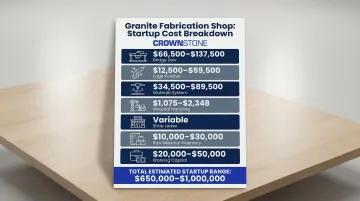
Total startup costs for a granite fabrication operation typically fall in the range of $650,000 to nearly $1 million when fully equipped. A leaner entry is possible with used or phased equipment purchases, but this affects capacity and production speed.
Realistic Financing Paths:
- SBA Loans: The average SBA 7(a) loan size was $443,097 in FY 2024. The SBA 504 program provides up to $5.5 million for machinery and real estate.
- Equipment Financing: Many lenders specialize in heavy equipment loans
- Partnerships: Bringing in a partner with capital or complementary skills
Lenders will want a business plan, projected cash flow, and evidence of market demand before approving capital for machinery.
Step 4 – Handle Legal, Licensing, and Compliance Setup
Register the business:
- Choose a business structure (LLC is common for liability protection)
- Register with state and local agencies
- Consult a business attorney or accountant to ensure correct setup
Obtain required permits:
- Zoning for industrial fabrication
- Water discharge permits
- Dust control compliance
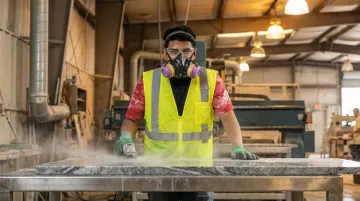
OSHA Silica Dust Compliance:Respirable Crystalline Silica (RCS) exposure is the most critical regulatory risk. OSHA enforces a Permissible Exposure Limit (PEL) of 50 µg/m³. Employers must establish a written exposure control plan, implement medical surveillance, and use engineering controls like integrated water delivery systems and HEPA vacuums.
OSHA is aggressively targeting the industry. In 2024, a Chicago countertop maker was fined over $1 million for willful violations after workers developed incurable silicosis.
Set up business insurance:
- General liability
- Commercial property
- Workers' compensation
Skipping insurance is a common early-stage mistake that creates serious risk exposure.
Step 5 – Invest in the Right Equipment and Set Up Your Shop
The core equipment for a granite fabrication shop includes:
- Bridge saw — for slab cutting
- Edge polisher — for edge profiling and finishing
- Sink cutout station — for precision cutouts
- Material handling equipment — slab racks, vacuum lifters, transport carts
Evaluate not just purchase price but also parts availability, service support, and warranty coverage. American-made machinery with US-sourced parts reduces downtime risk, which matters most when a shop is still building its client base.
Crown Stone USA's bridge saws, for example, carry a 2-year warranty with parts sourced primarily from the US — a practical advantage when a machine goes down mid-job and you can't wait weeks for an overseas shipment.
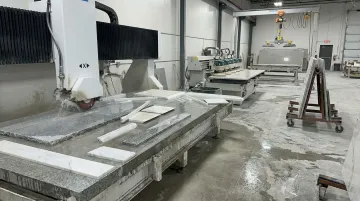
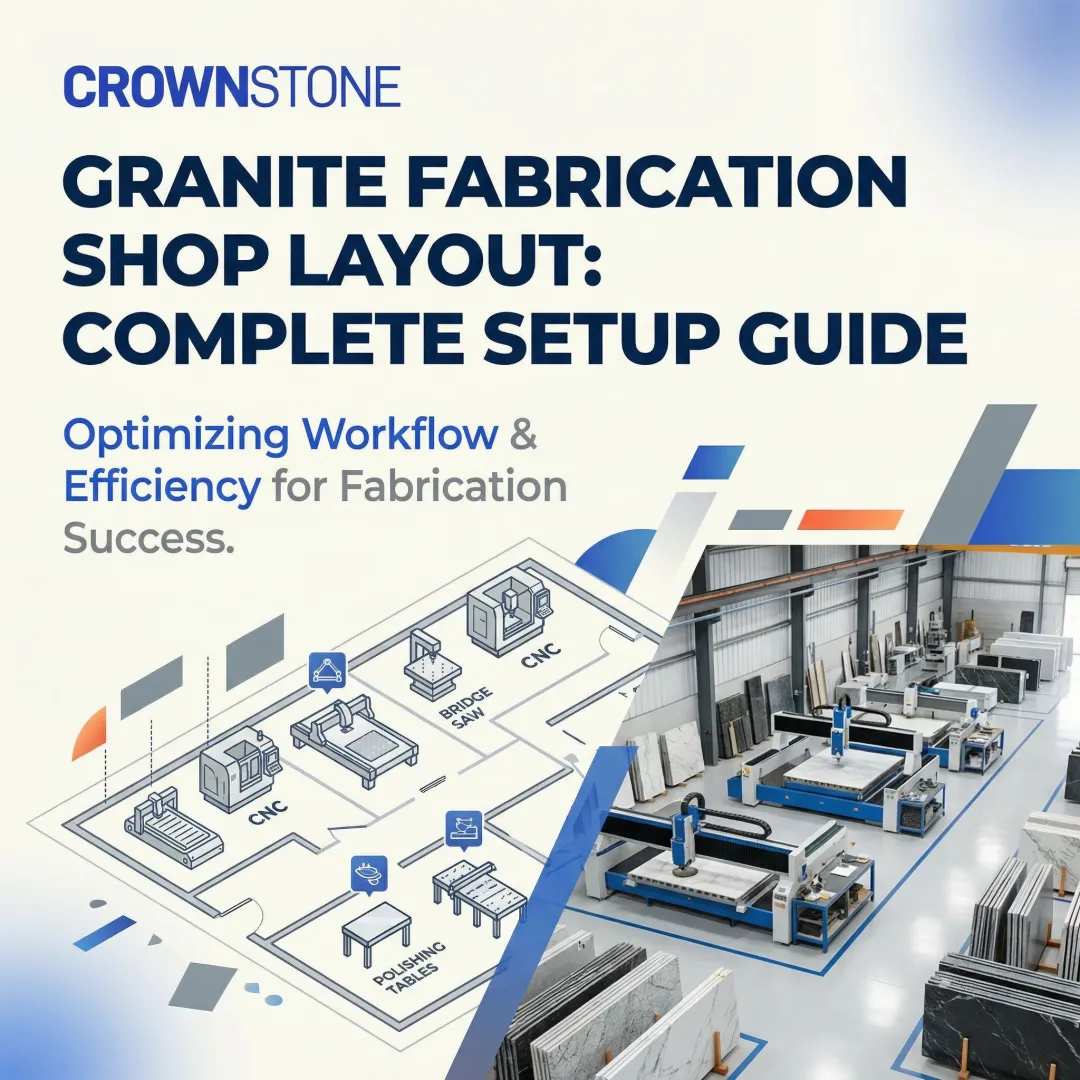
Plan Your Shop Layout:Support efficient workflow from slab storage and receiving through cutting, edge profiling, finishing, and staging for delivery. A poorly planned layout creates bottlenecks that are difficult and expensive to fix after setup.
Step 6 – Build Supplier Relationships and Establish Your Process
Identify stone slab distributors in your region:Pricing, material quality, and lead times from suppliers directly affect job margins and customer satisfaction. Establish accounts early.
Define your fabrication workflow:
- Templating
- CAD/layout
- Cutting
- Edge work
- Finishing
- Delivery and installation
Document each stage so it can be trained and repeated consistently.
Decide what you will and won't handle in-house:Some shops outsource waterjet cutting or specialty work initially. Clarity on scope prevents overcommitting before the operation is ready.
Step 7 – Develop Your Pricing Strategy and Go to Market
Build pricing from the bottom up:Calculate material cost, labor time per square foot, overhead allocation, and desired margin. Avoid setting prices by guessing at what competitors charge without understanding your own cost structure.
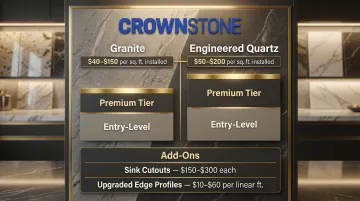
Consumer Pricing Context:
- Granite: $40–$150 per sq. ft. installed
- Engineered Quartz: $50–$200 per sq. ft. installed
- Add-ons: Sink cutouts ($150–$300 each), upgraded edge profiles ($10–$60 per linear foot)
Establish Initial Marketing Channels:
- Google Business Profile
- Simple website with project photos
- Direct outreach to kitchen designers, cabinet shops, and general contractors
In 2024, 88% of homeowners researched online before making renovation decisions. Your online presence matters.
Leverage Reviews:81% of consumers use Google to read online reviews for local businesses, and 88% would use a business that replies to all reviews. Review engagement is critical.
Set up basic job tracking:Know where leads come from, what jobs convert, and which customers refer others. This is essential data for making marketing decisions as the business grows.
Step 8 – Monitor Performance, Fix Gaps, and Stabilize Before Scaling
Track key metrics:
- Jobs completed per week
- Material yield (waste per slab)
- Customer callbacks or remakes
- Monthly gross margin
These tell you whether the business is functioning or just busy.
Prioritize fixing inefficiencies before adding capacity:Common early problems include templating errors, inconsistent edge work, and scheduling bottlenecks that cause delays. Solving these improves margin and reputation simultaneously.
The goal in the first 12–18 months is stability:Consistent quality, predictable cash flow, and a growing referral network. Scale only when the process is repeatable and the team can handle additional volume without service degradation.
Conclusion
Starting a granite fabrication business is achievable, but it rewards those who plan carefully, invest in reliable equipment, and build repeatable processes before chasing volume. The fundamentals—understanding your market, pricing correctly, staying compliant, and delivering consistent quality—matter more in this industry than speed to launch.
Treat the first year as a foundation-building period. The businesses that last stabilize operations, earn referrals, and refine their model before expanding. Keep these priorities front of mind as you build:
- Master your market first — know who you're serving and what they'll pay before scaling
- Price for sustainability, not just to win jobs
- Invest in equipment that holds up under daily commercial use, not just spec sheets
- Build referral relationships with contractors and designers early
- Document your processes so quality stays consistent as your team grows
Stone fabrication rewards operators who show up with precision and reliability every day. The shops that thrive long-term aren't necessarily the fastest to launch — they're the ones customers trust to get it right, every time.
Frequently Asked Questions
How much does it cost to start a fabrication shop?
Startup costs typically range from $650,000 to nearly $1 million for a fully equipped shop, covering equipment, shop space, materials, and insurance. Phased equipment investment can reduce upfront costs, though initial capacity and throughput will be limited until the shop is fully equipped.
How to become a stone fabricator?
The typical path involves working in an existing fabrication shop to learn cutting, templating, and installation, then building business and operational knowledge before going independent. Pricing, scheduling, supplier relationships, and crew management all need to be in place before the tools do.
Is granite business profitable?
Yes, granite fabrication can be profitable with strong margins on custom work. Profitability depends on pricing discipline, equipment uptime, and efficient production. Builder volume provides consistency while residential work often offers higher per-job margins.
What equipment do I need to start a granite fabrication business?
Core equipment includes a bridge saw, edge polisher, sink cutout tools, and material handling equipment like slab racks and vacuum lifters. Equipment quality and parts availability directly affect long-term uptime and shop profitability.
How long does it take to break even in a granite fabrication business?
Break-even timelines vary based on startup investment and revenue ramp, but 6–24 months is a realistic range. Shops that enter with strong builder relationships typically ramp volume faster and reach break-even closer to the 6-month end of that range.
Do I need a license to start a granite fabrication business?
At minimum, most shops need business registration, zoning compliance, and documented OSHA silica dust safety protocols — the last of which is federally enforced regardless of state. Additional license requirements vary by state and municipality, so verify with your local permitting office before opening.