Introduction
With countertop and custom stonework demand pushing past $32 billion in the U.S. alone, fabrication shops face a critical choice: the CNC machine on your shop floor directly determines throughput, quality, and daily uptime. When a single day of unplanned downtime costs between $2,000 and $5,000 in lost production, selecting the right bridge saw carries real financial weight — cutting specs are only part of the equation.
Build quality, parts availability, axis capabilities, and after-sales support separate shops that scale from those that stall on preventable delays. This guide ranks the top 10 CNC stone machine manufacturers worldwide in 2025, evaluated on reliability, real-world fabricator experience, and long-term value — so you can compare options before committing to a six-figure purchase.
TL;DR
- CNC stone machines automate precision cutting of granite, marble, quartz, and engineered stone for commercial fabrication
- Top manufacturers span Italy, the USA, and France, differing in cutting speed, axis range, and domestic parts availability
- Crown Stone USA is American-made, designed by working fabricators, and backed by a 2-year warranty with US-stocked parts
- Key buying factors: axis count, parts lead times, after-sales support, precision tolerances, and total ownership cost
- Use this guide to compare top brands before committing to a major equipment purchase
What Is a CNC Stone Machine and Why Does It Matter in 2025?
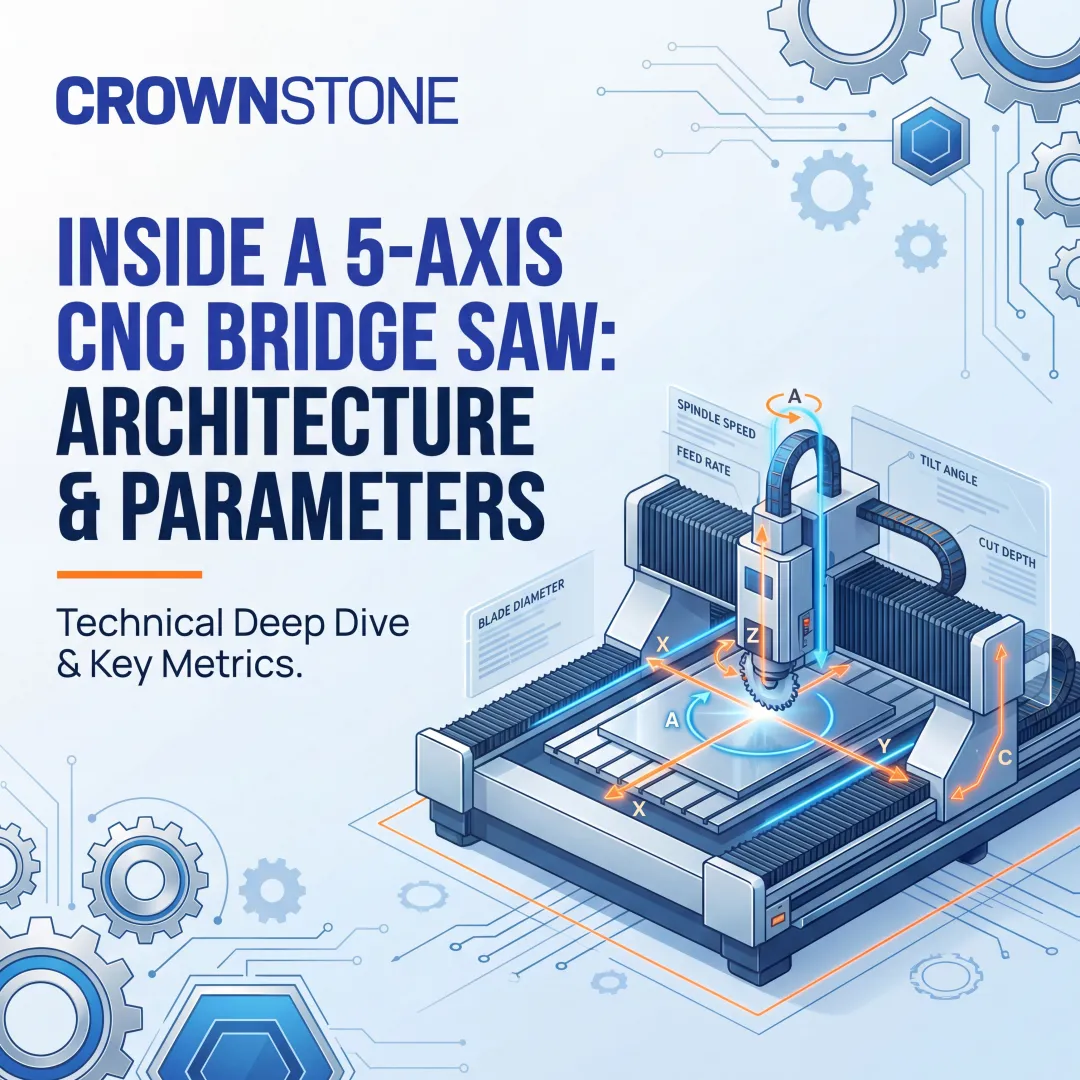
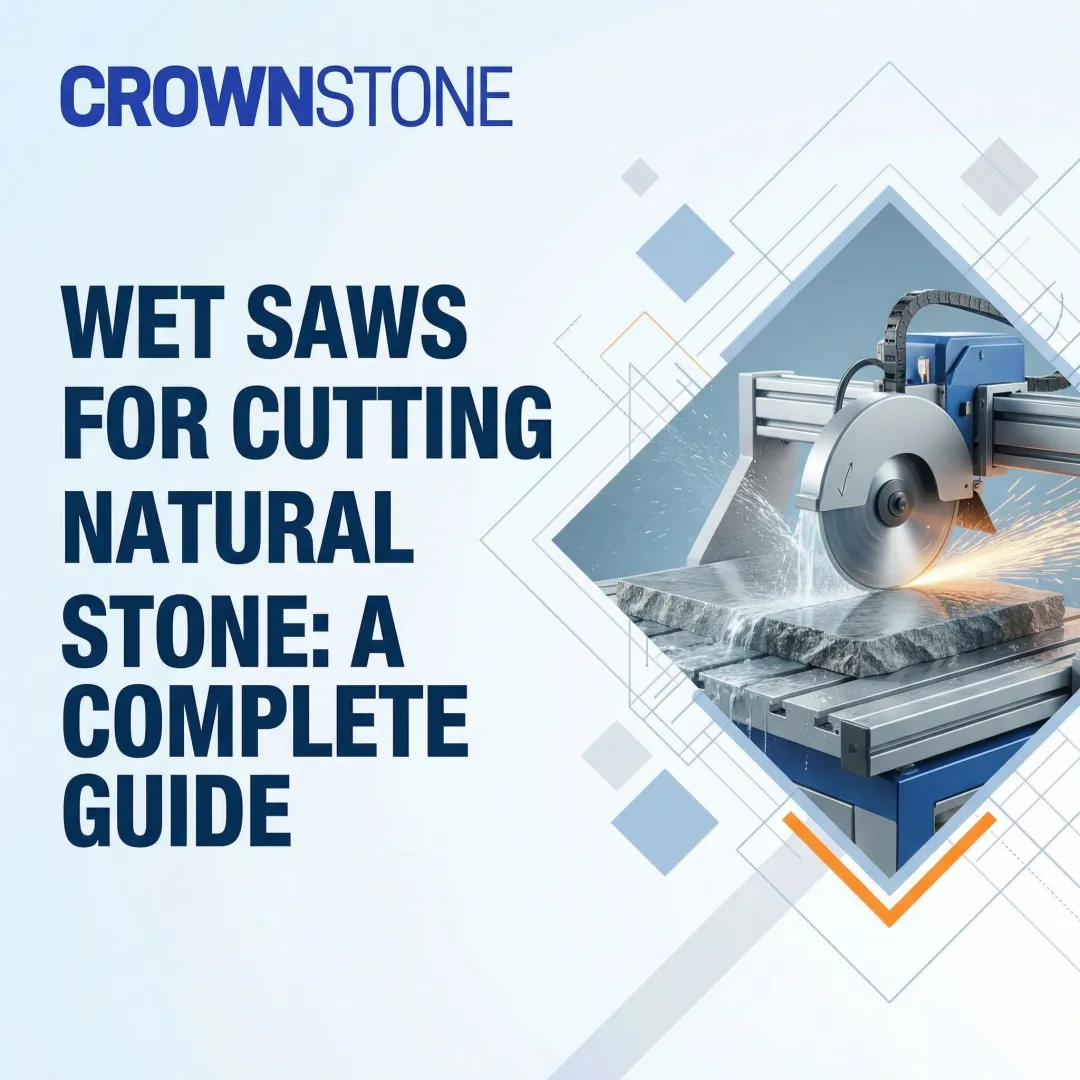
A CNC stone machine is computer-controlled equipment that cuts, profiles, drills, and shapes stone slabs with programmed precision. The three main types are CNC bridge saws (4-axis and 5-axis), CNC routers/engravers, and CNC machining centers.
The global stone processing machinery market reached $8.4 billion in 2025 and is projected to hit $14.2 billion by 2034, expanding at a 6.0% CAGR — driven by urbanization, construction growth, and rising demand for precision fabrication.
The technology shift is just as striking. By 2023, CNC system installations jumped 41%, with 5-axis machines accounting for 27% of new installations.
In the U.S. specifically, the countertop market is valued at $28.65 billion in 2024 and projected to reach $32.44 billion by 2030, fueled by kitchen and bathroom remodeling and growing demand for sintered stone and high-performance porcelain.
Top 10 CNC Stone Machine Manufacturers Worldwide 2025
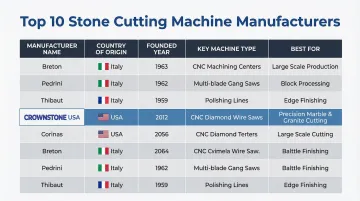
Manufacturers on this list were evaluated on technological capability, axis range, global market presence, after-sales support quality, parts accessibility, and proven use in stone fabrication environments—not marketing reputation.
Breton S.p.A.
Italian manufacturer with decades of history in stone processing machinery; offers a full line of CNC bridge saws, machining centers, and automated systems for large-scale production.
Founded in 1963 by Marcello Toncelli, Breton pioneered engineered stone plants and continues to dominate high-volume production environments. The GENYA series is a 5-axis monobloc CNC machining center with 21.6 kW spindle power, 12-position automatic tool magazine, and LabelPro automatic labeling integrated directly on the spindle. The system uses spindle vacuum cups for handling cut pieces, minimizing material waste without manual intervention.
| Specification | Details |
|---|---|
| Origin & Founded | Italy, 1963 |
| Key Machine Types | CNC bridge saws, automated machining centers, gang saws (BM for Breton) |
| Best For | Large-scale production facilities needing fully automated workflows |
Park Industries
US-based manufacturer known for user-friendly bridge saw designs and strong domestic after-sales service; offers a range of bridge saws and waterjet combination systems suited for mid-to-large fabrication shops.
Founded in 1953, Park Industries has sold over 18,000 machines in North America and dedicates 22% of its workforce—over 60 associates—to customer support. The company offers 24/7 phone support and a "Next Day or No Pay" parts guarantee. The SABERjet XP combines a 27 hp arbor motor with 5-axis waterjet cutting, featuring monoblock design, 0-47° blade mitering, and 0-58° waterjet mitering with max cut depths of 3.5" (blade) and 4.75" (waterjet).
| Specification | Details |
|---|---|
| Origin & Founded | USA, 1953 |
| Key Machine Types | CNC bridge saws (SIERRA, YUKON II, VOYAGER XP), CNC routers (TITAN, SPARTAN), CNC sawjets |
| Best For | US fabrication shops prioritizing domestic support and ease of operation |
Crown Stone USA
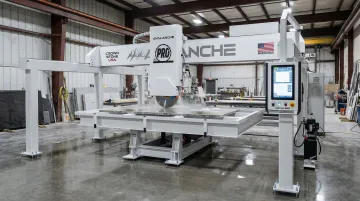
American manufacturer born from hands-on stone fabrication experience; founders drew on decades of repairing, operating, and maintaining bridge saws to design a machine built by fabricators, for fabricators—headquartered in Clearwater, FL.
The only manufacturer on this list to build machines in the USA with less than 2% of components by value from China. Parts sourced from the US, Korea, Japan, and Taiwan ensure rapid availability. The bridge saw table underwent 10 design iterations, building and testing 2 tables with the first-generation design before refining each subsequent version.
The Avalanche Pro features a 20 HP blade motor, automatic and manual operation modes, hydraulic lift up to 70 degrees, and intuitive touchscreen controls that minimize operator training time. Backed by a 2-year warranty and US-based parts support.
| Specification | Details |
|---|---|
| Origin & Founded | USA (Clearwater, FL); decades of combined fabricator experience |
| Key Machine Types | American-made CNC bridge saws with precision-engineered cutting tables |
| Best For | Granite, marble, and quartz fabrication shops needing reliable daily production with minimal downtime and US-based parts support |
BACA Systems
US-based manufacturer specializing in high-precision robotic and bridge saw systems; known for the Robo SawJet, which combines a robotic arm with waterjet cutting for automated, high-speed fabrication.
Founded in 2014 and headquartered in Orion Township, Michigan, BACA offers robotic flexibility with precise cutting accuracy via advanced sensors and software. The Robo SawJet 2.0 integrates a KUKA Quantec KR 210 3100 Ultra F foundry-grade robotic arm with a 26 HP Saccardo Motor and H2O Jet SMP-50 waterjet pump (50 HP / 60,000 PSI).
The system increases material yield by 10-20% by eliminating blade overtravel, reduces labor by 3-4 hours per slab, and produces a fully cut slab approximately every 20 minutes. Premium-priced and best suited for high-volume, high-value operations.
| Specification | Details |
|---|---|
| Origin & Founded | USA, 2014 |
| Key Machine Types | Robotic SawJet, CNC bridge saws, automated stone processing cells |
| Best For | High-volume shops investing in automation and robotic fabrication |
Intermac (Biesse Group)
Italian manufacturer and part of the Biesse Group; offers advanced CNC bridge saws and machining centers with strong automation features including automatic tool changing and slab positioning systems.
Established in Pesaro, Italy, in 1987 as the glass and stone processing division of the Biesse Group. The Master 45.5 Plus is a 5-axis CNC machining center with rapid axis speeds (X: 60 m/min, Y: 70 m/min), 15 kW spindle power, and up to 61-position tool magazine. The Matrix Telescopic System (MTS) configures the work table with up to 40 telescopic suction cups automatically managed by the machine's PLC, increasing productivity by up to 60% compared to manual loading.
| Specification | Details |
|---|---|
| Origin & Founded | Italy, 1987 |
| Key Machine Types | CNC bridge saws, 5-axis machining centers, glass and stone processing systems |
| Best For | Shops needing Italian-engineered automation with broad material compatibility |
CMS Brembana (CMS Group)
Italian manufacturer offering a wide portfolio of stone and glass processing CNC machines; known for energy-efficient, high-speed production systems used in large industrial environments.
CMS was established in 1969 by Pietro Aceti. In 1985, under the Brembana brand, CMS constructed the world's first stone-working machining center. The Brembana Formax is a 5-axis open-frame bridge saw with X-axis stroke of 3800mm, Z-axis stroke of 700mm, and motor options of 18.5 kW or 25.5 kW. The E-Pump (electrohydrostatic intensifier for waterjets) achieves operating efficiency above 31% compared to traditional hydraulic intensifiers and reduces components by up to 95%.
| Specification | Details |
|---|---|
| Origin & Founded | Italy, 1969 |
| Key Machine Types | CNC bridge saws, 5-axis machining centers, stone and glass systems |
| Best For | Industrial-scale facilities processing both stone and glass materials |
Pedrini S.p.A.
Established in 1962, Pedrini specializes in high-end stone processing machinery; offers customized CNC bridge saws and gang saws designed for premium stone projects with minimal material waste.
Headquartered in Carobbio degli Angeli (Bergamo), Italy, Pedrini pairs precision engineering with advanced CNC control. The Arco di Trionfo M596 block cutting center runs up to 80 vertical discs with two independent trolleys that alternate positions for vertical and horizontal cutting, enabling 24-hour work cycles. The GS131 gang saw offers an 80-blade or 100-blade configuration with a "pendulum" system for frictionless movement.
All machines are built with normalized heavy carpentry components verified through Finite Element Method (FEM) structural analysis.
| Specification | Details |
|---|---|
| Origin & Founded | Italy, 1962 |
| Key Machine Types | CNC bridge saws, block cutting machines, gang saws |
| Best For | High-end fabricators needing customized cutting solutions for premium stone |
Donatoni Macchine
Italian manufacturer recognized for producing cost-effective yet durable CNC bridge saws; offers a range of models with varying cutting capacities designed for ease of maintenance and smaller production environments.
Officina Donatoni was founded in 1959 as a maintenance workshop; Donatoni Macchine Srl was officially established in 2008, headquartered in Sant'Ambrogio di Valpolicella (Verona), Italy. The JET 625 is a compact 5-axis CNC bridge milling machine on a monobloc structure with X-axis stroke of 3800mm, Y-axis stroke of 2780mm, and 11 kW spindle power. The D-Portal platform provides video tutorials for routine maintenance and genuine spare parts kits, allowing shops to handle upkeep independently.
| Specification | Details |
|---|---|
| Origin & Founded | Italy, 1959 |
| Key Machine Types | CNC bridge saws, multi-axis stone cutting machines |
| Best For | Small to mid-size fabrication shops seeking reliable performance within budget |
GMM Group
Global stone machinery manufacturer with presence across multiple international markets; produces heavy-duty CNC bridge saws and machining centers capable of handling a wide variety of stone types and cutting complexities.
Founded in 1993 in Gravellona Toce, Italy, GMM manufactures block cutters, edge polishers, waterjets, and 3-to-5 axis bridge saws. The Litox 1000 CN2 is a heavy-duty 5-axis CNC bridge shaping machine with solid cast iron construction, blade capacity up to 1100mm (43.3 in), and 32 kW motor power. It includes software integration for parametric drawings, Cuts From CAD, and contouring. GMM supports international customers via a global tele-service network and branches in the USA, China, Germany, and Australia.
| Specification | Details |
|---|---|
| Origin & Founded | Italy, 1993 |
| Key Machine Types | 5-axis CNC bridge saws, heavy-duty stone machining centers |
| Best For | Industrial fabricators cutting thick or heavy stone materials at scale |
Thibaut
French manufacturer offering CNC bridge saws and profiling machines with an emphasis on intuitive touchscreen interfaces and accessibility for smaller operations; a strong option for entry-level to mid-range CNC stone processing.
Founded in 1959 and headquartered in Vire-Normandie, France, Groupe Thibaut manufactures 5-axis CNC bridge saws, machining centers, and edge polishers. The TC625 is a 5-axis CNC bridge saw available in Monobloc, Ergonomic (M), or Productive (TOPS) versions, with 13.2 kW spindle power, blade diameters from 300mm to 650mm, and X-axis travel of 3970mm. The Pilot interface keeps controls simple and ergonomic—a practical advantage for operators in smaller fabrication shops transitioning from manual cutting.
| Specification | Details |
|---|---|
| Origin & Founded | France, 1959 |
| Key Machine Types | CNC bridge saws, stone profiling machines, edge processing systems |
| Best For | Smaller fabrication shops or those transitioning from manual to CNC stone cutting |
How We Chose These Manufacturers
We assessed manufacturers on axis capability (4-axis vs. 5-axis), cutting precision tolerances, parts and service availability (domestic vs. international), warranty terms, and fabricator-reported reliability—not advertising spend or brand size.
The most common mistake fabricators make is prioritizing sticker price over total cost of ownership. Factor in downtime costs ($2,000 to $5,000 per day), parts lead times, and service responsiveness, and the equation shifts fast.
Ocean freight for international components typically takes 3 to 5 weeks—translating to 2 to 3 months of turnaround time when sourcing overseas.
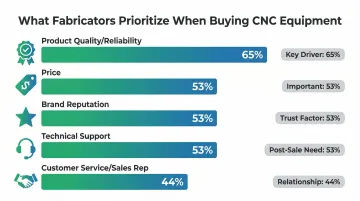
According to a 2019 Stone World Purchasing Plan Survey, fabricators prioritize:
- Product quality/reliability — 65% rated "extremely important"
- Price, brand reputation, and technical support — each at 53%
- Customer service/sales rep — 44%
That's why sourcing geography was a core part of our evaluation. Machines with globally available parts keep repair windows short; those tied to a single-country supply chain can strand a shop for weeks when disruptions hit.
Conclusion
Cutting specs only tell part of the story. The manufacturer you choose needs to still be supporting your shop five years after the purchase—with parts available and someone who picks up the phone. Before finalizing any equipment decision, evaluate:
- Service infrastructure and response times
- Parts lead times and global availability
- Warranty coverage and terms
- Operator learning curves and training resources
For fabricators who want a machine designed by people who've actually cut, lifted, and installed stone—Crown Stone USA builds American-made CNC bridge saws with a 2-year warranty, globally available parts, and a team that picks up the phone. Contact Crown Stone USA at info@crownstoneusa.com or 727-239-9875.
Frequently Asked Questions
What is the most used CNC machine in stone fabrication?
The CNC bridge saw is the most widely used machine type in stone fabrication shops. Market data shows that 5-axis stone CNC routers/saws hold 45% market share, with 4-axis machines at 40%, valued for precision straight cuts, angled cuts, and sink cutouts on granite, marble, and quartz slabs.
What is a CNC stone machine used for?
CNC stone machines are used for cutting slabs to size, profiling edges, drilling sink holes, engraving, and shaping decorative elements in granite, marble, quartz, and engineered stone. They replace manual operations with programmed precision, increasing consistency and throughput.
What is the difference between a 4-axis and 5-axis CNC bridge saw?
A 4-axis bridge saw moves on X, Y, and Z axes plus one rotation axis locked to fixed positions (typically 0°, 45°, 90°). A 5-axis model adds a second rotation axis on the head, enabling free-angle bevel cuts, undercutting, and complex curved profiles — at a higher price point.
How much does a CNC stone machine cost?
Entry-level 4-axis bridge saws range from $10,000 to $40,000, while 5-axis models run $40,000 to $80,000, with robotic and automated systems priced above that. Factor in parts availability, service costs, and downtime risk — not just the sticker price.
How do I choose the right CNC stone machine manufacturer?
Evaluate parts availability in your region, warranty length, axis capabilities needed for your project types, control system ease of use, and the manufacturer's track record with shops of similar size. Prioritize real-world reliability and after-sales support over brand name.
Are American-made CNC stone machines better than imported ones?
American-made machines mean faster parts sourcing and domestic service — ocean freight on international components typically adds 3–5 weeks, stretching repair turnarounds to 2–3 months. For US fabrication shops, that downtime cost often outweighs any upfront savings on an imported machine.