Introduction
Cut granite dry and you'll face two immediate problems: silica dust that violates OSHA exposure limits and chipped edges that ruin a high-dollar slab. A wet saw solves both. It's the professional standard for stone fabrication because it manages extreme friction, suppresses hazardous silica dust, and produces clean edges that meet the tight tolerances required for countertop seams and high-visibility installations.
For commercial fabricators, choosing the right wet saw — and using it correctly — directly affects cut quality, crew safety, and daily throughput.
This guide covers how wet saws work, the types available for professional shop use, what features matter most, blade selection, and operating best practices.
TLDR
- Wet saws use water-cooled diamond blades to cut natural stone precisely while keeping silica dust exposure to a minimum
- Bridge saws are the workhorse of professional stone fabrication shops; tile and handheld saws suit smaller or on-site jobs
- The right diamond blade depends on the stone type—granite, marble, and quartzite each have distinct hardness and abrasiveness profiles
- Consistent water flow, correct feed rate, and regular blade inspection protect both your equipment and your health
What Is a Wet Saw and Why Does Natural Stone Demand One?
How Wet Saws Work
A wet saw uses a diamond-segmented blade rotating at high speed while a continuous stream of water cools the blade, lubricates the cut, and suppresses airborne particles. Dry cutting is simply not a viable option for professional fabricators working with natural stone.
The Silica Dust Hazard
Natural stone such as granite and quartzite contains high concentrations of crystalline silica—up to 50% in granite and over 90% in engineered stone. OSHA's Respirable Crystalline Silica standards establish a Permissible Exposure Limit (PEL) of 50 µg/m³ and an action level of 25 µg/m³, calculated as an 8-hour time-weighted average.
Workers inhaling respirable crystalline silica (RCS) are at risk for silicosis, an incurable and potentially fatal lung disease. In Queensland, Australia, 21% of screened stone countertop workers had silicosis—a figure that underscores why enforcement has intensified globally.
In 2024, OSHA proposed over $1 million in penalties for a Chicago countertop manufacturer where workers faced silica exposure up to six times the permissible limit, resulting in severe silicosis cases.
The Thermal Challenge
Dense igneous and metamorphic stones generate significant heat during cutting. In dry grinding of granite, about 70% of the energy at the wheel–workpiece interface transfers directly to the grinding wheel, and diamond tip temperatures can exceed 1000°C.
Without water cooling, blades overheat rapidly, leading to warped segments, blade loss, and ruined material. Blade temperatures rising above 60°C consistently indicate cooling problems that risk core damage.
Cut Quality and Economics
Studies on granite edge finishing show that working with lubrication consistently yields the lowest roughness values, with dry edge finishing exhibiting up to 10 times greater roughness compared to lubricated edge finishing. Water-cooled cutting reduces micro-fractures along the cut edge—critical for stone that will be polished, profiled, or installed in high-visibility countertop applications.
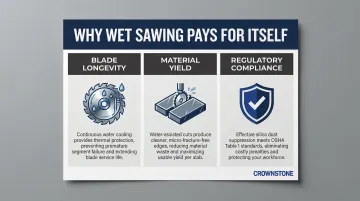
Those quality gains translate directly to the bottom line. Wet sawing pays for itself across three cost categories:
- Blade longevity — water cooling prevents the thermal damage that causes early diamond segment failure
- Material yield — cleaner cuts mean less waste on expensive stone slabs
- Regulatory compliance — proper dust suppression keeps silica exposure within OSHA limits and avoids costly penalties
Types of Wet Saws for Natural Stone Cutting
Bridge Saws
Bridge saws are the workhorses of professional stone fabrication shops. The blade travels along an overhead bridge frame above a fixed slab table, allowing fabricators to cut full granite and marble slabs up to 10+ feet, run long straight cuts, and dial in miters and angle adjustments.
Typical specifications:
- Table size: 144" × 84" (up to 12 feet)
- Blade diameter: 16" to 24" (up to 28" for dimensional stone)
- Maximum cut depth: 7.25" (with 24" blade)
- Motor power: 20 HP to 42 HP
- Market price range: $19,500 to $149,500
Crown Stone USA's Avalanche Pro, for example, is built around a 20 HP motor, a 126" × 77" table with extended sizes available, and a 150" cutting length. Crown Stone's founders spent years repairing and running bridge saws before manufacturing their own—the table design alone went through 10 iterations before they were satisfied with the stability and tolerances it produced.
CNC-Equipped Wet Saws
CNC-equipped wet saws add automated positioning to standard bridge saw capability—a meaningful upgrade for high-volume shops. A cutting line with an automatic pallet exchange system can process 28 slabs per 8-hour shift, compared to roughly 15 slabs on a standard CNC setup. The price premium is significant, but the throughput gain justifies it for shops running consistent production volume.
Wet Tile Saws
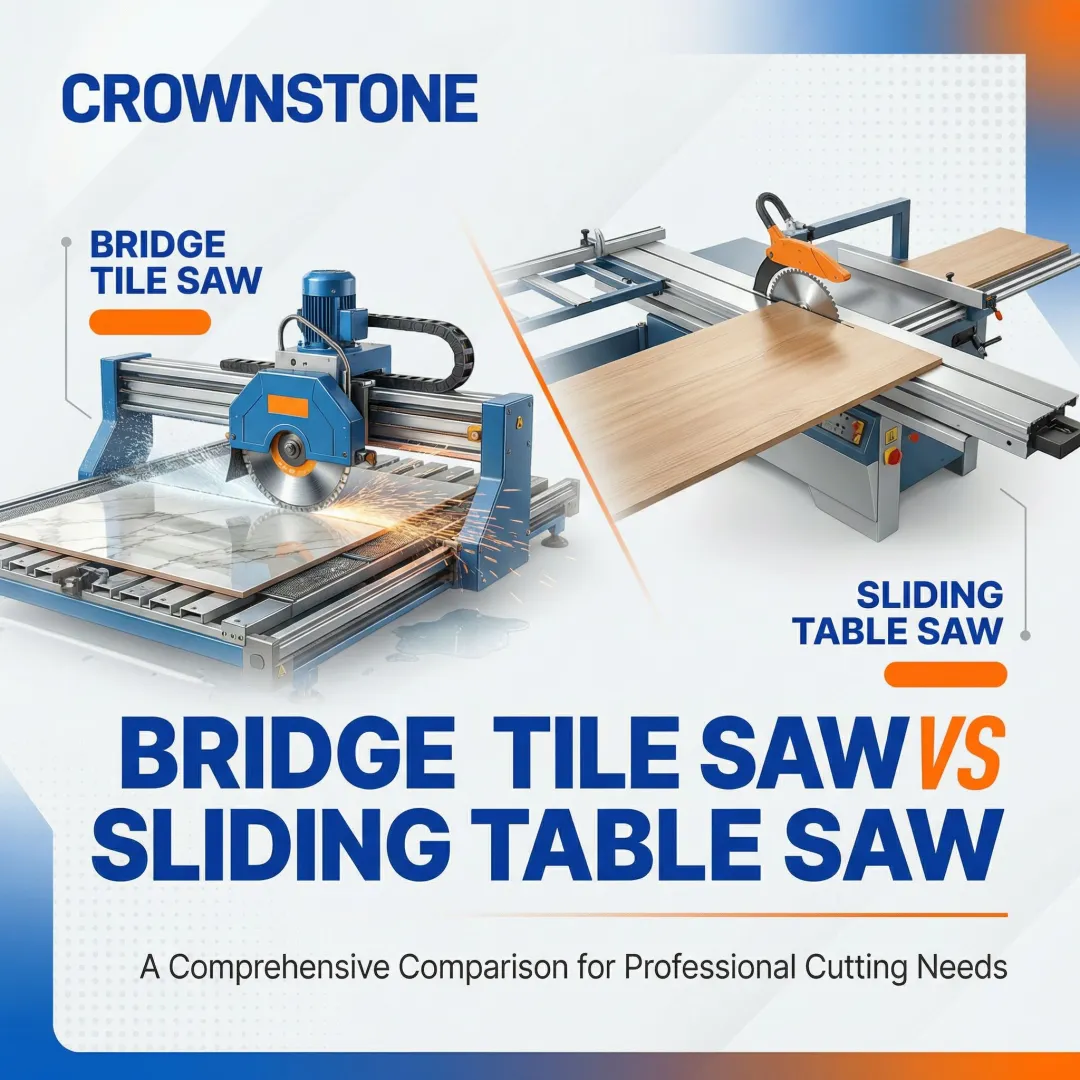
Tile saws (smaller, countertop-style wet saws) can cut thinner natural stone slabs, pavers, or backsplash tiles, but are limited by cutting depth (typically under 2") and slab size. A typical 12" blade capacity wet saw offers a 3" depth of cut and a 72" rip cut capacity—suitable for tile-sized pieces but not full slabs.
When tile saws are appropriate:
- Backsplash tiles and smaller stone pieces
- Thinner natural stone formats
- On-site cuts where portability matters
When they're not:
- Full slab fabrication
- Countertop cutting requiring tight tolerances
- High-volume production environments
Handheld Wet Saws and Angle Grinders with Water Attachments
Handheld wet saws and angle grinders with water attachments handle on-site cuts, notching, and curved cuts that no stationary saw can reach. However, they have limitations in precision and increased dust/splash management challenges. OSHA requires that handheld power saws used indoors or in enclosed areas be equipped with an integrated water delivery system and that the operator wears a respirator with an Assigned Protection Factor (APF) of 10.
Masonry Cut-Off Saws with Water Attachment
Gas or electric cut-off saws with a water feed are appropriate for jobsite cuts in hardscape stone but are not a substitute for a bridge saw in a production environment. They lack the precision, table support, and consistent water delivery required for countertop fabrication.
What to Look for When Buying a Wet Saw for Natural Stone
Motor Power and Blade Speed
Hard, dense stones like granite require higher torque and consistent RPM under load. Industry-standard arbor motors for cutting granite and quartzite slabs range from 20 HP up to 42 HP for heavy-duty block machining. A rule of thumb is that one horsepower per inch of blade diameter is required for efficient sawing.
Underpowered motors accelerate blade wear and produce chipped edges. When motors lack sufficient power, operators often force the blade, causing it to "close up" or "glaze over," preventing new diamonds from becoming exposed. This leads to segment cracking, core fractures, and premature blade failure.
Table Size, Rigidity, and Precision
For slab work, the table must support the full weight of large stone without flex, and the fence/guide system must hold tolerances suitable for countertop fabrication. The Natural Stone Institute specifies that for countertop stone-to-stone seams, the joint width variation must be ±25% of the specified dimension, but not less than ±1/64" (0.4 mm).
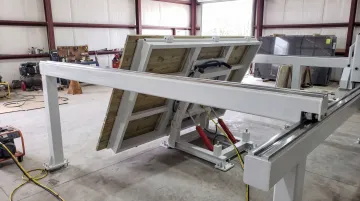
Crown Stone USA's bridge saw table underwent 10 design iterations to achieve the stability and precision required for professional fabrication. The final design features CNC-machined rolling surfaces, hydraulic lift capability up to 70 degrees, and air-cylinder powered indexing that locks at exact 90° and 45° angles for repeatable cuts.
Water Delivery and Recirculation System
The difference between a simple tray/pump setup and a proper recirculation and filtration system matters for shops cutting stone all day. Water quality degrades quickly, affecting cut quality and blade life. Look for:
- Adequate pump flow rate (2-4 gallons/minute for wet cutting blades)
- Accessible filtration
- Systems designed for easy cleaning
Crown Stone USA's water recycling system uses flocculant-based sediment settling technology that causes fine dust particles to aggregate and settle rapidly. The system comes in two versions: a small version (40 GPM) that supports one bridge saw, one polishing machine, and 2-3 hand polishers; and a large version (70 GPM) that can run 3 bridge saws, a polishing machine, a CNC machine, and 4-5 hand polishers simultaneously.
Parts Availability and Serviceability
A wet saw that goes down in a busy fabrication shop costs money every hour—approximately $260,000 per hour across all manufacturing sectors. Choose machines with globally or domestically available parts, intuitive service access, and responsive manufacturer support.
For shops in the US, sourcing from American or Western Hemisphere supply chains means faster repairs and less downtime. Crown Stone USA prioritizes domestic parts availability, with components sourced primarily from the U.S., North and South America, Korea, Japan, and Taiwan—less than 2% of components by value originate from China. When a part fails on a Monday morning, that sourcing discipline is what gets your saw back running by Tuesday.
Warranty and Build Quality
A 2-year warranty is the minimum worth considering — it signals the manufacturer stands behind long-term durability. Look for construction materials that indicate reliability:
- CNC-machined precision surfaces
- Stainless steel components for corrosion resistance
- Brushless AC motors for low maintenance
- Moisture-resistant design to avoid water trapping
Ask manufacturers about component sourcing, service access, and warranty coverage before buying.
Choosing the Right Diamond Blade for Your Stone Type
Stone Hardness and Bond Selection
Pick the wrong blade for your stone type and you'll burn through segments in hours — or end up with a glazed, useless blade. Stone hardness (measured on the Mohs scale) dictates how fast your blade's metal matrix should wear, which determines everything about blade selection.
Bond hardness refers to how easily the metal matrix holding the diamonds wears away. The key principle: harder, denser materials require a softer bond matrix so the metal wears away quickly, constantly exposing fresh, sharp diamond crystals.
| Stone Type | Mohs Hardness | Recommended Bond Matrix |
|---|---|---|
| Marble/Limestone | 3 to 4 | Hard Bond (resists abrasion) |
| Granite | 6 to 8 | Soft to Medium Bond |
| Quartzite | 6 to 8 | Soft Bond (wears easily to expose diamonds) |
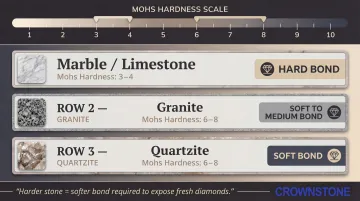
A hard bond on hard stone glazes over — the matrix doesn't wear fast enough to expose new diamonds. A soft bond on soft stone burns through segments before the job is done. Neither failure is cheap.
Blade Types for Natural Stone
Continuous Rim:
- Produces clean, smooth cuts with minimal chipping
- Best for marble and other easily chipped materials
- Preferred when finished edges will be visible
Segmented Rim:
- Cooling slots (gullets) allow faster heat dissipation and flexing
- Delivers maximum cutting life on hard stone
- Go-to choice for granite and quartzite
Turbo (Serrated) Rim:
- Notched segments combine speed with a reasonably smooth cut
- Good middle-ground option for general natural stone work
Blade diameter also determines safe operating speed. Diamond blades are tensioned to run between 9,000 and 13,000 surface feet per minute (SFPM) — exceeding that range damages the blade and creates a safety hazard. Reference your saw's specs against these common guidelines:
- 16" blade: ~2,200 RPM
- 24" blade: ~1,500 RPM
Blade Maintenance and Inspection
Signs of problems:
- Glazing: The blade bond is too hard for the material, or the blade is being forced through the cut — diamonds dull without the matrix wearing away
- Segment loss: Indicates overheating, incorrect bond selection, or excessive feed pressure
- Uneven wear: Points to blade wobble, worn bearings, or incorrect flange alignment
When to dress vs. replace:
- Dress a glazed blade by making a few passes through a concrete block — this wears the matrix and re-exposes sharp diamonds
- Replace blades when segments are worn to the core, when segment loss occurs, or when wobble persists despite proper mounting
A pre-shift inspection takes under two minutes and catches the problems that turn a minor fix into a full blade replacement.
How to Get the Most Out of Your Wet Saw
Water Management
Insufficient water is the number one cause of premature blade failure in natural stone work. Match your flow rate to blade diameter and cutting speed — aim for 2–4 gallons per minute, distributed equally on both sides of the blade.
Critical water management practices:
- Direct water precisely to the blade-stone interface
- Check water temperature (overheated water loses cooling efficiency)
- Clean reservoir and filter daily in high-volume operations
- Refresh water daily to prevent slurry buildup that scratches finished surfaces
Feed Rate and Cutting Technique
Forcing the blade (feeding too fast) causes blade deflection, chipping, and motor strain. Feeding too slowly can cause glazing, where the blade polishes the stone instead of cutting it.
Feed rate guidelines:
- Professional bridge saws can achieve cut speeds up to 15 ft/minute
- Feed rate should vary by stone type, thickness, and blade condition
- Harder stones, thicker slabs, and worn blades all call for a reduced feed rate
Experienced fabricators develop a feel for the right feed rate—listen to the motor and watch the cut. If the motor bogs down or the blade deflects, you're feeding too fast. If you see glazing or smell burning, you're feeding too slowly or have insufficient water.

Routine Maintenance Checklist
Good technique keeps cuts clean — but consistent maintenance is what keeps the saw running year after year.
Daily maintenance:
- Check blade tightness and wear
- Clean water tray and filter
- Inspect water flow to both sides of blade
- Verify table alignment for critical cuts
Weekly maintenance:
- Inspect motor and drive components
- Lubricate moving parts (follow manufacturer schedule)
- Check blade shaft bearings for wear
- Ensure blade collars are clean, flat, and of identical diameter
Monthly maintenance (bi-monthly for lower-volume operations):
- Grease CNC-machined rolling surfaces
- Flush water system completely
- Inspect hydraulic and pneumatic systems
- Check for rust or corrosion in moisture-exposed areas
Frequently Asked Questions
What saw is best for cutting stone?
A bridge saw is the best option for professional stone slab fabrication (granite, marble, quartz countertops), offering the table size, motor power, and precision required for full slabs. Wet tile saws work for thinner pieces and on-site cuts. Either way, a diamond blade with continuous water cooling is non-negotiable.
Can I use a regular tile saw to cut granite?
A standard tile saw can cut granite in thinner formats but is limited in depth (typically under 2") and slab size. Using the wrong blade or insufficient water flow will cause chipping and rapid blade wear on granite's hard surface. For full-slab countertop fabrication, a bridge saw is necessary.
What is the difference between a bridge saw and a tile saw for stone fabrication?
The specs tell the story: bridge saws have table sizes up to 144" × 84" and motors ranging from 20-42 HP, built to handle full stone slabs in a shop. Tile saws are compact, countertop or portable units — lower horsepower, smaller cutting capacity, designed for tile-sized pieces.
How does wet cutting reduce silica dust exposure?
Water suppresses the fine respirable silica particles generated when cutting stone, keeping them suspended rather than airborne. Wet cutting can reduce respirable dust exposures by 52-72% compared to dry cutting, which is why it's both the professional standard and an OSHA compliance requirement for fabrication environments.
What diamond blade do I need for cutting natural stone?
Blade selection depends on stone hardness: segmented blades for hard stones like granite and quartzite, continuous rim blades for softer stones like marble and limestone. The bond hardness should be matched inversely to stone abrasiveness—harder stones require softer bonds to expose fresh diamonds continuously.
How often should I change the water in my wet saw?
Check and refresh water daily in high-volume shop use. Slurry buildup from stone particles degrades cooling efficiency and can scratch finished surfaces — refresh whenever the water turns cloudy or contaminated.