Introduction
When a bridge saw goes down, unplanned downtime costs stone fabrication shops an average of $1,500 per hour in lost throughput and missed deadlines. For a machine that can run anywhere from $12,500 for an entry-level unit to over $250,000 for a high-production CNC system, the warranty backing it isn't a footnote — it's part of the investment. Lifetime warranty programs in particular offer the strongest long-term protection, but only if you understand what keeps them valid.
Despite that, many fabricators unknowingly void their coverage through poor maintenance, unauthorized repairs, or missed registration deadlines. That can mean tens of thousands of dollars in out-of-pocket repair costs during the busiest production periods.
This guide covers what bridge saw lifetime warranties include and exclude, the terms every shop owner needs to know, how to file a claim, and how daily maintenance decisions directly affect your coverage.
TLDR
- Know what your bridge saw warranty covers before downtime forces you to find out the hard way
- Most warranties cover structural defects in motors, frames, and drives but exclude consumable wear parts like blades, seals, and coolant filters
- Unauthorized repairs or skipped maintenance can void coverage entirely; keep detailed service records
- Claims require proof: serial number, purchase date, fault description, and photos or video of the issue
- When comparing machines, warranty duration, parts availability, and claim response time matter as much as machine specs
Why Your Bridge Saw Warranty Matters
A bridge saw is the production backbone of your fabrication shop, and warranty coverage is the financial safety net that protects throughput, not just the equipment itself. An unplanned repair without warranty coverage can mean weeks of lost output, emergency technician fees, and expedited parts shipping that costs 300% to 500% more than scheduled maintenance.
Total Cost of Ownership (TCO) is where warranty strength becomes measurable. The 5-year TCO for CNC equipment is typically 2.5 to 3.5 times the initial sticker price, with maintenance and repairs accounting for 10% to 15% of that total. A machine with a short or poorly defined warranty may cost less upfront but far more over a 3–5 year operating cycle once you factor in parts, labor, and downtime.
That TCO gap often comes down to four warranty variables that differ widely between manufacturers:
- Duration — how many years of coverage you actually get
- Scope — what's explicitly covered versus excluded in fine print
- Claim turnaround — how fast a technician responds and parts ship
- Domestic parts availability — whether components are stocked in the US or back-ordered overseas
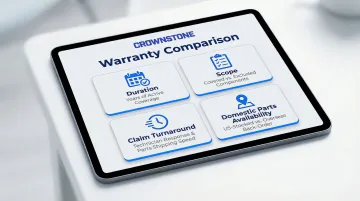
Crown Stone USA, for example, backs its American-made bridge saws with a 2-year warranty and stocks parts domestically, which cuts turnaround time when a failure threatens to shut down production. A weak warranty on any of these four points is a signal worth taking seriously before you sign a purchase order.
What Bridge Saw Warranties Typically Cover (and Don't)
Bridge saw warranties cover manufacturing defects — not wear, misuse, or consumable failure. Miss that distinction, and a single denied claim can cost a fabricator thousands of dollars.
Covered Components
Most bridge saw warranties cover defects in materials or workmanship affecting core structural and mechanical systems:
- Main frame and structural components – welds, cast components, and base structures
- Motor and drive systems – blade motors, servo motors, variable frequency drives (VFD)
- Control boards and electrical components – CNC control panels, relays, contactors
- Hydraulic or pneumatic systems – cylinders, valves, pumps (excluding seals and hoses)
- Linear guides and motion components – rails, ball screws, bearings
Some manufacturers extend standard coverage to CNC control panels, servo motors, and VFDs, while others classify these as premium components requiring additional coverage. Always request a written covered-components list before purchase — verbal commitments won't hold in a claim dispute.
Common Exclusions
Consumable and wear parts are excluded across the board:
- Saw blades
- Water nozzles
- Seals and gaskets
- Coolant filters
- Belts and hoses
- Abrasive media
Operators are expected to replace these as part of routine maintenance.
Beyond consumables, these exclusions catch fabricators off guard:
- Improper electrical supply or site conditions – voltage fluctuations, inadequate grounding, or power surges caused by facility issues
- Unauthorized third-party modifications or repairs – even well-intentioned fixes by local technicians not approved by the manufacturer
- Neglect or insufficient maintenance – failure to follow prescribed lubrication, coolant system cleaning, or inspection schedules
- Force majeure events – flood, fire, lightning strikes, or natural disasters
⚠️ CRITICAL WARNING: Any unauthorized repair—even by a skilled local technician—can void your entire warranty, not just coverage on the repaired component. Manufacturers require written authorization before third-party work begins. When in doubt, call the manufacturer first.
Key Warranty Terms Every Fabricator Should Understand
Warranty Duration and Start Date
Warranty clocks typically begin on the date of delivery or date of installation, not the date of purchase. A machine sitting in a warehouse for 60 days before delivery means you receive equipment with less active warranty coverage than you paid for.
Crown Stone USA provides a 2-year warranty on its American-made bridge saws. For context, imported machines typically carry only 6–12 months of coverage, making the gap in protection substantial from day one.
Warranty Registration Requirements
Many manufacturers require registration within 30 days of purchase to activate full coverage or qualify for extended terms. Missing this window can mean losing access to extended warranty plans entirely or complicating the claims process later.
Keep these documents in a dedicated equipment file:
- Original purchase receipt
- Delivery receipt with date
- Warranty registration confirmation
- Serial number and model information
Limited Warranty Definition
"Limited warranty" means coverage is restricted to repair or replacement of defective parts only. It does not cover incidental or consequential damages such as:
- Lost production revenue during downtime
- Wasted material from incomplete cuts
- Downstream project delays and penalties
- Emergency rental equipment costs
This limitation is legal because commercial equipment is exempt from the federal Magnuson-Moss Warranty Act, which applies only to consumer products, not commercial machinery.
Warranty Transferability
Most manufacturer warranties are non-transferable and tied to the original purchaser. The warranty voids upon ownership change unless stated otherwise. For buyers of used equipment, that means absorbing all repair risks and parts costs from the moment of purchase.
Some manufacturers allow transfers with conditions:
- Written OEM consent
- Transfer fees ranging from $500 to $2,000
- Requirement for OEM-certified re-installation
- Loss of remaining coverage period
Always review transferability language before purchasing used equipment or planning to sell your own.
How to File a Bridge Saw Warranty Claim
A well-documented claim is processed far faster than a vague complaint. Most manufacturers require specific information before dispatching parts or service—providing this upfront accelerates resolution when every hour of downtime costs $1,500.
Step 1: Document the Issue
Before contacting the manufacturer, gather:
- Machine model and serial number (usually on a plate near the control panel)
- Date of purchase or delivery (from your original paperwork)
- Written fault description – when it occurred, conditions at the time, and how machine behavior changed
- Photos and video of the issue, any error messages on the display, and the affected component
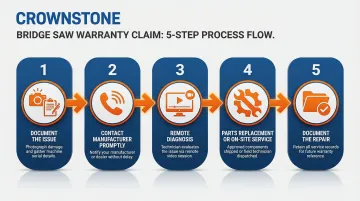
High-quality documentation separates a claim that resolves in days from one that drags on for weeks.
Step 2: Contact the Manufacturer Promptly
Most warranty claims must be submitted within the active warranty period—waiting too long can disqualify the claim . Contact the manufacturer directly through the specified claim channel, not a third-party dealer.
For Crown Stone USA, fabricators can reach the team directly at info@crownstoneusa.com or 727-239-9875 during business hours (Monday-Friday, 7 AM–3 PM).
Step 3: Remote Diagnosis and Response
Most manufacturers attempt remote diagnosis first—via video call, guided troubleshooting, or review of submitted media—before dispatching parts or technicians. Park Industries resolves 99% of cases remotely using TeamViewer, while Intermac uses IoT-enabled predictive maintenance through its SOPHIA platform.
Industry standard response time is 24–48 business hours for initial diagnosis. Ask upfront for expected resolution timelines so you can plan production accordingly.
Step 4: Parts Replacement or On-Site Service
If a component defect is confirmed, resolution typically follows one of two paths:
For electrical components, control boards, or motion parts, manufacturers ship replacements directly. Premium OEMs offer next-day parts dispatch, while machines sourced from manufacturers with poor US distribution can add weeks to resolution time.
For structural issues, motor replacements, or complex mechanical failures, manufacturers arrange field service. This is where domestic parts availability becomes critical—Crown Stone USA's US-stocked parts supply means faster resolution than machines dependent on overseas supply chains.
Step 5: Documenting the Repair
Keep written records of every warranty interaction:
- Claim submission date
- Manufacturer response and reference number
- Parts shipped (including tracking numbers)
- Repair completion date
- Technician name and work performed
Some warranties specify that only manufacturer-authorized repairs extend the component's coverage period (often 90 days to 6 months from date of repair). Documentation protects you if the same component fails again.
How Maintenance Affects Your Warranty Coverage
Most bridge saw warranties include language requiring the machine to be operated and maintained "in accordance with manufacturer guidelines." Skip those routines and the manufacturer can deny your claim on operator negligence grounds—even if a manufacturing defect played a role.
Common maintenance-related warranty violations:
- Using unfiltered water or letting mineral deposits build up in the cooling system causes internal corrosion — spindle warranties are routinely voided by water contamination that inspectors can detect immediately
- Skipping lubrication on linear guides, ball screws, and hydraulic systems leaves rust, scoring, and metal-on-metal wear that manufacturers spot at a glance; Crown Stone USA tables, for example, require greasing every 2 months
- Operating through early warning signs — blade wobble, unusual motor noise, hydraulic pressure drops — escalates component wear into structural damage that's distinguishable from a manufacturing defect during inspection
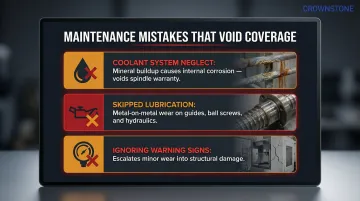
These violations share one thing: they leave evidence. Protecting your claim means staying ahead of them.
Maintain a simple maintenance log recording every service action, part replacement, and inspection date. That documentation is your evidence of due diligence if a claim is ever disputed — and it becomes critical on machines with multi-year warranty periods.
Conclusion
A bridge saw warranty is only as useful as your understanding of it. Knowing what's covered, maintaining the machine properly, registering on time, and documenting issues thoroughly are the difference between a claim that resolves in days and one that's denied outright—leaving you with a five-figure repair bill during peak production season.
Treat warranty terms as a non-negotiable part of the purchasing decision. A machine built to last, backed by a transparent warranty, with US-available parts and responsive support, is the true measure of long-term value for a stone fabrication shop.
Crown Stone USA's 2-year warranty, American manufacturing, and domestic parts availability reflect that standard: equipment built by fabricators who have cut, lifted, and installed stone themselves, and who understand exactly what a day of unplanned downtime costs.
Frequently Asked Questions
What will be covered in warranty?
Standard bridge saw warranties cover manufacturing defects in core mechanical and structural components—such as motors, frames, drive systems, and control electronics—but exclude consumable and wear parts like blades, seals, and filters.
How do I claim on my warranty?
Claims typically require the machine's serial number, proof of purchase, a description of the issue, and supporting photos or video. Contact the manufacturer directly through their specified channel—Crown Stone USA can be reached at info@crownstoneusa.com or 727-239-9875—and expect a remote diagnosis before any parts or service is dispatched.
What voids a bridge saw warranty?
Unauthorized repairs by non-approved technicians, failure to follow manufacturer maintenance guidelines, improper installation or electrical supply conditions, and unsanctioned modifications to the machine all void warranty coverage.
How long do most bridge saw warranties last?
Warranty duration varies by manufacturer. Some imported machines offer as little as 6 months, while American-made bridge saws like those from Crown Stone USA carry 2 years or more. Always request written terms before purchase rather than relying on verbal commitments.
Does routine maintenance affect my bridge saw warranty?
Yes, most warranties require the machine to be maintained per manufacturer specifications. Poor maintenance practices give the manufacturer grounds to deny a defect claim if they determine neglect contributed to the failure.
Is a bridge saw warranty transferable if I sell the machine?
Most manufacturer warranties are non-transferable and tied to the original purchaser. Fabricators should review warranty terms explicitly for transferability language before buying a used machine or selling their own, as transferability directly affects resale value.