Introduction
Imagine this: A fabricator rushes a high-profile countertop order through the shop floor. The stone leaves the saw perfectly cut, but when it exits the edge polisher, the finish is uneven—one section gleaming, another dull and scratched. The problem isn't operator error or a faulty abrasive. It's the machine itself. The wrong edge polisher doesn't just create rework; it creates downstream costs that compound: extra labor hours correcting finishes, unplanned downtime waiting for parts, and customers who won't return after inconsistent work.
Edge polishing is a reputation-defining step in stone fabrication. Unlike cutting or templating, the edge is what customers see and touch every day. The machine you choose directly affects throughput, finish consistency, labor cost, and long-term ROI.
This guide breaks down the factors that matter most—spindle configuration, automation level, motor capacity, and floor space requirements—so you can match the right machine to your shop's actual production volume and material mix.
TL;DR
- An edge polisher automates grinding and polishing of stone slab edges at speeds 4–13x faster than manual methods
- Key selection factors: head count, machine orientation, throughput speed, control systems, and parts availability
- Granite and quartz require different abrasive settings; a machine that can't adjust limits what your shop can handle
- Factor in downtime risk and parts lead time alongside purchase price when comparing machines
- Match specs to your shop's actual volume and material mix, not brand popularity
What Is an Edge Polisher and What Does It Do?
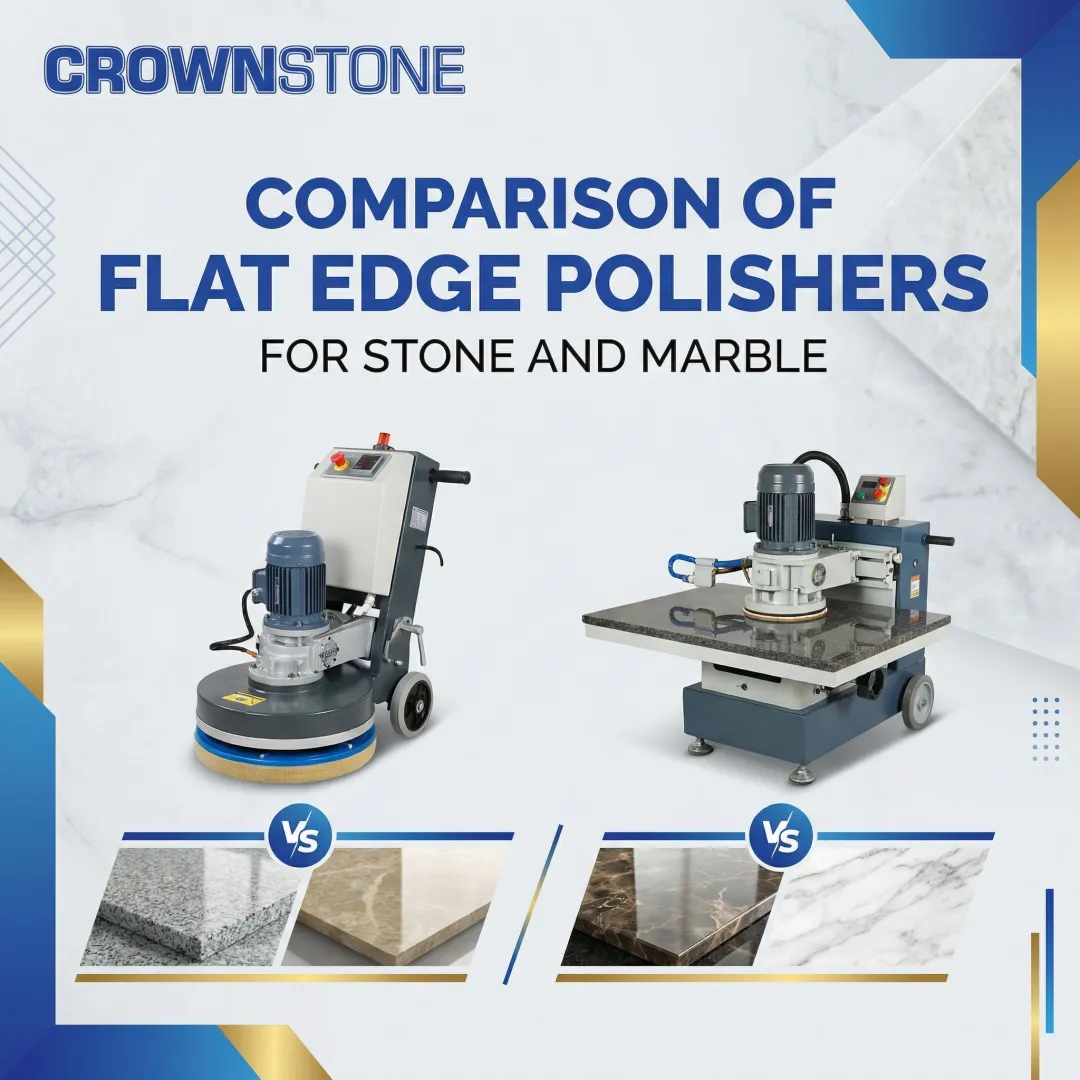
An edge polisher is a production machine that automates the grinding, beveling, and polishing of stone slab edges through a sequence of progressively finer abrasive heads. It replaces the labor-intensive process of hand-polishing with consistent, high-speed automation. Unlike CNC profiling machines that create decorative shapes like ogee or bullnose, most edge polishers handle flat or eased edges—the workhorses of countertop fabrication.
The eased edge—a straight profile with a slight 1/8-inch radius on top and bottom corners—dominates the industry. One established fabricator reports approximately 90% of their 10,000+ installations use the eased edge, and industry sources consistently identify it as the most popular profile. Cambria, a major U.S. quartz manufacturer, calls it "the simplest and most popular edge profile" for its clean, contemporary lines.
This demand makes the flat/straight-line edge polisher the primary machine category for most granite and quartz shops. If your shop processes standard countertops at volume, this is where your investment focus should land.
Types of Edge Polishers: Know What You're Buying
Flat/straight-line edge polishers handle eased and chamfer edges at production volume. These machines excel at repetitive, high-throughput work where consistency matters more than decorative complexity. They're built for shops running dozens of slabs weekly through standard edge profiles.
Profiling machines and CNC routers create bullnose, ogee, waterfall, and custom curved edges. These machines serve a different function—adding decorative detail rather than volume processing. While some shops eventually need both, the flat edge polisher typically delivers faster ROI for countertop-focused operations.
Most granite and quartz shops should evaluate flat edge polishers first, then consider profiling equipment only after auditing actual demand for decorative edges.
Core Machine Anatomy: The Three-Stage Sequence
Once you know which machine type fits your shop, the next step is understanding what happens inside it. That knowledge lets you compare machine specs with confidence rather than relying on brochure language. Here's the functional sequence:
Calibrating head — The entry stage levels slab thickness variation before polishing begins. Without it, inconsistent stone thickness creates uneven pressure across subsequent heads, leading to patchy finish quality.
Frontal polishing heads — Typically 6-7 spindles progress from coarse (50-100 grit) through fine (1500-3000 grit), each removing scratches left by the previous stage. More heads generally means faster throughput; fewer heads means slower speeds or multiple passes.
Bevel heads (upper and lower) — These chamfer the top and bottom corners at 45°, producing the eased edge profile. They run independently from the flat polishing heads, with separate motors positioned above and below the stone.
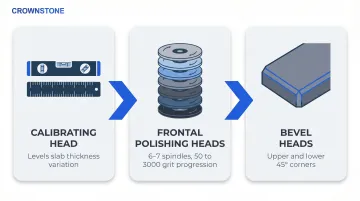
Each stage builds on the previous one. Skip a grit stage or miscalibrate entry thickness, and the finish suffers—no matter how skilled your operator.
Key Factors to Consider When Choosing an Edge Polisher
The right edge polisher connects technical specifications to your shop's production realities. A machine that clears every spec sheet can still underperform if it doesn't fit your volume, material mix, or infrastructure. These six factors are where the real decision gets made.
Polishing Head Count and Grit Progression
Head count is the primary indicator of finish quality and throughput efficiency. Production-grade machines use 7-9 total heads (6-7 polishing plus 2 bevel) to complete the full grit progression—typically 50, 100, 200, 400, 800, 1500, 3000—in a single pass. Marmo Meccanica's LCV-711M states that 9 heads "allow processing in one pass with no need for micro-oscillation".
Why this matters:
- Machines with fewer heads require slower belt speeds to achieve equivalent finish quality
- Slower speeds or multiple passes cut into the throughput advantage automation is supposed to deliver
- More handling per slab = more labor cost per linear foot
For example, a machine with only 5 polishing heads might require running the same slab twice—effectively halving your throughput. On high-volume runs, that labor cost compounds quickly. Calculate your typical weekly linear footage, multiply by labor hours per foot, and you'll see why single-pass capability isn't just convenient—it's financially essential.
Approximate time difference: Manual hand-polishing averages 20-25 linear feet per hour, while automated systems can reach 80-275 linear feet per hour depending on model—roughly 4-13x faster. Machines with insufficient heads erase much of that advantage.
Machine Orientation: Horizontal vs. Vertical
The choice between horizontal and vertical belt orientation isn't about which is "better"—it's about which matches your work mix and floor space.
Vertical belt machines (slab feeds upright):
- Compact footprint—ideal for shops with limited floor space
- Faster feeding for standard countertop runs
- Higher throughput speeds (80-275 lf/hr on Marmo Meccanica's LCV model)
- Best for high-volume countertop shops processing consistent thicknesses
Horizontal belt machines (slab lays flat):
- Better stability for heavy, thick, or fragile pieces
- Reduces slab breakage risk during processing
- Handles large-format slabs and architectural pieces more safely
- Slower throughput (80-150 lf/hr on Marmo's LCH model) but gentler handling
- Larger floor footprint required
If 80%+ of your work is standard 2cm-3cm countertop slabs, vertical orientation delivers speed. If you handle thick architectural pieces, waterfall panels, or fragile materials like bookmatched marble, horizontal orientation provides the handling security worth the footprint trade-off. Your work mix makes the call—not a general preference for one design over another.
Throughput Speed and Production Capacity
Throughput speed—measured in linear feet or inches per minute—directly multiplies daily output. But published specs reflect ideal conditions. Actual throughput depends on belt speed settings appropriate for the material being processed.
Published manufacturer specs:
| Machine | Orientation | Speed Range |
|---|---|---|
| Marmo Meccanica LCV-711M | Vertical | 80-275 lf/hr |
| Marmo Meccanica LCH-711M | Horizontal | 80-150 lf/hr |
| Park Industries Fastback II | Vertical | Up to 65 in/min |
| Crown Stone USA Eversplash | Vertical | Up to 100 in/min |
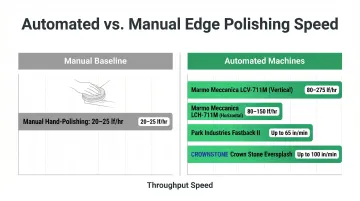
The efficiency gap is real: Manual methods average 20-25 linear feet per hour. An 8-hour shift yields approximately 160-200 linear feet by hand. The same shift on a mid-range automated polisher yields 640-2,200 linear feet—a 4-11x improvement.
But don't buy based on maximum specs alone. Granite and harder quartz often require slower belt speeds than softer materials to prevent burning, chipping, or haze. Match machine throughput to your realistic material mix, not best-case figures. A machine rated at 275 lf/hr running engineered quartz may deliver closer to 150 lf/hr at safe speeds—still excellent, but plan accordingly.
PLC Controls and Automation Features
Control systems reduce operator skill dependency and deliver consistent results across shifts. Machines range from basic electro-mechanical controls to advanced PLC (Programmable Logic Controller) systems.
Key automation features to evaluate:
- Programmable presets per stone type: Save belt speeds, pressure settings, and grit sequences for granite vs. quartz vs. marble
- Automatic belt speed adjustment: Reduces operator error from manual speed changes
- Tool-life tracking with maintenance alerts: Prevents finish degradation from worn heads
- Automatic stop at cutouts or defined points: Reduces waste from over-processing
These features directly affect operator error rate, finish consistency across production runs, and onboarding time for new employees. Machines with intuitive controls reduce the learning curve and lower rework risk on customer slabs.
Crown Stone USA's Eversplash uses electro-mechanical controls built for simplicity and reliability. Park Industries' Fastback II takes a different approach—programmable touchscreen controls with tool-life monitoring and remote diagnostics. Which matters more depends on your labor turnover rate and how much skill variance exists across your crew.
Note: While manufacturers emphasize automation benefits, specific data quantifying operator error reduction or onboarding time improvement is limited. Evaluate based on feature comparisons and consider whether your shop's labor turnover and skill levels justify the premium for advanced PLC systems.
Parts Availability and Serviceability
Parts availability is the most consequential (and most overlooked) selection factor. A single delayed component can cost more in lost production than its purchase price many times over.
When a polishing spindle fails, the real cost isn't the $500-$800 replacement part—it's idle labor, delayed installations, and rushed jobs handed to competitors. That operational hit accumulates fast, even when downtime is measured in days rather than weeks.
Evaluate these factors before purchase:
Domestic parts stocking: Are replacement spindles and polishing heads stocked in the U.S., or do they ship from overseas? A 3-day domestic delivery vs. a 3-week international shipment changes everything when production is stopped.
Manufacturer support model: Does the manufacturer offer real-time phone support, or just a ticketing system? Immediate troubleshooting access matters when production is stopped.
Serviceability design: Are service points accessible without major disassembly? Machines that require frame teardown to replace common wear items add labor cost to every maintenance cycle.
Supply chain transparency: Recent tariff changes have disrupted stone equipment supply chains. Stone World reported in May 2025 that 10% general tariffs and 25% steel tariffs were already active, with approximately 80 shipping carriers pulled offline. Equipment origin matters when you're evaluating long-term parts reliability.
Crown Stone USA's Eversplash addresses supply chain risk directly: less than 2% of component value originates from China, with parts sourced primarily from the U.S., North and South America, Korea, Japan, and Taiwan. This diversification reduces exposure to single-country supply disruptions.
Shop Infrastructure Requirements
Production edge polishers demand specific infrastructure. Underestimating requirements leads to costly facility upgrades post-delivery.
Standard requirements across manufacturers:
| Requirement | Typical Range | Notes |
|---|---|---|
| Electrical | 208-240V, 3-phase | Verify panel capacity before purchase |
| Compressed Air | 80-120 PSI | Continuous supply for pneumatic systems |
| Water Flow | 12-20 GPM | Pressurized supply for cooling and slurry management |
| Drainage | 3-inch outlet | For water discharge and slurry removal |
Verified specifications:
- Eversplash (Crown Stone USA): 208-240V/3-phase, 80-120 PSI, 20 GPM
- Marmo Meccanica LCV-711M: 230V/3-phase/60 amps, 12-15 GPM
- Park Industries: 480V for CNC systems; edge polisher specs similar
Floor space and machine footprint also require planning. Both horizontal and vertical machines have defined footprint requirements plus infeed and outfeed clearance. Measure your shop layout carefully—including ceiling height for vertical models, which may require 10+ feet clearance with support systems.
Verify infrastructure readiness before purchase, not after delivery. Upgrading electrical panels or water supply systems adds weeks to installation timelines and thousands in unexpected costs.
Matching the Right Machine to Your Granite and Quartz Shop
Understanding individual factors is only half the equation. The right machine matches your shop's specific production reality—volume, material mix, and growth direction.
Material-Specific Abrasive Considerations
A machine capable of running granite, quartz, and marble with adjustable settings is far more versatile than one optimized only for granite. Each material demands different tooling parameters.
Granite — natural stone, harder, more brittle:
- Requires a full grit sequence with diamond-bond wheels
- Runs at higher RPMs (1,500–2,500 at coarse grits)
- More forgiving of aggressive starting grits
Quartz — engineered with resin binders:
- Demands lower RPM — max RPM at half-open position for high grits
- White resin pads only to prevent color transfer
- Copious water at finishing grits to prevent burning and hazing
- Too-high RPM creates excessive heat, smearing or burning the surface
Marble — softer, more porous:
- Needs softer resin bonds and less aggressive starting grits
- Higher risk of edge blowouts from excessive pressure
- Gentler handling throughout the sequence
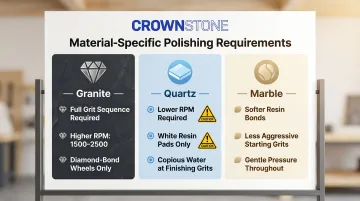
If your shop processes multiple stone types, confirm the machine offers adjustable RPM settings, compatible pad systems, and programmable presets. A machine locked into granite-only specs limits your ability to serve quartz clients—and that's a growing share of the market. Volume is the next variable to nail down.
Production Volume Framework for Machine Selection
Match machine specs to actual production volume, not projected growth. Over-investing ties up capital; under-investing creates bottlenecks.
Small/growing shops (15-40 jobs per month):
- Compact horizontal machine with 6-7 heads may meet needs without over-investing
- Prioritize ease of operation and parts availability over maximum throughput
- Price range: $20,000-$80,000 depending on features
Mid-to-high-volume shops (40-80+ jobs per month):
- Vertical machines with 7-9 heads and higher throughput speeds (80-150+ lf/hr)
- Single-pass capability essential to avoid labor bottlenecks
- Price range: $80,000-$180,000 for industry-standard models
Shops with mixed architectural and countertop work:
- Evaluate whether a single flat edge polisher handles volume or if dual setups make sense
- Consider horizontal orientation if processing thick slabs or large-format pieces regularly
- May justify premium machines ($100,000-$250,000) with advanced automation
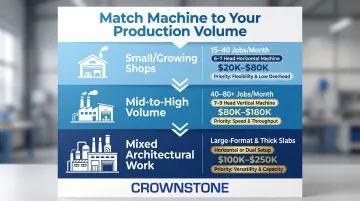
Production volume benchmarks: Small shops (5-10 employees) typically process 15-40 jobs per month; mid-size shops (10-20 employees) handle 40-80 jobs monthly.
The 80/20 Audit: What You Actually Process
Before selecting a machine, audit your recent order history. Calculate what percentage is straight/eased edge work versus curved or custom profile work.
If 80%+ is flat edges: A high-throughput flat edge polisher is the right primary investment. Focus budget on head count, throughput speed, and parts availability.
If 20-30%+ involves custom profiles: That warrants evaluating a separate profiling machine or CNC tool rather than over-specifying the flat edge polisher for work it's not designed to handle.
This audit prevents two common mistakes: buying an expensive profiling machine for work that's 90% flat edges, or buying a flat edge polisher without enough heads because you're chasing occasional custom work.
ROI Calculation Framework
Compare operational impact, not sticker prices. Here's a straightforward formula:
Simple ROI formula:
- Calculate hours currently spent on edge polishing per week
- Multiply by hourly labor cost
- Multiply by 52 weeks = annual labor cost
- Compare against machine annual cost (purchase price ÷ expected lifespan in years)
- Calculate payback period
Example:
- Current manual polishing: 20 hours/week × $25/hour = $500/week
- Annual labor cost: $500 × 52 weeks = $26,000
- Machine cost: $90,000 ÷ 10-year lifespan = $9,000/year
- Labor savings: $26,000 - (reduced hours: 5 hours/week × $25 × 52) = $19,500/year
- Payback period: ~8.6 years (faster if higher throughput enables more jobs)
Run these numbers with your actual labor costs and job volume before comparing machine prices. The math usually tells a clearer story than the sticker.
Facilities processing 3,000+ sq meters monthly that upgraded to automatic polishing lines saw average payback periods of 2 years, with one mid-sized plant hitting 12-month payback — a useful benchmark for the ROI potential of automation in stone fabrication.
How Crown Stone USA Can Help
Crown Stone USA builds stone fabrication equipment from firsthand shop experience. The founders started by cutting, lifting, and installing stone—not by drafting spec sheets—and that background drives every design and sourcing decision they make.
The Eversplash Flat Edge Polisher reflects this fabricator-focused approach with specs and design choices that address the selection factors covered in this guide:
Key Specifications:
- Throughput: Up to 100 inches per minute polishing speed
- Head configuration: 6 flat-edge polishing spindles + 2 beveling motors (45° top and bottom)
- Material compatibility: Granite, marble, and quartz (1 cm–6 cm thickness range)
- Controls: Electro-mechanical controls designed for low downtime and ease of operation
- Infrastructure requirements: 208-240V/3-phase power, 80-120 PSI compressed air, 20 GPM pressurized water
- Spindle construction: Durable in-house cast aluminum spindles for reliability
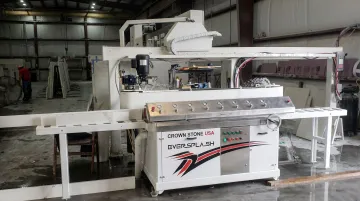
Those specs tell part of the story. Here's what distinguishes the machine behind them:
What sets Crown Stone USA apart:
- American-made equipment assembled in Clearwater, FL with less than 2% of component value sourced from China
- Supply chain built on U.S., North/South American, Korean, Japanese, and Taiwanese components for reliable domestic parts access
- 2-year warranty with quick customer response—call 727-239-9875 or email [email protected]
- Designed by fabricators with decades of combined experience repairing, maintaining, and operating stone equipment
If your shop is weighing reliability, parts availability, and long-term serviceability, those are exactly the factors Crown Stone built the Eversplash around. Reach out to discuss your production volume and shop setup before committing to a machine.
Conclusion
The right edge polisher for your granite and quartz shop is the one that matches your production volume, material mix, floor space, and supply chain realities—rarely the most expensive or most widely advertised option.
Review these six selection factors as a checklist:
- Head count and grit progression — More heads mean fewer passes and less operator handling per slab
- Machine orientation — Vertical machines move faster; horizontal machines handle thicker, heavier stone more reliably
- Throughput speed — Manufacturer specs reflect ideal conditions; test against your actual material mix
- PLC controls — Advanced automation only pays off if your operators can use it without constant retraining
- Parts availability — Confirm domestic stocking and ask specifically where components are sourced
- Infrastructure requirements — Verify power, air, and water before purchase
Your shop's needs will shift. A machine well-suited to 50 slabs per week may fall short at 150—so revisit this checklist as volume grows, your material mix changes, or newer technology enters the market.
To discuss your specific shop configuration and get guidance tailored to your production realities, contact Crown Stone USA at 727-239-9875 or visit crownstoneusa.com/contact.
Frequently Asked Questions
Why does granite chip at the edges during polishing?
Edge chipping on granite typically occurs from too-aggressive starting grits, excessive belt speed for the material hardness, or insufficient water cooling causing micro-fractures. Skipping grit steps in the sequence locks in subsurface scratches that surface during final polish. For a deeper look at preventing this, see how to polish marble edges.
What are common polishing mistakes when finishing stone edges?
The most common mistakes are:
- Skipping grit steps, which locks in scratches finer grits can't remove
- Running belt speed too fast for the material
- Insufficient water flow, causing heat buildup and micro-fractures
- Not replacing worn polishing heads on schedule
See how to polish marble edges for full guidance.
What does vinegar do to granite?
Vinegar is acidic and will etch and dull the polished surface of granite countertops over time by chemically attacking the mineral structure—particularly at the edges. Fabricators should advise customers to use pH-neutral stone cleaners only.
What is the difference between a flat edge polisher and a profiling machine?
A flat edge polisher automates the straight/eased edge—the most common countertop profile—at production volume. A profiling machine or CNC router creates decorative shapes like bullnose, ogee, and waterfall profiles. Most countertop shops need both eventually, but the flat edge polisher typically delivers faster ROI.
How many polishing heads does an edge polisher need for granite and quartz?
Production-grade machines use 7–9 polishing heads (6–7 flat + 2 bevel) to complete the full grit progression from 50 through 3000 grit in a single pass. Fewer heads mean slower speeds or multiple passes—and significantly less throughput.
How do I know when my edge polisher spindles need replacing?
Worn spindles show up as inconsistent finish quality, visible scratch patterns at specific grit positions, or audible changes in motor load. Track spindle hours and replace on a set schedule—don't wait for finish quality to drop before acting.