
Introduction
Marble edges are one of the most visible steps in stone fabrication. A flawless surface finish means nothing if the edge is dull, chipped, or uneven. The concept is straightforward — coarse to fine grit progression with water — but real-world results vary based on grit sequence, pad quality, machine speed, water flow, and operator technique.
This guide covers the exact steps, required tools, the variables that control quality, common mistakes, and how to troubleshoot the most frequent problems. Whether you're finishing Carrara countertops or Emperador bar tops, the difference between a polished result and a rework call comes down to execution at every stage.
TL;DR
- Wet polishing with diamond polishing pads—progressing from coarse (50–100 grit) to ultra-fine (3000 grit)—is the standard method for polishing marble edges
- Water cooling prevents heat buildup that causes burn marks, pad glazing, and micro-cracking
- Each grit stage must fully remove scratches from the previous stage before advancing
- Your initial saw cut quality determines how much grinding is needed before polishing can begin
- Pad pressure, RPM, and grit-to-hardness compatibility are what separate consistent professional results from uneven finishes
How to Polish Marble Edges: Step-by-Step
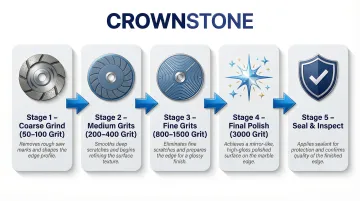
Step 1: Clean and Prepare the Marble Edge
Inspect the freshly cut edge for saw marks, chips, or irregularities. The depth of saw scoring determines the starting grit needed. Clean the edge thoroughly with water to remove dust, slurry, and debris—any residue left on the surface will contaminate the polishing pads and cause scratching.
Ensure the slab is stable and properly supported on the work surface. Movement during polishing introduces uneven pressure and inconsistent results. The cleaner and more consistent the initial bridge saw cut, the less material you'll need to remove in the coarse grit stages—a precise cut directly reduces your total polishing time.
Step 2: Begin with the Coarsest Appropriate Grit (50–100 Grit)
Attach a 50 or 100 grit diamond polishing pad to an angle grinder or wet polisher, keeping water running continuously at the edge during the entire pass. Work the pad along the edge in smooth, even strokes—apply consistent pressure and maintain the same angle throughout to avoid creating new low spots or high spots.
This stage removes deep saw marks left by the blade. Continue until all saw scoring is gone and the surface shows only uniform shallow scratches from the current grit. If you advance to the next grit before all scoring is gone, those deeper marks will reappear as haze in the final polish—there's no recovering them without stepping back down.
Step 3: Progress Through Medium Grits (200–400 Grit)
Switch to a 200 grit pad and repeat the process. The goal is to replace the deep scratches left by the 100 grit with finer, more uniform scratches. Dry the edge briefly and inspect under good lighting after each grit to confirm all previous-grit scratches have been removed before advancing to 400 grit.
Maintain consistent water flow and avoid pressing harder to speed up the process. Increased pressure causes uneven abrasion and can gouge softer marble varieties.
Step 4: Refine with Fine Grits (800–1500 Grit)
Work through 800 grit, then 1500. By 1500, the edge should show a honed, matte-to-satin appearance with no visible scratching. Surface temperature sensitivity increases at this stage—keep water cooling uninterrupted and slow your pass speed so the pad works evenly across the full edge profile.
Step 5: Final Polish (3000 Grit + Polishing Compound)
Finish with a 3000 grit pad to bring the edge to a high-gloss mirror polish. For an even higher gloss, follow with a marble polishing powder or compound—oxalic acid-based powder applied with a felt pad or buffing wheel works well here.
Wipe the edge dry and inspect under strong light. The surface should be fully reflective with no visible scratch patterns, haze, or flat spots. Finish by applying a stone sealer to protect the polished edge against staining and etching.
What You Need Before You Start
The right preparation keeps your process moving and your finished edge clean. Gaps in equipment, material condition, or safety setup will show up in the result.
Equipment and Tools
Minimum requirements include:
- Variable-speed wet polisher or angle grinder rated for wet use
- Set of diamond polishing pads spanning at least 6 grit levels (50/100, 200, 400, 800, 1500, 3000)
- Continuous water supply or recirculating water system
- Stable work surface with adequate slab support
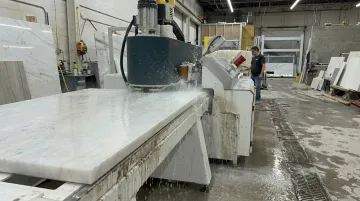
For professional fabrication shops, automated edge polishers like Crown Stone's Eversplash can process flat edges at speeds up to 100 inches per minute with 6 polishing spindles and 2 beveling motors. These machines require a pressurized water supply at 20 gallons per minute (GPM) and 208-240V, 3-phase power.
Material and Edge Condition
The marble slab must be fully cut to final dimension before edge polishing begins. Know your marble variety before you start. Softer calcitic marbles like Carrara (Mohs hardness 3) tolerate lighter pad pressure than harder dolomitic varieties like Emperador (Mohs hardness 3.5–4), and that difference drives your starting grit selection.
Safety Readiness
Use wet polishing specifically because it suppresses silica dust. Never dry-polish marble without proper respiratory protection (N95 minimum, P100 preferred). Wear eye protection and non-slip gloves throughout the process.
Key Parameters That Affect Edge Polishing Results
Even with the right tools and correct technique, four variables will make or break your finished edge. Operators who track these actively — rather than reacting after a defect appears — consistently produce cleaner, more consistent results.
Grit Progression Speed
Advancing to the next grit before removing all scratches from the current stage locks in defects that only become visible under the final polish. No amount of buffing at 3,000 grit will hide scratches left by 200 grit.
Move forward only after visually confirming the previous grit's scratch pattern is gone. Manual hand-polishers average 20–25 linear feet per hour for a complete edge; automated systems can reach up to 325 linear feet per hour, with dwell times of 15–30 seconds per foot on eased edges and 60–120 seconds on complex ogee profiles.
Marble hardness affects how long each stage takes. Calcitic marbles like Carrara and Calacatta (Mohs 3) clear faster than dolomitic marbles like Emperador (Mohs 3.5–4), which require longer dwell at each grit.
Water Flow Rate and Cooling
Insufficient water causes localized heat buildup, which can discolor marble — especially white and light-toned varieties — glaze the pad (killing its cutting ability), and create micro-fractures at the edge.
Keep water as a steady, continuous stream directed at the pad-to-stone contact point, not a drip. Professional wet polishing setups typically require 20 GPM for automated edge polishers. Crown Stone's water recycling systems come in 40 GPM and 70 GPM configurations, using flocculant-based sediment settling to keep clean water cycling through continuous shop operations.
Pad Speed (RPM) and Applied Pressure
Running pads too fast for the grit level causes glazing and heat buildup; too slow and you lose cutting efficiency. Combined with excessive pressure, incorrect speed is the leading cause of uneven edges and premature pad wear.
Key guidelines for marble:
- Run coarser grits at 1,500–2,500 RPM to avoid heat generation
- Finer grits can tolerate higher speeds without glazing
- Avoid bearing down to accelerate progress — over-pressing at higher grits compresses the pad face and reduces abrasive contact, producing an uneven sheen
Pad-to-Stone Angle and Consistency
Changing the pad angle mid-pass creates surface variations that catch light differently, producing a patchy or wavy appearance on the finished edge.
Maintain consistent, flat pad contact across the full edge width. This is especially critical on profiled edges — bullnose and ogee profiles already introduce natural angle variation through the curve, so any additional inconsistency compounds the problem.
Common Mistakes When Polishing Marble Edges
Most edge polishing failures trace back to the same handful of errors. Knowing them in advance saves a lot of re-grinding.
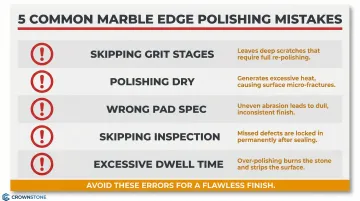
- Skipping grit stages to save time leaves subsurface scratches that show up as haze under the final polish — each stage has to complete its full job before you move on.
- Polishing dry or with inadequate water lets heat build until discoloration or micro-cracking sets in. By the time the slab dries, the damage is permanent.
- Using granite-spec diamond pads on marble causes aggressive scratching at coarser grits. Not all pads are formulated for marble's softness — always verify compatibility with the stone type before you start.
- Skipping the inspection step between stages is one of the most consistent sources of rework. Problems caught at stage 3 are fixable; problems caught after the final polish usually mean starting over.
- Excessive dwell time on a single section causes softer minerals to abrade faster than harder veins, producing an irreversible "orange peel" texture that requires re-grinding to correct.
Troubleshooting Common Edge Polishing Problems
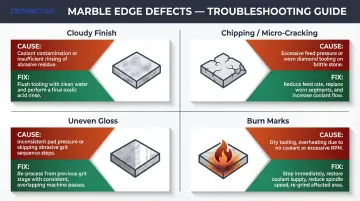
Even experienced fabricators encounter edge polishing problems. Recognizing them early saves significant rework time. The four most common issues — cloudy finish, chipping, uneven gloss, and burn marks — each have a distinct cause and a clear fix.
Cloudy or Hazy Final Finish
Usually caused by scratches from a prior grit stage that weren't fully removed before advancing, or by pad glazing — where the pad loses its cutting surface from heat or clogging.
Dry the edge and inspect under raking light. If a scratch pattern is visible, step back to the matching grit and re-work the sequence from there. A smooth, non-cutting pad needs to be conditioned or swapped out.
Chipping or Micro-Cracking Along the Edge
This typically traces back to one of three causes: starting grit too coarse for the marble's hardness, excessive pad pressure, or dry-polishing that creates thermal shock at the edge.
To correct it:
- Reduce pressure on coarser grits
- Establish continuous water flow before the pad contacts the stone
- Verify the starting grit is appropriate for the specific marble variety
Uneven Gloss (Flat Spots or Wavy Reflection)
Inconsistent pad angle or pressure is the usual culprit — especially on longer runs or profiled edges. Uneven starting conditions from the saw cut can also contribute.
Slow down pass speed to improve pad contact consistency. Use a straightedge or light test to locate the flat spots, work those areas with medium grit, then re-polish the full edge to blend.
Burn Marks or Discoloration on the Edge
Burn marks result from water flow interruption, excessive RPM, or stopping the machine with the pad still on the stone. Heat discoloration on marble is hard to reverse — prevention matters here.
- Never stop a spinning pad on the surface; keep it moving or lift before stopping
- Increase water flow and reduce RPM on heat-sensitive marble varieties
- If discoloration has already occurred, expect to re-grind from a coarser grit to recover the edge
Conclusion
Polishing marble edges to a professional finish is a process built on discipline: the right grit sequence, consistent water cooling, appropriate pad speed, and careful inspection between each stage determine whether you walk away with a mirror finish or a rework job.
Most edge polishing failures trace back to preparation shortcuts or parameter control lapses—not equipment limitations. When the process is followed correctly, the results are consistent and repeatable. For fabrication shops focused on throughput and quality, the equipment underneath the process matters. Machines that deliver clean initial cuts and maintain stable water delivery throughout the polishing sequence — like the bridge saws and edge polishing equipment built by Crown Stone USA — reduce labor time and produce finishes that don't require a second pass.
Frequently Asked Questions
How do you restore shine to cultured marble?
Cultured marble is a resin-based composite, not natural stone. Shine is typically restored with a fine polishing compound or automotive-grade polish rather than diamond pads, as the material is softer and can be easily over-ground.
What should you not use on cultured marble?
Avoid abrasive cleaners, harsh chemicals (bleach, ammonia), and coarse diamond polishing pads on cultured marble. These can scratch the gel coat surface and dull the finish permanently.
What cleaners are safe to use on marble?
Use pH-neutral stone cleaners. Acidic cleaners (vinegar, citrus-based) and alkaline degreasers etch marble's calcium carbonate surface and permanently damage the polish.
How many grit levels do you need to polish marble edges?
A minimum of 6 grit stages is recommended for a high-gloss edge (typically 50/100, 200, 400, 800, 1500, 3000). Fewer stages are acceptable for a honed finish but not for mirror-polish results.
Can you polish marble edges by hand or do you need a machine?
Hand polishing with sanding blocks and wet/dry abrasive paper is possible, but it's slow and inconsistent at countertop scale. For fabrication shop work, a variable-speed wet polisher is the practical standard.
What is the difference between a honed and a polished marble edge finish?
A honed finish is matte-to-satin with no reflective shine, stopping around 800–1500 grit. A polished finish pushes through 3000 grit — and sometimes a polishing compound — to achieve a high-gloss, mirror-like surface.