Introduction
Edge profiles are one of the most client-visible outputs of stone fabrication, and every profile decision carries a direct equipment implication. A flawless ogee communicates craftsmanship. A poorly executed miter means rework. Behind every clean profile is a specific set of machines, tooling, and process choices that determine whether a shop delivers profitable, repeatable quality — or burns time and margin on fixes.
This article is written for stone fabrication shops — granite, marble, and quartz fabricators — not homeowners. It maps each major edge profile to the specific tooling and machines required to produce it consistently and profitably. Whether you're running high-volume production or custom one-off work, understanding the equipment requirements for each profile tier is what separates efficient fabrication from costly trial-and-error.
This guide covers:
- Profile categories and their complexity tiers
- Foundational equipment every shop needs
- Tool requirements broken down by profile
- Key variables that determine whether you can execute a profile in-house or need to invest in additional equipment
TL;DR
- Edge profiles range from simple (eased, bevel) to complex (ogee, waterfall), with each step up requiring more specialized tooling
- Core setup: bridge saw for slab prep, angle grinder or router, diamond profile bits, and a 50–3000 grit polishing sequence
- Simple profiles work with standard CNC wheels or hand routers; complex profiles need multi-pass bits and significantly more polishing time
- CNC machines deliver precision and repeatability at volume; hand-guided methods suit custom work and field corrections
- Shops that align their equipment to profile complexity spend less time reworking edges and more time billing finished jobs
Edge Profile Taxonomy: What Fabricators Are Working With
Stone fabrication edge profiles fall into three tiers based on fabrication complexity and equipment requirements: simple (eased/straight, bevel/chamfer), mid-range (bullnose, half bullnose), and complex (ogee, double ogee, waterfall/mitered, laminated build-ups). This classification directly reflects the tooling, polishing time, and machine capability needed to execute each profile consistently.
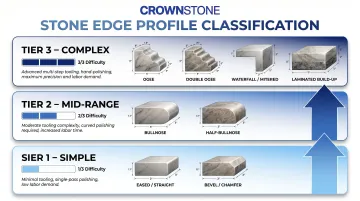
Profile names vary by shop and region. What one fabricator calls "eased," another might call "straight." A "chamfer" and a "bevel" are often used interchangeably. The Natural Stone Institute's Dimension Stone Design Manual recognizes over a dozen distinct nomenclatures — straight/eased, pencil round, chamfer/bevel, bullnose variations, ogee profiles, cove combinations, mitered edges, and laminated build-ups among them.
That inconsistency has a practical consequence: always confirm profiles by cross-section sketch rather than name alone. A shared drawing eliminates the ambiguity that leads to misaligned client expectations and remakes.
Material type directly affects which profiles are feasible and which tooling grades are appropriate:
- Granite requires higher-grade diamond tooling and slower feed rates to manage hardness
- Marble shapes faster but chips under excess pressure, so tooling contact must stay controlled
- Engineered quartz generates significant heat at routing speeds — robust cooling is non-negotiable
- Thin porcelain restricts profile options; several complex edges risk breakage without specialized support
Each of these material behaviors directly determines which machine configurations and tooling setups apply to a given profile — which is where the equipment breakdown begins.
The Equipment Foundation Every Shop Needs Before Edge Profiling
Bridge Saw: The Starting Point for Edge Quality
Before any edge profiling begins, a bridge saw delivers accurate, clean slab cuts — straight factory edges and precise angles for miter work. Inaccurate initial cuts compound edge profiling difficulty, increase tool wear, and drive up rework rates.
A clean, square saw cut reduces grinding time before profiling. Stone World's seam preparation article reinforces this principle: dressing a saw-cut edge to a precise seam depends entirely on how clean and square that initial cut was. Shops that start with a dimensionally accurate cut spend less time at the profiling stage and put less stress on their tooling.
Crown Stone USA manufactures bridge saws specifically engineered by experienced stone fabricators. Their equipment features air-cylinder powered indexing that pulls the table to exact 90° and 45° angles for repeatable cuts, plus an air brake that locks the table at any angle for precise cutting control. That repeatability means miter faces mate cleanly and profiling tools engage square stock — not a corrective grind away from a usable edge.
Secondary Tooling Stack: Shaping and Polishing
With a clean cut as the starting point, the profiling process relies on a consistent tooling stack. Every shop needs:
Shaping Tools:
- Cup wheels for initial stock removal and shaping
- Diamond router bits or profiling wheels matched to profile geometry
- Grinder/router (hand or CNC-mounted)
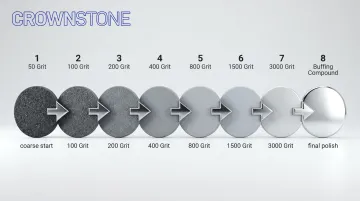
Polishing Sequence:A seven-step grit progression is standard for granite and quartz edge polishing, according to Dynamic Stone Tools:
- 50 → 100 → 200 → 400 → 800 → 1500 → 3000 grit
After the 3000 grit step, apply buffing compound for the final high-gloss finish. This sequence applies to most hard stone; marble may require adjustments to avoid over-polishing soft calcite.
Simple to Mid-Range Profiles: Equipment Requirements
Eased and Straight Edge
The eased or straight edge is the fastest, least tool-intensive profile in any shop's lineup. Core requirements are minimal:
- Single CNC tool pass or hand-guided router pass
- Flat-face profiling wheel for edge contact
- Flat polishing wheel to lightly radius the top corner (typically 3–5mm)
The Natural Stone Institute specifies pencil round radii on the order of approximately 1/8–5/32 inch (about 3–4 mm) for eased edges, with a standard arris (small chamfer) at roughly 1/16 inch × 1/16 inch to prevent chip-out from saw blades.
The polishing sequence for eased edges follows the standard 50–3000 grit progression on granite and quartz. Because the radius is minimal and the face is largely flat, polishing time is straightforward and short.
Bevel/Chamfer Edge
The bevel is a 45-degree angled cut requiring a chamfer bit or angled CNC wheel. Bevel width changes both material removal and polishing requirements:
- Micro-bevel (3–5mm): Minimal polishing, fast execution
- Wide architectural bevel (15–20mm): Exposes more stone face, requires full polishing sequence on the angled face
On directional-veining materials like marble and quartzite, bevel angle must be consistent across the full countertop run. A CNC setup provides repeatability that hand-guided chamfer work cannot reliably match at production volumes.
Bullnose (Half and Full)
Bullnose profiles require a rounded router bit whose radius matches the intended profile. Half bullnose uses a partial-radius bit affecting only the top portion; full bullnose requires a full-radius pass from top surface through the front face, removing more material and requiring additional polishing time.
Polishing direction shifts from horizontal (top surface) to curved (edge face), so pads must follow the contour. Alpha Professional Tools recommends "extremely flexible" backer pads for tough contours and inside curves, with undersized backers so the pad can overhang and conform to tight radii. Wet-only use at a maximum 6,000 RPM (recommended under 4,000 RPM) is standard.
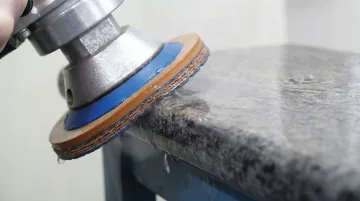
The same 50–3000 grit sequence used for eased edges applies here — the difference is execution. Flexible pads keep contact even across the full curve, preventing flat spots or over-polishing at transition points.
Complex and Premium Profiles: Equipment Requirements
Ogee Edge
The ogee is an S-curve profile (concave-to-convex) that requires a shaped ogee router bit whose cross-section is the inverse of the profile. The concave portion of the bit produces the hollow of the S; the convex produces the raised portion. Achieving a clean ogee on the first pass requires the correct bit geometry and proper router speed for the material being cut. Shops should consult the diamond bit manufacturer's published RPM/feed/water settings for the exact tool and material.
The concave channel of the ogee is the hardest section to polish. Flexible finger-profile polishing pads or contour polishing attachments are required to reach into the hollow without rounding off the S-curve's transition points. Shops without these tools produce ogee profiles with visibly unpolished recesses — a common quality failure that requires complete re-work.
The double ogee multiplies these requirements: two tool passes with precise alignment between them, and a longer polishing sequence. Dynamic Stone Tools notes that the double ogee requires multiple passes with several specialized bits and has the highest fabrication time among standard profiles. This profile is profitable only in shops with CNC capability or fabricators with significant hand-profiling experience.
Waterfall and Mitered Edge
The waterfall or mitered edge requires a precision 45-degree miter cut on two stone pieces — a bridge saw operation. The accuracy of that cut determines whether the bonded joint is invisible or visible in the finished installation.
Miter Precision:Dynamic Stone Tools' fabrication guide states that a deviation of even approximately 0.5 degrees from 45 degrees produces a visible gap on one face. Miter faces should mate with zero visible gap. To hit that standard:
- Use a precision angle gauge before every cut
- Make a slow, single-pass tilting-head saw cut with a fresh or dressed blade
- Reduce feed rate roughly 30–40% compared to straight cuts
- Maximize water flow throughout the cut
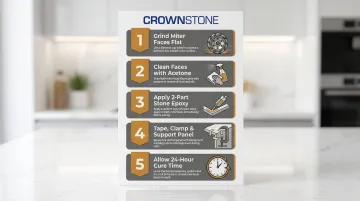
Post-Cut Process:Once the miter faces are cut, follow this bonding sequence:
- Grind miter faces flat with a cup wheel
- Clean both faces with acetone
- Apply 2-part stone epoxy or polyester (not silicone) to both faces
- Tape and clamp; support the vertical waterfall panel during cure
- Allow approximately 24 hours of cure time
After curing, remove squeeze-out and hand-grind the 90-degree corner to match the surrounding finish. Blending across the miter joint without creating a visible step is the key polishing challenge — it requires careful hand grinding along the transition.
Short Miter vs. Full Waterfall:A short miter edge build-up creates the appearance of a thicker slab, while a full waterfall installation runs stone vertically to the floor. Both require the same miter cutting precision but differ in material quantity and installation complexity. Fabricators should factor material wastage into pricing; European Granite Design reports waterfall countertops typically require a 20–40% higher investment than standard installations due to extra material and specialized labor.
Laminated Build-Up Edges
Laminated edges require a second strip of matching stone bonded to the underside of the slab edge to create the visual appearance of a thicker slab. The critical equipment requirement is a bridge saw cut that produces a perfectly square laminate strip — deviation in the laminate strip dimensions creates bonding gaps that show in the finished edge.
Tenax's fabrication training describes a 45-degree lamination technique where two pieces are bonded so the seam lands precisely on the edge corner, helping conceal the joint after profiling and polishing.
After bonding with structural epoxy and clamping, the combined edge face is profiled and polished as if it were solid stock. Any profile — eased, ogee, bullnose — can be applied to the laminated face. The laminate seam should be invisible after profiling and polishing if the bond was tight.
Key Factors That Shape Your Equipment Decisions
Material Hardness and Density
Material type dictates tooling selection, feed rates, and coolant requirements. Dynamic Stone Tools' CNC guide emphasizes that shops must match diamond tooling and settings to material hardness. Porcelain and quartzite are "notoriously brutal" on tooling, requiring robust coolant and appropriate feeds. Marble is softer but heat- and pressure-sensitive.
Engineered quartz generates significant heat during high-speed routing. The ENVI Quartz Fabrication Guide prohibits dry cutting and polishing due to heat buildup and respirable crystalline silica (RCS) dust hazards. Use quartz-specific abrasives and maintain continuous coolant flow throughout profiling operations.
CNC vs. Hand-Guided Equipment Decision
The choice between CNC and hand-guided routing comes down to volume, profile complexity, and how much variability your shop runs day to day.
Dynamic Stone Tools reports CNC edge profiling runs 20–40 minutes per edge set versus 60–90 minutes for skilled hand routing — and pre-programmed job changeovers cut another 15 minutes per run. At roughly 15+ full kitchens per week, CNC investment starts paying for itself. The 15–30 kitchens-per-week range is a common entry point for a 5-axis center.
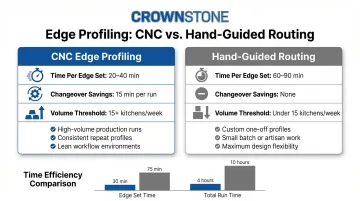
Hand-guided routing stays the better fit for:
- Custom one-off profiles with no repeat demand
- Field corrections where CNC access isn't practical
- Shops that run highly variable profiles across small batches
High-volume shops running the same profile across consistent material justify CNC investment. Custom shops with variable work benefit from the flexibility of hand-guided equipment.
Common Equipment Mismatch Mistakes
Even experienced shops run into equipment mismatches that cost time and tooling. The most common ones:
- Wrong-geometry router bit: Attempting an ogee with a flat wheel damages tooling and produces unusable results — always match bit geometry to the intended profile
- Skipping intermediate polishing grits: Jumping grit ranges to save time causes visible scratching in profile faces that requires complete re-grinding to fix
- Using 3-axis equipment for compound angles: Miters and multi-plane profiles require 5-axis capability; forcing 3-axis creates geometry errors
- Undersized or low-quality tooling: Tooling that fails mid-job costs more in downtime than the upgrade would have
- No dedicated CNC programmer: High-volume shops without a programmer lose the throughput gains CNC is supposed to deliver
- Cardboard templates instead of digital templating: Analog templates introduce cumulative error across cuts that digital eliminates
Frequently Asked Questions
What is the best edge profile for countertops?
The "best" profile depends on the client's kitchen style and the material being used. Eased and bevel edges suit modern kitchens and high-traffic use, while ogee and waterfall edges suit traditional or luxury applications. Fabricators should guide clients toward profiles the shop can execute consistently and profitably.
What is a waterfall edge?
A waterfall edge continues the stone slab's surface pattern vertically down the side of the cabinetry to the floor using a precision 45-degree mitered joint. It requires matched slabs, accurate bridge saw miter cuts, and careful bonding — polishing the seam to invisible is the final test of the fabricator's skill.
Can you do an ogee edge on granite?
Yes, ogee edges are frequently applied to granite. Granite's hardness demands the correct diamond-tipped ogee router bit run at the right feed rate and RPM. Contour polishing pads are essential for finishing the concave channel without leaving tool marks or unpolished recesses.
What are the different materials used for countertop edges?
Countertop edges are cut from the same stone as the slab itself — granite, marble, quartzite, quartz, or porcelain. The edge is not a separate material but a shaped and polished face of the slab. Material type determines which profiles are feasible and which tooling is required.
What is the current trend on countertop edges?
Client demand is shifting toward waterfall and mitered edges in contemporary kitchens, with clean eased profiles remaining a steady staple. Ogee profiles are gaining traction in traditional and luxury renovations. Shops that can cut accurate mitered waterfall edges are winning more of the high-value remodel work.
How much extra does a waterfall countertop cost?
Waterfall edges typically add significant cost due to additional material (matched slab panels), precise miter cutting, bonding labor, and polishing time. Industry sources report a 20–40% premium over standard installations, though exact pricing depends on material selection, project complexity, and local market conditions.