Introduction: Why Diamond Blade Selection Is a Fabricator's First Decision
Choosing the wrong diamond blade for granite doesn't just slow production—it chips slabs, burns bonds, and turns a profitable job into a rework nightmare. When a fabricator loads a $300 blade onto a bridge saw, that blade will either extract maximum linear footage from every dollar spent or burn through segments before the first slab is done.
This guide covers blade anatomy, types, stone-matching logic, operating parameters, and how to get the most life from every blade. It addresses the real-world stakes: consistent edge quality, predictable blade life, and cost-per-foot calculations that directly affect profitability.
TLDR
- Soft bond for hard granite: the bond must shed to keep fresh diamonds exposed
- Segment height determines blade life more than price — taller segments mean more linear feet
- Water flow at 6-8 GPM for granite is non-negotiable for blade cooling and OSHA silica compliance
- Silent core blades reduce noise by 10 dB(A), from 105 to 95 dB(A), improving shop safety
- Cost per linear foot is the only meaningful measure—not hours, not jobs
Diamond Blade Anatomy: What You're Actually Paying For
The Five Core Components
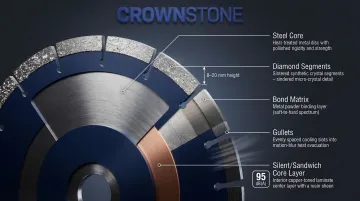
Every diamond blade consists of five fundamental parts that determine cutting performance:
Steel core — A round, flat metal disc that supports the outer segments. It keeps cuts straight and absorbs heat during cutting. Premium cores undergo heat treatment for higher strength; wholly sintered cores cannot be quenched and tend toward lower rigidity.
Diamond segments — Synthetic diamond crystals sintered into metal powder to form the cutting teeth. Segment height determines blade life — MK Diamond's granite blades range from 8 mm (standard) to 20 mm (premium silent core), a 2.5x difference in usable diamond material.
Bond matrix — A mixture of metal powders that holds diamonds in place just long enough to maximize their cutting efficiency before releasing worn diamonds and exposing fresh ones. Norton describes this as the "glue" that wears away at a controlled rate. Soft bonds contain bronze and show a yellow tint; hard bonds contain tungsten carbide and appear darker.
Gullets — Slots between segments that evacuate slurry and heat from the cutting zone. Adequate gullet size allows debris to escape rather than clogging the cut, which would generate excessive heat and accelerate bond failure.
Silent/sandwich core layer — Found in premium models, this construction bonds two steel cores with a copper or resin center layer. MK Diamond documents that sandwich core blades produce only 95 dB(A) compared to approximately 105 dB(A) for standard cores — a 10 dB(A) reduction that matters in enclosed shops where operators run blades for hours at a stretch.
Bond Hardness: The Single Most Important Spec
Bond hardness determines how quickly the matrix wears away to expose fresh diamonds. For granite fabricators, this specification matters more than diameter, segment count, or price.
The counterintuitive rule: Hard, dense granite requires a soft bond. Soft, abrasive materials require a hard bond.
Norton Abrasives calls this "opposites attract." The mechanism is straightforward: granite's extreme hardness dulls diamond crystals fast. A soft bond releases those dulled diamonds before they go completely ineffective, exposing fresh ones underneath to keep the cut moving.
Use a hard bond on granite and the opposite happens. Diamonds dull and round off without releasing — a condition called glazing. The blade generates heat, slows to a crawl, and often needs dressing or replacement well before the segment height is gone.
Bond classification by composition:
- Soft bonds: Mostly bronze content, appear yellow-tinted, designed for very hard, dense granites
- Medium bonds: Balanced composition, general-purpose use for mid-range granite densities
- Hard bonds: High tungsten carbide content, darker appearance, designed for softer, more abrasive materials like marble or limestone
Segment Geometry Basics
Three segment specifications interact to determine cutting speed, edge finish, and blade longevity:
Segment height — Taller segments contain more diamond material and last longer, but introduce more flex on deep cuts. MK Diamond's spec sheets show 8 mm for standard granite blades and up to 20 mm for premium silent core models on 16"–20" diameters. ChinaStoneTools lists 10, 12, 15, and 20 mm as available heights for matrix and arix segments.
Segment count — More segments produce a smoother edge finish but slower cutting speed. Fewer segments cut faster but leave a rougher edge that requires polishing.
Core thickness — Thinner cores waste less material and reduce motor load, but become more vulnerable to wobble at high RPM. Thicker cores provide rigidity but remove more kerf material per pass.
Knowing these specs lets you read a data sheet with intention — not just compare price tags.
The Five Diamond Blade Types Used in Stone Fabrication
Continuous Rim Blades
Continuous rim blades feature a smooth, uninterrupted edge design that produces the cleanest, chip-free cuts available. MK Diamond describes these as ideal for "clean, smooth cuts on glazed ceramic tile, marble, granite" with minimal edge breakout.
Best for:
- Visible countertop edges
- Miter cuts where both faces will be exposed
- Polished granite applications requiring minimal finishing
Tradeoff: Slowest feed rate of all blade types. The solid rim limits debris evacuation and heat dissipation, requiring abundant water flow and conservative cutting speeds.
Wet-cut only. These blades must be used with water to prevent segment overheating and bond failure.
Segmented Blades
Segmented blades use distinct tooth-and-gullet construction that maximizes cooling and debris evacuation for the fastest cutting speed. MK Diamond markets these for "maximum life and cutting strength" on stone.
Best for:
- Rough dimensioning of thick granite slabs
- High-volume cutting where speed matters more than surface quality
- Situations requiring maximum blade life under aggressive feed rates
Tradeoff: Roughest edge finish of all blade types, typically requiring a polishing pass before installation. The aggressive gullet design prioritizes speed over surface quality.
Available in diameters from 4" to 60", segmented blades can be run wet or dry depending on application and blade construction.
Turbo Rim Blades
Turbo blades feature an angled, serrated rim design that sits between continuous and segmented types in both speed and finish quality. This makes them the most versatile option for mixed-material shops.
Best for:
- General granite fabrication where both speed and finish quality matter
- Wet or dry use on angle grinders for sink cutouts
- Curved or shaped cuts requiring maneuverability
MK Diamond describes turbos as providing "fast cutting with minimal chipping," positioning them as the compromise choice when fabricators need balanced performance across multiple applications. Available in 4"-16" diameters and usable wet or dry, turbos are the most commonly run blade type in general granite fabrication — though wet cutting significantly extends blade life.
Silent Core (Bridge Saw) Blades
Silent core blades use sandwich construction — two steel cores laminated with a copper center layer — that dampens vibration and reduces cutting noise. MK Diamond rates these blades at 95 dB(A) compared to approximately 105 dB(A) for standard cores — a 10 dB(A) reduction that directly lowers operator hearing risk.
Best for:
- High-volume countertop shops running production bridge saws
- Enclosed facilities where OSHA noise compliance matters
- Operations prioritizing operator safety and long-term hearing protection
Wet-cut only. These blades require consistent water delivery to perform at full rated capacity. Available in 14"-20" diameters with segment heights up to 20 mm on larger sizes.
The blade is only half the equation. Silent core blades depend on consistent RPM, mechanical rigidity, and steady water flow to the cutting zone — which is why the bridge saw running them matters as much as the blade itself. Crown Stone USA builds their bridge saws with water delivery systems designed around exactly this requirement. An undersized or poorly maintained saw will undercut a premium blade regardless of its engineering.
Contour and Specialty Blades
These blades handle work that standard production blades can't:
- Contour blades — thin, flexible design for curved sink cutouts and radius cuts; not suited for straight-line production
- Milling wheels — surface planing and flattening, typically run on CNC equipment
- Concave blades — bowl and trough cuts requiring interior radius profiles
None of these are everyday runners, but when a job demands one, nothing else substitutes.
How to Match Your Blade to the Stone and the Machine
Granite Is Not One Material
Granite varies dramatically in density and quartz content, directly affecting bond selection. Very dense, dark granites require soft-bond blades; lighter, more porous granites can tolerate harder bonds.
Bond Matching by Granite Type:
| Granite Type | Density/Characteristics | Recommended Bond |
|---|---|---|
| Absolute Black, Impala Black | Very hard, dense, high quartz content | Soft bond (bronze-rich) |
| Santa Cecilia, Ubatuba | Medium density, moderate quartz | Medium bond |
| Kashmir White, Colonial White | Lighter, more porous, lower quartz | Medium to hard bond |
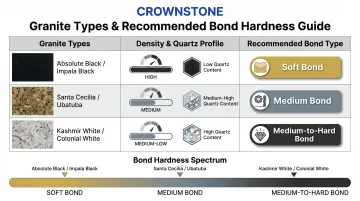
Dynamic Stone Tools confirms that "hard, abrasive stone types (granite, concrete, extremely hard sintered stone) demand soft or medium bonds." The mechanism: hard granite dulls diamonds quickly, so the bond must release those dulled diamonds rapidly to expose fresh cutting surfaces.
Diameter and Arbor Matching
Blade diameter must match the saw's design specifications—not just clear the guard, but match the motor's torque curve and the depth of cut required for slab thickness.
Common size categories:
- 4"–7" — Angle grinders for sink cutouts, field trims; arbor typically 5/8" or 7/8"
- 10"–12" — Mid-size circular and track saws; arbor typically 1"
- 14"–18" — Production bridge saws (standard core); arbor typically 1" or 50–60 mm
- 16"–20" — Large bridge saws (silent core); arbor typically 60–50 mm
MK Diamond's spec sheets confirm that arbor size changes with blade diameter and core type. Standard-core granite blades use 1" arbors, while silent-core versions on the same diameter may use 60–50 mm arbors. Verify arbor compatibility before purchasing. Adapters and off-spec bushings introduce wobble that shortens blade life and degrades cut quality.
Wet vs. Dry Decision for Granite
Once you've confirmed diameter and arbor fit, the next decision is coolant. Granite should almost always be cut wet in a fabrication shop setting. Water performs four critical functions:
- Cools the diamond bond, preventing premature diamond release
- Suppresses silica dust in compliance with OSHA's crystalline silica rule (29 CFR 1910.1053)
- Removes slurry from the cutting zone
- Extends blade life significantly
OSHA's respirable crystalline silica standard sets a permissible exposure limit of 50 µg/m³ (8-hour time-weighted average) with an action level of 25 µg/m³. Wet cutting with adequate water flow is a primary engineering control for compliance.
When dry cutting is acceptable:
- Very shallow field trims (under 1/4" depth)
- Emergency on-site corrections where water isn't available
- Situations requiring mobility that wet systems can't provide
Required precautions for dry cutting:
- Feather the cut in shallow passes, never plunging full depth
- Allow blade to free-spin periodically to cool between passes
- Use proper dust extraction with N95 or higher respirator
- Limit exposure duration to minimize silica inhalation risk
Calculating True Cost Per Linear Foot
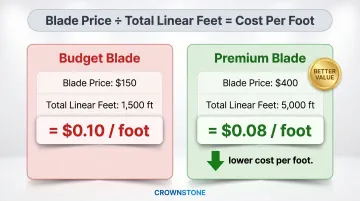
The upfront blade price is a poor measure of value. A premium blade that cuts significantly more linear feet before failure can cost substantially less per foot than a budget blade.
Formula: Cost per linear foot = Blade price ÷ Total linear feet cut
Example:
- Budget blade: $150 price, cuts 1,500 linear feet = $0.10 per foot
- Premium blade: $400 price, cuts 5,000 linear feet = $0.08 per foot
Husqvarna Construction confirms this principle: "For larger jobs or more regular use, a higher priced blade will actually be less expensive to use because it will deliver the lowest cost per cut."
Log linear footage by blade type and material. Even a simple spreadsheet tracking blade, stone type, and footage cut will surface which blades are actually earning their price in your shop.
Reading Warning Signs Before the Blade Fails
Blades give clear signals when performance degrades. Consistent sparking at the kerf usually means the bond has glazed over — dress the blade with a soft abrasive brick to re-expose the diamond grit. Smoke or a burning smell points to insufficient water flow or a feed rate that's too slow; check your delivery nozzles and increase feed pressure.
An audible pitch change mid-cut is more serious. Stop immediately and inspect segments for cracks or loss — that sound is the blade loading up or taking damage. Visible segment loss or core wobble means pull the blade now. Continuing to run a damaged blade risks catastrophic failure.
Operating Parameters: How You Run the Blade Matters as Much as Which Blade You Choose
RPM: Never Exceed Rated Speed
Every diamond blade carries a maximum RPM rating stamped on the core. Exceeding this rating overheats the bond, warps the core, and can cause catastrophic segment loss.
RPM Formula: RPM = (Surface Feet per Minute × 3.82) ÷ Blade Diameter in Inches
The constant 3.82 comes from 12/π — converting the blade's diameter and surface speed into rotational speed.
Maximum RPM by Blade Diameter (from Vortex Diamond):
| Blade Diameter | Maximum Safe RPM |
|---|---|
| 7" | 8,730 |
| 10" | 6,115 |
| 12" | 5,095 |
| 14" | 4,365 |
| 16" | 3,820 |
| 18" | 3,395 |
| 20" | 3,055 |
Always verify your saw's spindle speed against the blade's rated spec — especially when swapping blade sizes. Vortex Diamond documents three failure modes from overspeed operation:
- Blade warping from overheated bond material
- Segment loss — segments ejected at high speed
- Complete core destruction, which can cause serious injury
Feed Rate: The Goldilocks Zone
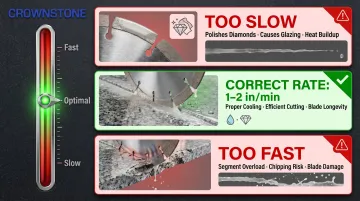
Steady, consistent feed rate is essential. Too slow "polishes" diamonds without exposing fresh ones, causing glazing. Too fast overloads segments and causes chipping or segment loss.
Dynamic Stone Tools recommends 1-2 inches per minute for granite on bridge saws. Start at approximately 70% of the saw's maximum feed rate and adjust based on the slurry stream:
- Continuous, fine slurry — Proper feed rate and water flow
- Dry or intermittent slurry — Slow down or check water delivery
DinoSawMachine confirms the glazing mechanism: "The bond won't wear away fast enough. The exposed diamonds will become dull and rounded, causing the blade to stop cutting." Running too slow reduces cutting efficiency and causes segments to glaze prematurely.
Water Flow and Delivery: The 6-8 GPM Rule
Adequate water volume must reach the cutting interface — not just splash on the blade face. Dynamic Stone Tools provides material-specific guidance:
Recommended water flow for granite: 6-8 GPM
For comparison:
- Quartzite: 7-9 GPM
- Engineered quartz: 6-7 GPM
Check nozzle position regularly and keep lines clear — a clogged or misaligned nozzle defeats even the right flow rate. Dropping below 5 GPM accelerates bond degradation and increases respirable silica exposure risk.
When evaluating bridge saw options, look for water delivery systems that maintain consistent flow directly to the cutting zone — not just surface-level coolant. Crown Stone USA designs their saws with this in mind, given how directly water delivery affects blade life in production environments.
Blade Dressing: Reviving a Glazed Blade
Even a good blade can glaze over after extended use — the bond surface becomes polished and diamonds stop cutting efficiently. Johnson Tools confirms the solution: "Keep a dressing stone handy — it's an easy way to revive a blade that's just glazed."
How to dress a blade:
- Cut into a soft abrasive material (dressing stone or soft brick)
- Make several shallow passes to abrade the bond surface
- Re-expose fresh diamond grit
- Run a test cut to verify cutting performance
Glazed blade vs. end-of-life blade:
- Glazed (dressable): Segments look shiny, glassy, or caked with debris — dressing will restore cut quality
- End-of-life (replace): Segments worn to the steel core, or blade stays slow and rough even after dressing
Dress when cutting performance noticeably degrades and segments appear glazed. Dressing frequency varies with material hardness, bond type, and operating parameters, so track performance over time to find your shop's natural interval.
Maximizing Blade Life: Shop Practices That Compound Over Time
Break-in and Storage
New bridge saw blades benefit from a break-in pass on scrap material before running production cuts. This allows the bond to open up and seat properly, ensuring optimal performance from the first production pass.
Proper blade storage:
- Store flat or hung vertically
- Keep away from moisture and impact
- Avoid stacking carelessly—dropping or mishandling blades can cause core micro-cracks that aren't visible until the blade fails mid-cut
Tracking Performance by Blade
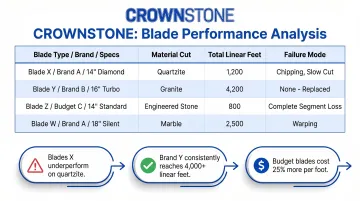
Shops that document which blades produce how many linear feet on which materials build a knowledge base that directly improves purchasing decisions and reduces downtime.
Simple tracking approach:
Create a spreadsheet logging:
- Blade type, brand, and specifications
- Material cut
- Total linear feet achieved
- Failure mode (glazed, segment loss, core damage)
After a few months of logging, patterns emerge: which blades underperform on quartzite, which brands consistently hit 4,000+ linear feet, and where the purchasing budget is quietly leaking.
That performance data also makes the following mistakes harder to ignore—because you'll see exactly what they cost you.
Three Common Mistakes That Shorten Blade Life Prematurely
1. Running outside rated RPM or with insufficient water flow
Exceeding maximum RPM generates excessive heat, warps the core, and causes premature segment failure. Insufficient water (below 6 GPM for granite) accelerates bond degradation and increases silica exposure. Check your saw's RPM setting against the blade's rated maximum, and verify water flow volume with a bucket test—both take under five minutes.
2. Buying by price rather than cost-per-foot
A $150 blade that cuts 1,500 linear feet costs more per foot than a $400 blade that cuts 5,000 feet. Track actual performance to make informed purchasing decisions based on delivered value, not sticker price.
3. Running a glazed blade rather than dressing it
When cutting performance drops and segments appear shiny or caked, operators often continue forcing the cut or prematurely replace the blade. Dressing with a soft abrasive stone takes minutes and can restore cutting performance. Done consistently, it adds hundreds of linear feet to blades that would otherwise get tossed.
None of these mistakes require new equipment or major process overhauls. A verified RPM setting, a simple spreadsheet, and a dressing stone on the shelf are enough to stop most preventable blade failures.
Frequently Asked Questions
What kind of diamond blade do I need to cut granite?
Granite requires a soft-bond diamond blade due to its density and high quartz content. Choose the rim style based on finish quality required: continuous rim for clean, chip-free edges; turbo for general-purpose wet or dry use; segmented for fast rough cuts where edge finish will be polished afterward.
What's the difference between a diamond turbo blade and a diamond segmented blade?
Turbo blades have an angled, serrated rim that balances cutting speed with a relatively smooth edge finish, suitable for wet or dry use. Segmented blades have distinct tooth-and-gullet construction for maximum speed and cooling, but leave a rougher edge that typically requires a finishing pass.
How long does a diamond blade last?
Blade life varies considerably by blade size, bond quality, stone hardness, water flow, and RPM accuracy. Smaller grinder blades typically cut hundreds to a few thousand linear feet, while premium bridge saw blades can reach several thousand linear feet under proper operating conditions. Cost per linear foot is a more meaningful measure than hours or jobs.
Is it better to cut granite wet or dry?
Wet cutting is strongly preferred for granite in a shop setting. Water cools the bond, extends blade life and suppresses crystalline silica dust — keeping you within OSHA's 50 µg/m³ PEL. Dry cutting works for shallow field trims only, with proper dust control in place.
How do I prevent chipping when cutting granite?
Prevent chipping by addressing the most common causes:
- Use a continuous rim or sharp turbo blade with 6-8 GPM water flow
- Maintain a consistent feed rate — don't force or stall the blade
- Support and secure the granite fully before cutting
- Replace glazed or damaged segments, which increase edge breakout risk