Introduction
Dekton and Neolith are landing in more fabrication shops every year—and they punish shops that treat them like granite or quartz. Both materials are fused under extreme heat and pressure into surfaces denser and harder than anything most fabricators cut daily. Dekton uses Cosentino's TSP (Technology of Sintered Particles) process, achieving 25,000 tons of pressure and near-zero porosity. Neolith is sintered at similarly extreme parameters, reaching densities of 2.4 g/cm³ and water absorption below 0.1%.
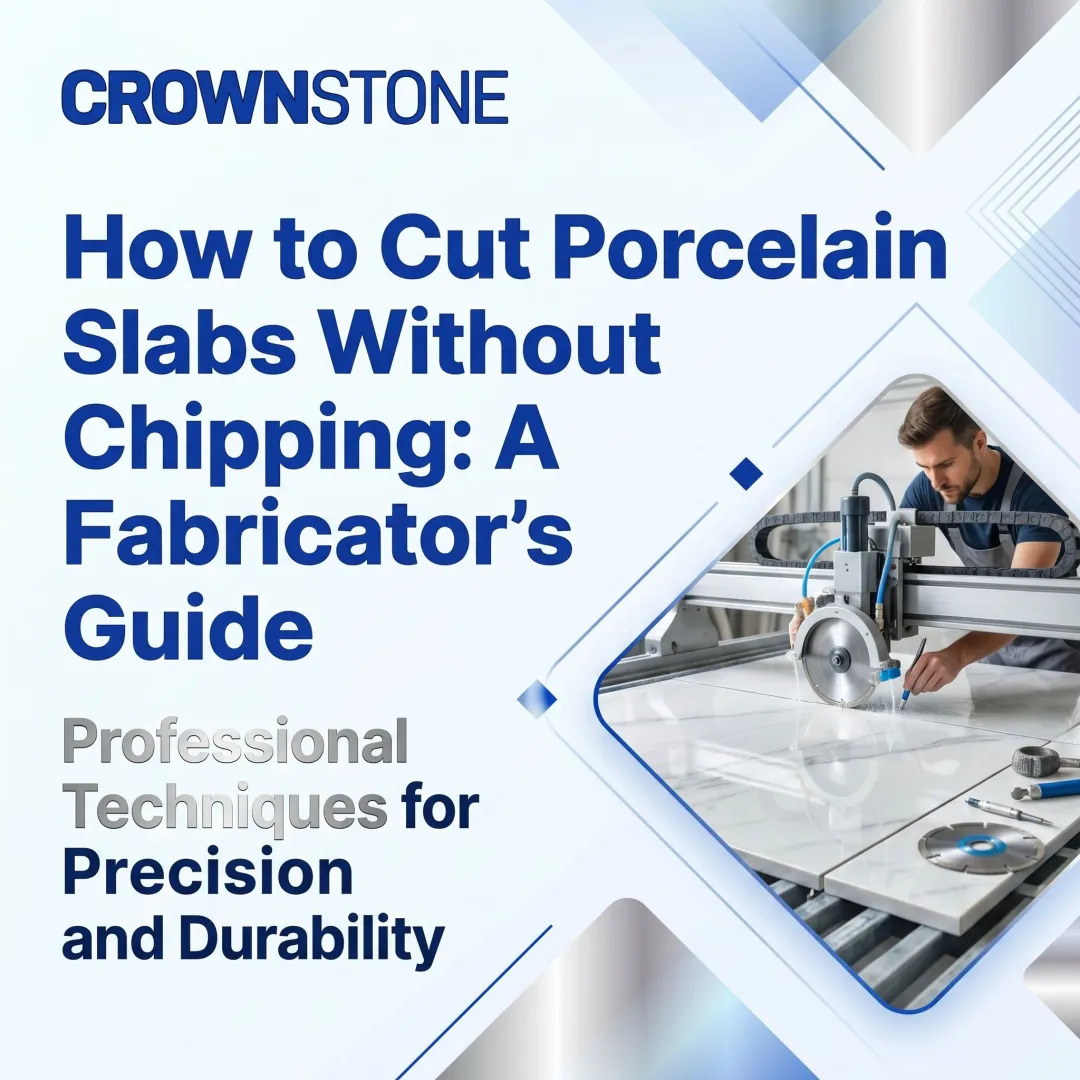
Cutting sintered stone is possible with the right shop setup, but the material is unforgiving. Small errors in blade selection, feed rate, or water flow result in chipping, cracking, or ruined slabs. This guide covers what equipment, blade specs, parameters, and process steps will get clean cuts consistently — every time.
TL;DR
- Use a continuous-rim diamond blade rated for sintered or ultra-compact stone
- Cut wet with high-volume water flow aimed directly at the blade contact point
- Feed slow and steady — never push through resistance
- Rigid, stable machines prevent vibration-induced edge chipping
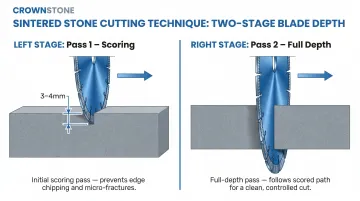
- Score shallow passes first before cutting full depth to reduce chipping
Why Sintered Stone Is Harder to Cut Than Granite or Quartz
Sintered stone is mechanically different from traditional stone surfaces. The sintering process compresses natural minerals under extreme heat and pressure — Dekton is manufactured with 25,000 tons of uniform pressure, producing surfaces with null porosity and no micro-defects.
The numbers back that up: Dekton shows apparent density of 2.44–2.53 g/cm³, open porosity of just 0.2%, and flexural resistance of 48–55 N/mm². Neolith delivers similar performance at 2.4 g/cm³ density with a modulus of rupture between 47–57 N/mm².
This same density that makes sintered stone durable also makes it brittle under the wrong cutting conditions.
Specific Challenges in the Shop
Dekton and Neolith present distinct challenges for fabricators:
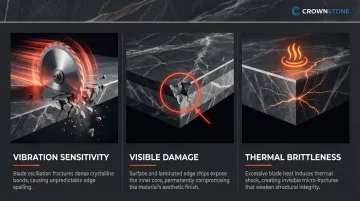
- Vibration sensitivity: Dekton is particularly sensitive to blade vibration and inconsistent feed rates; any lateral flex in the cutting head translates directly to edge chipping
- Visible damage: Neolith often features through-body patterning, meaning any chip or deviation is immediately visible on laminated edges—there's no hiding mistakes
- Thermal brittleness: Both materials are prone to micro-fractures at the cut edge when heat builds up or the blade glazes over
The Chipping Risk
Unlike granite where a chip can sometimes be polished out, sintered stone edge damage is usually not recoverable. Cosentino's R&D team emphasizes that without proper water flow, correct speed, and controlled feed rate, there's serious risk of breaking tools, the material, or even damaging machinery. That's not a margin-of-error situation — it's a wasted slab and a lost job.
What You Need to Cut Sintered Stone in Your Shop
Preparation directly determines results. Having the wrong equipment or blade going into a sintered stone job is the single most common source of wasted slabs and callbacks.
Equipment and Machine Requirements
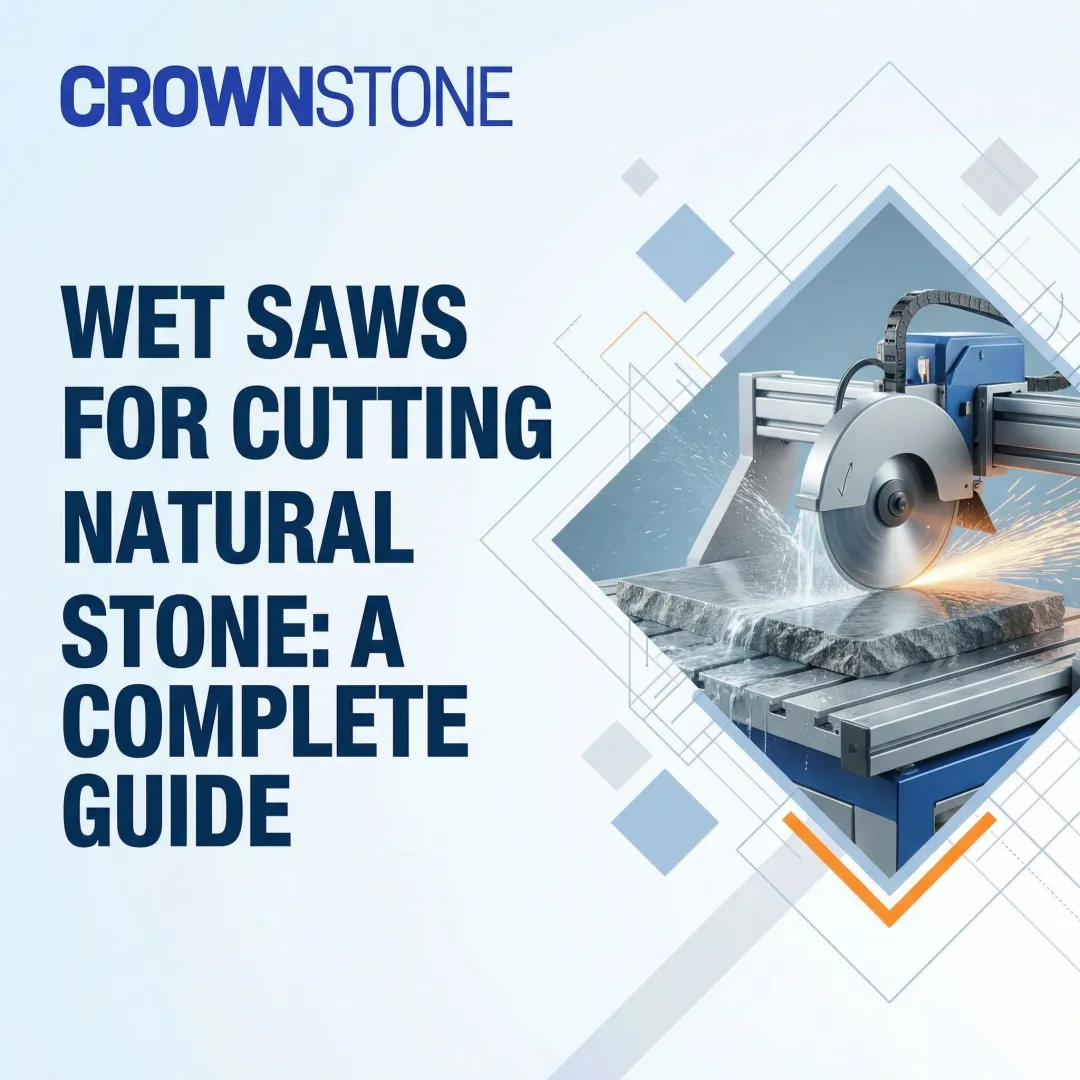
The primary tool for shop cutting of sintered stone slabs is a bridge saw or precision track saw with a rigid, vibration-dampened cutting head. Rigidity matters more than motor power alone—any lateral flex in the cutting head translates directly to chipping at the cut line.
For shops handling sintered stone regularly, a saw like Crown Stone USA's Avalanche Pro—with its 20 HP blade motor and CNC-machined rolling surfaces designed to prevent moisture trapping—addresses exactly this rigidity requirement.
For cutouts and curved profiles: CNC machines or waterjet systems are the standard. Neolith publishes waterjet parameters of 3,500-3,700 bar pressure with 0.4 kg/min abrasive flow for clean internal cuts. Angle grinders with appropriate diamond blades can handle small field cuts but don't deliver consistent results for primary slab cuts due to inconsistent feed rate control.
Blade Requirements
Sintered stone requires a continuous-rim or turbo-rim diamond blade rated specifically for ultra-compact surfaces or porcelain/sintered stone—not a general granite blade.
Key blade specs to look for:
- High diamond concentration for aggressive cutting
- Soft metal bond to allow self-dressing on hard materials
- Thin kerf to reduce cutting pressure
- Peripheral speed rating of 35-40 m/s (Neolith recommendation)
- RPM range of 2,000-2,600 for 300-400mm diameter blades
Segmented blades—appropriate for granite—cause micro-shock at each gap that can fracture sintered stone at the edge. Continuous or fine turbo-rim blades provide constant contact, reducing chipping risk significantly. Industry suppliers like Tenax and Diamax manufacture blades specifically engineered for Dekton and ultra-compact materials in 14", 16", and 18" sizes.
Water and Cooling Setup
Sintered stone must always be cut wet. The material generates significant heat at the blade contact point; without continuous water flow, the blade glazes over, the material micro-cracks from thermal shock, and edge chipping becomes severe.
Water flow requirements:
- Direct maximum flow at the cutting point, not just generally onto the slab surface — see the Dekton Technical Manual for machine-specific guidance
- Water must hit both sides of the blade at the contact zone
- Crown Stone USA's water recycling systems deliver 40 GPM (small version) or 70 GPM (large version) with flocculant-based sediment settling for continuous shop operation
Skill and Safety Readiness
Operators should be familiar with bridge saw operation and slab handling before cutting sintered stone slabs. Review silica dust exposure protocols—sintered stone cutting generates fine respirable dust, and OSHA silica regulations require wet cutting plus appropriate respiratory protection. Verify shop dust and water management systems are functional before starting.
How to Cut Sintered Stone: Step-by-Step
These steps apply to straight slab cuts on a bridge saw, the most common shop scenario for Dekton and Neolith countertop fabrication.
Step 1: Measure, Mark, and Inspect the Slab
Inspect the full slab surface before cutting—look for pre-existing hairline cracks, voids, or stress fractures. Sintered stone can arrive from shipping with micro-damage that won't show up until a cut is made nearby.
Mark cut lines clearly on both the top and underside using a non-permanent marker or chalk. Confirm measurements twice; repositioning the slab after partial cutting is a common source of error.
Step 2: Support and Secure the Slab
Support the slab fully and evenly across the cutting table—unsupported overhangs cause the slab to flex under the blade, which is a primary cause of cracking.
- Use foam padding or rubber support strips to prevent vibration or walking during the cut
- Confirm the slab is level and stable before turning on the saw
- Add support blocks close to the cut line, especially where the offcut piece will separate
Step 3: Set Up the Blade and Water System
Mount the correct sintered stone diamond blade and verify it is seated properly with the arbor nut torqued to spec. Turn on the water flow and confirm it is hitting the blade at the contact point before starting the motor.
Set blade depth to just clear the slab thickness—avoid excessive blade exposure below the cut line. For slabs 12mm and thicker, make a shallow scoring pass (3-4mm deep) along the cut line before proceeding to full depth; this reduces chipping on the finished face.
Step 4: Execute the Cut
Start the blade before contacting the material and allow it to reach full speed. Feed the blade into the slab slowly and steadily—do not force the cut. The correct feed rate is one where the blade moves without bogging down the motor or audibly straining. For Dekton 20mm slabs, aim for 0.5-1.0 m/min; for Neolith 12mm, approximately 1.5 m/min. If the blade sounds labored, slow down further.
Through the cut and at completion:
- Maintain continuous forward motion—stopping mid-cut causes the blade to dwell, building heat and risking a crack
- Never stop and restart in the middle of a cut
- At the end of the cut, let the blade fully exit the slab before stopping forward motion
Key Parameters That Control Cut Quality on Sintered Stone
Cut quality on sintered stone comes down to four variables fabricators can directly control. Get them wrong and you're looking at chipped edges, glazed blades, and rejected slabs. Get them right and the material cuts cleanly every time.
Blade Feed Rate
Feed rate controls heat buildup and cutting pressure at the contact zone. Push too fast and the blade skips or chips the edge. Go too slow and the blade glazes from insufficient abrasion — it burns rather than cuts. Recommended feed rates by thickness:
| Material & Thickness | Feed Rate | Source |
|---|---|---|
| Dekton 8-12mm | 1.0-1.5 m/min | Dekton Technical Manual |
| Dekton 20mm | 0.5-1.0 m/min | Dekton Technical Manual |
| Dekton 30mm | ~0.5 m/min | Dekton Technical Manual |
| Neolith 6-12mm | 1.5 m/min | Neolith Technical Manual |
| Neolith 20mm | 1.0 m/min | Neolith Technical Manual |
For 45-degree miter cuts, reduce speed by approximately 50%.
Blade RPM and Peripheral Speed
Neolith recommends 2,000-2,600 RPM for 300-400mm diameter blades, targeting a peripheral speed of 35-40 m/s. Each blade has a rated surface speed — run outside that range and you're shortening blade life and degrading cut quality.
One of the most common setup errors: dropping RPM without adjusting feed rate. That mismatch is a fast path to glazing.
Water Flow Volume and Direction
Insufficient water flow is the leading cause of blade glazing and thermal micro-cracking on sintered stone. Water pulls triple duty: cooling the blade, lubricating the cut, and flushing abrasive slurry out of the kerf.
Flow must be continuous and aimed at both sides of the blade at the cutting point. Both Dekton and Neolith technical manuals call for maximum flow your machine allows, directed precisely at the cutting area — not approximated.
Blade Condition and Bond Hardness Match
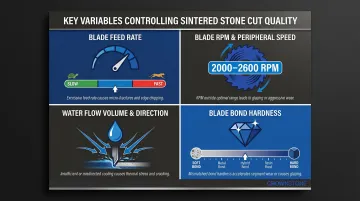
Bond hardness has to match the material. A blade with too hard a bond won't shed worn diamonds and will glaze; too soft and it wears out before the job is done. Either way, a worn or glazed blade applies uneven cutting forces — and sintered stone's brittle surface will micro-chip before granite even shows a mark.
Watch for these signs of a glazed blade:
- Cutting noticeably slower than usual
- Polished or shiny appearance on the diamond segments
- Burn marks or discoloration at the cut edge
Dress the blade on a dressing block when performance drops. If dressing doesn't bring it back, replace it.
Common Mistakes and How to Troubleshoot Them
Most sintered stone failures in the shop come down to four avoidable errors:
- Using a granite or general-purpose blade instead of a sintered stone-rated blade
- Cutting dry or with insufficient water flow
- Forcing the feed rate to match the speed you're used to on granite
- Failing to properly support the slab, especially near the cut line where the offcut piece can drop and cause a running crack
Cosentino's technical guidance confirms it directly: treat Dekton like granite and you will get failures. Each of the troubleshooting scenarios below traces back to one of those four errors.
Troubleshooting: Chipping at the Cut Edge
Chipping usually points to a glazed blade, a feed rate that's too aggressive, incorrect RPM, or water that isn't hitting the contact zone. Start here:
- Dress the blade on a dressing block or softer material
- Reduce feed rate by 20-30%
- Verify water is hitting the contact zone directly
- Confirm blade spec matches the material (continuous rim, soft bond, sintered stone rating)
Troubleshooting: Slab Cracking Mid-Cut
Mid-cut cracks are almost always a support or motion problem — flex from undersupported slabs, a pre-existing micro-fracture, or the blade dwelling in one spot. To prevent recurrence:
- Inspect the slab for pre-existing damage before cutting
- Add support blocks closer to the cut line
- On future cuts, never stop forward motion mid-cut—if the saw must stop, retract the blade before killing the motor
Troubleshooting: Blade Glazing or Cutting Slowly
A blade that glazes or slows down typically has a bond that's too hard for sintered stone, excessive water volume flushing abrasive away, or is simply worn out. Check these in order:
- Dress the blade on a concrete block or dressing stone
- Slightly reduce water volume while maintaining contact-point coverage
- If dressing doesn't restore cutting performance, replace the blade
Frequently Asked Questions
What do you use to cut sintered stone?
Sintered stone is cut with a continuous-rim or turbo-rim diamond blade rated for ultra-compact surfaces, mounted on a bridge saw, precision track saw, or CNC machine. For cutouts and curved shapes, waterjet is the preferred method to avoid thermal stress and chipping.
Is sintered stone hard to cut?
Sintered stone is one of the most technically demanding materials to cut cleanly because its extreme density makes it brittle under heat or vibration. With the right blade, machine rigidity, and controlled feed rate, you can achieve consistent results—but it's less forgiving than granite or quartz.
What is the best saw for cutting stone?
For shop fabrication of slabs like Dekton and Neolith, a rigid bridge saw with a precision cutting head and reliable water delivery is the most effective tool—delivering straight, repeatable cuts at the slab scale that portable tools simply can't match.
What is a sintered saw blade?
A "sintered blade" refers to a diamond blade with a sintered metal bond, where diamond segments are fused into the bond matrix under heat and pressure. For cutting sintered stone, look for a continuous-rim or turbo-rim blade with a soft bond grade rated for ultra-compact or porcelain/sintered materials.
Is sintered stone prone to chipping?
Sintered stone chips readily when the wrong blade is used, the blade overheats, or feed rate is too high. Its brittle structure means edge chips are typically not repairable, making correct setup critical before the first pass.
How to prevent Dekton from chipping?
Three steps make the biggest difference when cutting Dekton without chipping:
- Use a continuous-rim diamond blade rated for ultra-compact surfaces
- Make a shallow scoring pass before the full-depth cut
- Maintain a slow, consistent feed rate with high-volume water flow at the blade contact point