Introduction
Between 2017 and 2019, NIOSH identified 18 confirmed silicosis cases among engineered stone workers across California, Colorado, Texas, and Washington—two of those workers died. Engineered stone contains over 90% crystalline silica, making every cut a potential exposure event. California's inspection data paints an even starker picture: 51% of stone fabrication shops inspected between January 2019 and February 2020 had at least one employee exposed above OSHA's permissible silica limit.
Non-compliance carries serious consequences: operator injuries, citations averaging $16,000 to $161,000 per violation, and forced shutdowns. Bridge saws are among the highest-risk machines in any fabrication shop because they combine three hazard categories at once:
- Mechanical: blade contact and pinch points
- Electrical: unexpected energization during maintenance
- Dust: respirable crystalline silica generated with every cut
OSHA's enforcement emphasis has intensified. Georgia stone fabricators recently faced combined penalties exceeding $100,000 for silica and respiratory protection violations alone. This guide covers the specific OSHA requirements that apply to bridge saw operations, the controls that keep workers safe, and the best practices that keep shops compliant.
TLDR
- Wet cutting is required under OSHA 29 CFR 1910.1053 to suppress silica dust — not a recommendation
- Blade guards and perimeter guarding are mandatory under 29 CFR 1910.212, with no compliance exceptions
- Lockout/Tagout (LOTO) under 29 CFR 1910.147 applies to every blade change and maintenance task
- Engineering controls come before PPE in OSHA's hierarchy of controls — PPE is the last line of defense, not the first
- Daily pre-checks, documented training records, and written SOPs are ongoing compliance obligations
OSHA Requirements That Apply to Bridge Saw Operations
No OSHA standard is written exclusively for bridge saws. Instead, multiple general-industry regulations apply simultaneously. Stone shop owners must understand which standards govern their operation and how they layer together to create a complete compliance framework.
OSHA's Crystalline Silica Standard (29 CFR 1910.1053)
For stone shops running bridge saws, this regulation carries the most direct worker health risk. Cutting granite, quartz, and engineered stone generates respirable crystalline silica (RCS) — a known carcinogen and the cause of silicosis, an incurable and potentially fatal lung disease.
Exposure Thresholds and Triggers:
OSHA establishes two key exposure levels:
- Action Level (AL): 25 micrograms per cubic meter (µg/m³), 8-hour time-weighted average (TWA)
- Permissible Exposure Limit (PEL): 50 µg/m³, 8-hour TWA
At or Above the Action Level (25 µg/m³):
- Conduct exposure assessment and monitoring at least every 6 months
- Provide medical surveillance to any employee exposed at or above the AL for 30+ days per year
- Establish and implement a written exposure control plan covering tasks, engineering controls, work practices, respiratory protection, and housekeeping
- Review and update the written plan at least annually
Above the PEL (50 µg/m³):
- Use engineering and work practice controls to reduce exposures to or below the PEL
- Supplement with respiratory protection as needed
- Establish regulated areas with warning signs and limit access to authorized employees only
- Increase monitoring frequency to at least every 3 months
Wet Cutting as Engineering Control:
While the general industry standard (1910.1053) does not include a Table 1 of specified methods like the construction standard does, wet cutting remains the primary engineering control for bridge saw operations. OSHA requires employers to use feasible engineering controls first. For stone cutting, wet methods are the only practical way to reach compliant exposure levels.
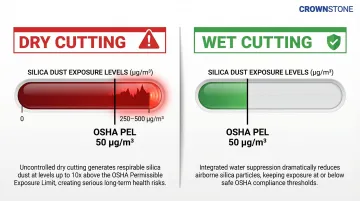
The data is stark: OSHA/NIOSH hazard data shows dry cutting produces exposures many times the PEL, while wet cutting significantly reduces — though does not eliminate — respirable silica.
Housekeeping:
Dry sweeping or dry brushing that contributes to RCS exposure is prohibited unless wet sweeping or HEPA vacuuming are not feasible.
Machine Guarding (29 CFR 1910.212)
This general machine guarding standard requires that all moving parts of a bridge saw be guarded to protect operators from contact, entanglement, and ejected material.
Specific Guarding Requirements:
- Blade guards must cover the portion of the blade not in contact with material
- Guards must be affixed to the machine where possible and secured elsewhere if machine attachment is not feasible
- Perimeter guarding with interlocked access gates is considered best practice; heights and configurations should be determined through documented risk assessments
- Guards must protect against point-of-operation hazards, ingoing nip points, rotating parts, and flying chips
International standards like ISO 13857 provide guidance on safety distances and protective structure heights (typically 1.4–2.0 meters depending on reach distances), but OSHA compliance in the U.S. is based on 29 CFR 1910.212's performance requirements and applicable ANSI B11 machine-specific standards.
Lockout/Tagout (29 CFR 1910.147)
LOTO is required any time a bridge saw is being serviced, adjusted, or when a blade is being changed. The machine must be de-energized and locked out before any operator accesses the blade or mechanical components to prevent unexpected energization or release of stored energy.
Penalty Exposure:
Lockout/Tagout violations consistently rank among OSHA's Top 10 most cited standards across all industries. As of January 2024, OSHA penalty maximums are approximately:
- $16,131 per serious, other-than-serious, or posting violation
- $161,323 per willful or repeat violation
- $16,131 per day for failure-to-abate violations
Beyond the financial exposure, LOTO failures put workers directly in contact with blade hazards, crushing injuries, and electrocution risks. These are not paperwork violations.
PPE Requirements for Bridge Saw Operators
OSHA's PPE standard (29 CFR 1910.132) requires employers to assess workplace hazards and provide appropriate PPE at no cost to employees. PPE selection for bridge saw operators must address four primary hazard types: respiratory, impact/projectile, noise, and slip/laceration.
Critical principle: PPE is the last line of defense in OSHA's hierarchy of controls. Engineering controls (wet cutting, guarding) and administrative controls (training, SOPs) must be established first.
Respiratory Protection
Operators cutting high-silica materials (quartz, granite, engineered stone) must wear NIOSH-approved respiratory protection appropriate to their exposure level:
- Up to 0.5 mg/m³: APF 10 respirator—N95, R95, or P95 filtering facepiece (minimum)
- Up to 1.25 mg/m³: APF 25 respirator—PAPR with HEPA filter or supplied-air respirator (SAR) continuous-flow
- Up to 2.5 mg/m³: APF 50 respirator—full-facepiece air-purifying respirator (APR) with N100/R100/P100 filter or tight-fitting PAPR with HEPA
All tight-fitting respirators must be fit-tested before initial use and at least annually thereafter under OSHA's Respiratory Protection Standard (29 CFR 1910.134). Employers must implement a written respiratory protection program covering selection, medical evaluations, fit testing, use, and maintenance.
Eye and Face Protection
Safety glasses alone are insufficient. Full-face shields or safety goggles rated for impact protection (ANSI Z87.1) are required to protect against stone fragments and wet slurry ejected during cutting. Bridge saw operations routinely generate high-velocity projectiles that can cause permanent eye injury.
Hearing Protection
Bridge saw operation often exceeds OSHA's noise action level of 85 dBA (8-hour TWA), which triggers hearing conservation program requirements. At or above 90 dBA, feasible engineering and administrative controls must be implemented, and hearing protection must be provided.
Wear earplugs or earmuffs with an adequate Noise Reduction Rating (NRR) during sustained operation, and conduct noise surveys to confirm actual exposure levels in your shop.
Clothing and Footwear
- Prohibited: Loose clothing, dangling jewelry, unsecured long hair near moving machinery
- Required: Steel-toed boots rated for heavy slabs
- For slab handling: Cut-resistant gloves when handling materials away from the blade
- Never near the blade: Do not wear gloves near the rotating saw blade. Entanglement is a serious and well-documented hazard — keep gloves off when the blade is running.
Safe Operating Procedures: Before, During, and After Cutting
Safe bridge saw operation is a three-phase process: pre-operation checks, active cutting discipline, and proper shutdown. Documented standard operating procedures (SOPs) are required for shops with five or more workers — and considered best practice for every shop, regardless of size.
Pre-Operation Checklist
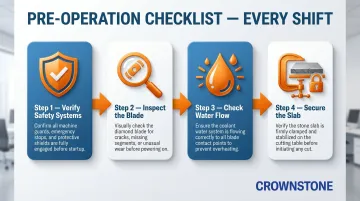
Perform these checks every shift before powering on the machine:
- Verify safety systems: Confirm all blade guards and interlocked gates are functioning properly
- Inspect the blade: Check for cracks, missing segments, or excessive wear; confirm the blade specification matches the material being cut
- Check water flow: Confirm the cooling system is flowing properly before powering on—running a bridge saw blade dry even briefly can cause blade failure and fire risk
- Secure the slab: Verify the material is properly secured with clamps or vacuum cups; an unsecured slab can shift during cutting and cause blade binding or kickback
Safety During Operation
Keep these rules in place on every cut:
- Never reach over or across the cutting path while the blade is in motion
- Always operate from the designated control station, outside the blade's sweep zone
- Maintain clear sight lines to the cutting operation at all times
- Never bypass safety interlocks or disable blade guards — this is a direct OSHA violation under 1910.212 and a leading cause of serious injury
When a machine is designed for compliant operation from the ground up, operators are less likely to work around safety systems. Crown Stone USA builds its bridge saws with integrated safety controls specifically because the founders have run these machines themselves and know where shortcuts happen.
Post-Operation and Blade Change Protocol
Shutdown Sequence:
- Power down the blade motor
- Wait for complete blade stop before approaching the machine
- Follow LOTO procedure before any blade change or maintenance task
- Clean slurry from the table and machine bed after each shift to prevent bacterial growth in standing water
Blade Change Requirements:
- De-energize the machine and apply lockout devices
- Verify zero energy state before accessing the blade
- Use proper tools and follow manufacturer's torque specifications when installing new blades
Silica Dust Management and Water System Safety
Wet cutting suppresses silica dust but doesn't eliminate it. Fine particles remain suspended in the cutting mist, so wet cutting must be paired with respiratory protection and ventilation to meet OSHA's PEL.
Water System Hygiene
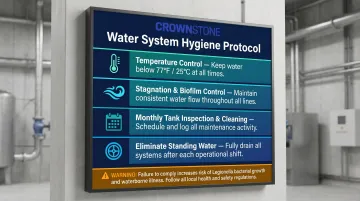
Recirculated cooling water in bridge saw systems can harbor Legionella bacteria if water temperature rises above 77°F (25°C) or if tanks are not regularly cleaned. CDC guidance recommends:
- Keep cold water below 77°F (25°C) where feasible
- Control stagnation, scale, and biofilm through regular flushing
- Inspect and clean sedimentation tanks monthly at minimum
- Eliminate standing water in sumps and drip pans after each shift
Legionnaires' disease — a severe, sometimes fatal pneumonia contracted by inhaling contaminated water droplets — makes water system hygiene both a safety and a compliance requirement. The same water system keeping silica down can create a Legionella risk if left unmanaged.
Dry Cutting Prohibition
Dry cutting natural stone is effectively prohibited under OSHA's Silica Standard for general industry. No feasible dust controls can keep RCS exposure below the PEL without water suppression, and OSHA/NIOSH data shows dry cutting can expose workers to silica at levels hundreds of micrograms per cubic meter — many times the 50 µg/m³ PEL. Operating above the PEL without feasible controls is a direct OSHA violation, regardless of intent.
Common Bridge Saw Safety Mistakes Stone Shops Make
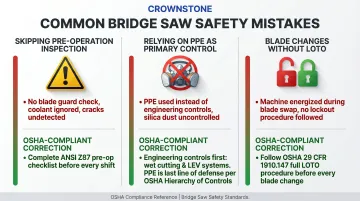
Skipping the Pre-Operation Inspection
Many shops treat the daily safety check as optional, but an undetected cracked blade, blocked cooling nozzle, or malfunctioning interlock can cause catastrophic failure mid-cut. Blade fragmentation at operating speed is a potentially fatal event—diamond blade segments can be ejected at hundreds of feet per second.
Relying on PPE as the Primary Control
OSHA's hierarchy of controls places engineering controls (wet cutting, guarding) and administrative controls (training, SOPs) above PPE. Shops that rely only on respirators without implementing engineering controls remain out of compliance and expose workers to far higher silica doses than necessary.
Respirators also have real limitations that are easy to overlook:
- Require individual fit testing and medical clearance before use
- Must be properly maintained and inspected before each shift
- Only work when worn correctly — every single time
Performing Blade Changes Without LOTO
One of the most common and frequently cited violations in fabrication shops. A blade that appears stopped may still be spinning, and stored electrical or hydraulic energy can cause unexpected restart. LOTO is not optional regardless of how routine the task feels or how experienced the operator is.
Avoiding these mistakes starts with equipment designed so that safe operation is the default — and with operators trained to treat every shortcut as a liability, not a time-saver.
Frequently Asked Questions
What is a bridge saw?
A bridge saw is a large stationary stone-cutting machine with a circular diamond blade mounted on an overhead bridge that traverses over a cutting table. It's used in stone fabrication shops to cut granite, marble, quartz, and similar materials, typically featuring hydraulic lift systems and water cooling.
Can you get silicosis from stone dust?
Yes. Silicosis is a serious, incurable, and sometimes fatal lung disease caused by inhaling respirable crystalline silica. Cutting granite, quartz, and engineered stone (which contains over 90% silica) generates high RCS concentrations. OSHA's Silica Standard (29 CFR 1910.1053) was established specifically to address this risk.
Is it illegal to dry cut stone?
No law uses those exact words, but OSHA's Silica Standard effectively prohibits dry cutting of silica-containing stone in general industry settings — no other engineering control can bring exposures to compliant levels. Wet cutting, combined with respiratory protection, is the required approach.
What are the OSHA requirements for circular saws?
OSHA 29 CFR 1910.212 requires that all circular saw blades be guarded to the maximum extent practicable, with the blade guard covering the portion not in use. For bridge saws specifically, this includes perimeter guarding, interlocked access gates where feasible, and emergency stop devices accessible from the operator position.
What should an operator never wear when using a saw?
Operators should never wear loose clothing, dangling jewelry, or unsecured long hair near a bridge saw. Gloves should not be worn near the rotating blade itself, as they can catch and pull the hand into the cutting zone. Cut-resistant gloves are appropriate for slab handling away from the blade.
How to reduce dust when cutting stone?
Use wet cutting first (required under OSHA's Silica Standard), ensure adequate ventilation or local exhaust ventilation, and provide NIOSH-approved respiratory protection as a supplement. Wet cutting alone does not eliminate silica exposure, so pairing it with ventilation and respiratory protection is required under OSHA's hierarchy of controls.