Introduction
For stone fabricators, choosing the right bridge saw isn't just about cutting slabs—it's about keeping production moving. A machine down waiting on an overseas part costs roughly $1,500 per hour in lost revenue. A saw that can't hold tolerances on engineered quartz means wasted material and callbacks.
That kind of downtime has consequences. When your supplier's "support" means waiting days for a callback, you're the one missing customer commitments.
Denver Stone machines occupy a recognized position in the North American stone fabrication market. Even so, many shop owners are actively comparing alternatives—driven by concerns over parts lead times from international suppliers, US-based technical support, and total cost of ownership beyond the sticker price.
This guide covers five credible alternatives, evaluated on the criteria fabricators weigh most:
- Reliability under real production loads
- Parts availability when you need them
- Warranty coverage that protects your investment
- Post-sale support quality when something goes wrong
TLDR
- Strong Denver Stone alternatives exist at multiple price points — each with trade-offs worth knowing before you buy
- The list spans American-made and imported machines, each with distinct strengths for granite, marble, and quartz shops
- Crown Stone USA is the only American-made option on this list designed by fabricators with hands-on shop experience
- Evaluate uptime reliability, parts availability, warranty coverage, cutting precision, and post-sale support
- Match machine capability to your shop's volume, material mix, and service infrastructure
Why Fabricators Look Beyond Denver Stone Machines
Denver S.p.A., established in 1984 and headquartered in the Republic of San Marino (Italy), manufactures 3/4/5-axis CNC bridge saws, CNC routers, fab centers, and surface polishers for stone fabrication. The company operates a US subsidiary in Columbus, OH, with a dedicated parts warehouse and US-based technicians.
The pain points pushing fabricators to evaluate alternatives aren't unique to Denver—they apply to any imported equipment platform:
- When a critical component fails, waiting weeks for an overseas shipment costs more than the price difference between machines
- A toll-free number isn't the same as field technicians who can be on-site within 24 hours
- A machine that costs $15,000 less upfront but sits idle for two weeks waiting on parts will cost far more in lost production
- Not all bridge saws are built for the same production volume or material mix your shop actually runs
Each alternative below was chosen based on how well it closes these gaps: reliability, service access, build quality, and value for different shop sizes.
Top 5 Alternatives to Denver Stone Machines for Fabricators
These five alternatives were evaluated based on real fabricator priorities: reliability under production loads, parts accessibility (especially for US-based shops), cutting precision for granite/marble/quartz applications, warranty coverage, and the quality of after-sale support—not brand size or marketing budgets.
Crown Stone USA
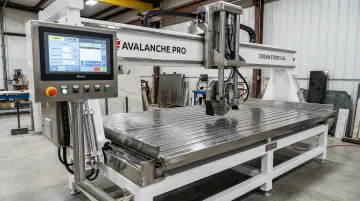
Crown Stone USA (Clearwater, FL) manufactures American-made bridge saws and fabrication tables built from the ground up by people with hands-on stone fabrication experience. The founders drew on decades of combined experience repairing, maintaining, and operating bridge saws before designing their own equipment—a background that shows in every design choice.
Their bridge saw table went through 10 design iterations before commercialization: build two tables, test under shop conditions, identify failures, revise, repeat. That cycle ran 10 times until the design earned production status.
Components are sourced primarily from the US, South America, Korea, Japan, and Taiwan, with less than 2% by value from China. Parts are readily available domestically, reducing the downtime risk that plagues shops dependent on overseas supply chains. All equipment is backed by a 2-year warranty.
| Machine Type / Key Specs | Notable Features | Warranty & Support |
|---|---|---|
| American-made bridge saw; Avalanche Pro features 20 HP blade motor, 150° cutting length, 126" x 77" table (132" or 138" extended widths available); hydraulic lift to 70°, air-powered indexing to 90°/45° | Fabricator-designed Kinco HMI touchscreen controls, automatic and manual cutting modes, one-touch miter/vertical switching, stainless steel rolling surfaces, moisture-resistant table design, globally available parts | 2-year warranty; US-based customer support (727-239-9875); parts sourced domestically for fast turnaround; equipment manufactured in Clearwater, FL |
The Avalanche Pro combines automatic cutting (with preset bridge movements) and full manual operation via physical buttons or remote control. The water recycling system uses flocculant-based sediment settling, available in 40 GPM (supports 1 bridge saw + polisher + 2-3 hand tools) and 70 GPM versions (supports 3 bridge saws + CNC + polisher + 4-5 hand tools).
Park Industries
Park Industries (St. Cloud, MN) is one of the most established US-based stone fabrication equipment manufacturers, producing CNC bridge saws, routers, and waterjet systems for shops ranging from small operations to high-volume production facilities. Founded in 1953, the company remains 100% family-owned and manufactures domestically.
Park's strength is its full ecosystem approach: machines, software, tooling, and training all developed in-house. Parts and service technicians are accessible without international lead times. Flagship models include the TITAN 4800 (CNC router), VOYAGER XP (CNC saw), and SABERjet XP (CNC sawjet).
| Machine Type / Key Specs | Notable Features | Warranty & Support |
|---|---|---|
| CNC Router (TITAN 4800): 21 HP Quantum Belt Drive spindle (100-8,000 RPM), 8' x 14'4" table; CNC Saw (VOYAGER XP): 27 HP arbor motor (1,000-6,000 RPM), 144" x 84" max slab, 5-axis; CNC Sawjet (SABERjet XP): 27 HP arbor motor, 144" x 84" max slab, 5-axis waterjet | Alphacam CAD software with proprietary Park EZ Buttons, high-horsepower arbor motors for quartzite and hard materials, integrated CNC automation, US-manufactured | 5-year limited warranty on TITAN Quantum Belt Drive Spindle; 24/7 customer service; "Next Day or No Pay" parts guarantee; field service technicians available for immediate dispatch |
Park's "Next Day or No Pay" parts guarantee directly mitigates the downtime costs that hit fabricators dependent on imported equipment. With 24/7 customer service and field technicians available for immediate dispatch, Park offers one of the strongest support networks in the industry.
BACA Systems
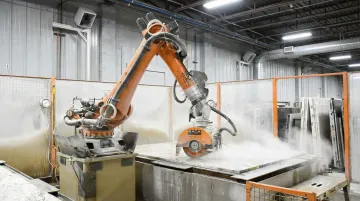
BACA Systems (Orion Township, MI) specializes in robotic sawjets and 5-axis CNC saws designed for fabricators processing high volumes of countertops, mitered edges, and complex cuts that exceed standard bridge saw capability.
Their Robo SawJet and Versa 5 platforms combine waterjet cutting with saw technology in a single machine, reducing material handling steps and improving throughput for mid-to-large shops. Case studies report shops achieving 1,000 square feet per day (one shift) with the Robo SawJet; a standard 40-square-foot kitchen countertop with sink hole cuts in 15-18 minutes.
| Machine Type / Key Specs | Notable Features | Warranty & Support |
|---|---|---|
| Robotic SawJet (Robo SawJet 2.0): 26 HP saw motor, 50 HP waterjet (60,000 PSI), 90" x 144" table, 6-axis KUKA robot; 5-Axis CNC Saw (Versa 5): 25 HP saw motor, 137.7" x 92.1" table, 5-axis | 6-axis KUKA robotics for extreme flexibility, dual-table upgrade path to double production, integrated saw and waterjet mitering, adaptive mitering, scrap nesting technology, minimal operator interference; KUKA robot requires virtually no maintenance for 10,000 hours | Michigan-based; Customer Care Center with remote troubleshooting and field service technicians; KUKA robot reliability reduces maintenance overhead |
The Robo SawJet is upgradeable to a dual-table configuration, doubling production by masking loading and unloading downtime. For shops running multiple shifts or high-mix production—waterfall islands, mitered backsplashes, complex edge profiles—the labor savings and throughput gains can justify the investment.
Northwood Machine Manufacturing
Northwood Machine (Louisville, KY) produces CNC bridge saws and routers built for the stone, glass, and composites fabrication market. Their equipment is known among US fabricators for heavy-duty construction and programmable precision suited to production environments.
Northwood emphasizes extreme-duty components: their Raptor SawJet uses a 32 HP Saccardo motor and 60,000 PSI KMT waterjet pump for cutting dense materials. The SW-138UFC FabCenter combines a 15 HP saw with an extreme-duty spindle (EDS) in a 156" x 96" work envelope, offering 5-axis capability with saw tilt from 44° to 90°.
| Machine Type / Key Specs | Notable Features | Warranty & Support |
|---|---|---|
| CNC Sawjet (Raptor): 32 HP Saccardo motor, 60,000 PSI KMT waterjet pump, dual-table configuration available, 5-axis; CNC Router/Saw (SW-138UFC FabCenter): 15 HP saw, extreme-duty spindle (EDS), 156" x 96" work envelope, 5-axis (saw tilt 44-90°) | Heavy-gauge construction, programmable cutting sequences, compatible with StoneVision 3.0 and Alphacam CAD/CAM software, designed for hard materials and high-volume production | 3-year warranty on Extreme Duty Spindle (EDS); coast-to-coast technicians; 24/7 online support access; lifetime phone support; US manufacturing base |
Northwood's US manufacturing base provides domestic service advantages for shops prioritizing supply chain reliability. Alphacam compatibility—shared with Park Industries—reduces the learning curve for fabricators already running that software.
Intermac (Biesse Group)
Intermac, part of the Italian Biesse Group, manufactures CNC bridge saws, waterjet cutters, and machining centers widely distributed across the US stone fabrication market. Their Master series bridge saws are used in both mid-sized shops and large production facilities processing granite, marble, and engineered stone.
Intermac competes on precision engineering and product breadth. The Master 625 machining center offers 20-26 kW spindle power (depending on duty cycle) and a 5-axis work envelope of 3500 x 2000 mm (138" x 78.5"). The Smart 625 bridge saw provides 13.2 kW spindle power with a 3800 x 2400 mm table.
| Machine Type / Key Specs | Notable Features | Warranty & Support |
|---|---|---|
| CNC Machining Center (Master 625): 20-26 kW spindle, 3500 x 2000 mm (138" x 78.5") max workpiece, 5-axis; CNC Bridge Saw (Smart 625): 13.2 kW spindle, 3800 x 2400 mm table, 5-axis | Italian CNC engineering, multi-axis capability for complex shaping and polishing, broad model range for different production volumes, dedicated Primus series waterjet systems available | Biesse America operates from Charlotte, NC; SOPHIA IoT platform for predictive maintenance; Intermac Parts network reports 95% of downtime orders dispatched within 24 hours; specific US warranty terms require confirmation with Biesse America |
Fabricators evaluating Intermac should assess US service network depth carefully. The 95% same-day dispatch figure doesn't account for shipping time or field technician availability for complex repairs—two factors that determine actual downtime, not just parts pipeline speed.
How We Chose These Alternatives
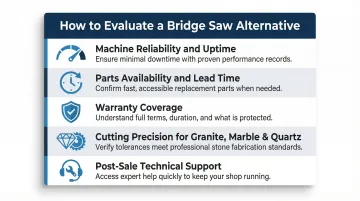
Alternatives were assessed on five criteria relevant to working fabricators:
- Machine reliability and uptime: Downtime costs fabricators roughly $1,500 per hour in lost revenue. Reliability shows up in machine availability percentages and mean time between failures—not in marketing copy.
- Parts availability and lead time: US-based parts networks were weighted positively. A two-week wait on an overseas component costs far more than any upfront price difference between models.
- Warranty coverage: Terms vary from 2-year comprehensive coverage to narrow component warranties. What's covered—parts, labor, travel, specific components—directly affects total cost of ownership.
- Cutting precision for granite/marble/quartz: Granite (Mohs 6-7) demands diamond tooling and high-rigidity frames to prevent blade deflection. Quartz requires even tighter tolerances due to brittleness and resin content.
- Post-sale technical support: A toll-free number is not the same as a field technician available within 24 hours. Response time, technician training, remote diagnostics, and parts stocking all count.
The throughline across all five criteria: total cost of ownership beats purchase price every time.
Conclusion
The right machine for your shop comes down to production volume, material mix, service expectations, and long-term operational costs — not brand loyalty.
Before committing, request demos from multiple suppliers and ask the questions that actually matter:
- What percentage of components are stocked domestically?
- What's your average parts delivery time to my zip code?
- What does warranty response look like when a machine goes down on a Friday afternoon?
- Who else in my region is running this equipment — and can I talk to them directly?
That last one is key. Skip the testimonials on the supplier's website. Find fabricators who've had the machine for 2-3 years and ask them straight.
If you run those questions past Crown Stone USA, you'll get concrete answers: parts sourced primarily from the US, Americas, Korea, Japan, and Taiwan — with less than 2% of component value from China — and a 2-year warranty backed by a team that has actually cut, lifted, and installed stone. For fabricators who want an American-made bridge saw without the guesswork, it's worth a direct conversation. Visit crownstoneusa.com or call 727-239-9875.
Frequently Asked Questions
Can you CNC granite?
Yes, CNC machines are widely used to cut, shape, and engrave granite in commercial fabrication shops. Because granite is exceptionally hard (Mohs 6-7), CNC bridge saws, routers, and waterjet systems use diamond tooling to handle the material effectively. Most modern fabrication shops rely on CNC equipment for countertop production due to the precision and throughput that manual methods cannot consistently match.
What are the alternatives to CNC for stone cutting?
Manual bridge saws, angle grinders, and wet tile saws are the main non-CNC options. For production-level work, CNC equipment is significantly faster — automated bridge saws cut up to 120 linear feet per hour versus roughly 10 linear feet per hour on a manual saw.
What should fabricators look for when switching from Denver Stone machines?
Focus on four areas: parts availability and domestic lead times, US-based service and warranty response times, cutting precision for your specific materials (granite, quartz, and marble each have different requirements), and total cost of ownership beyond the purchase price — installation, software, tooling, and maintenance all add up.
Are American-made stone fabrication machines more reliable than imported alternatives?
Origin of manufacture matters less than parts availability, service network proximity, and build quality. That said, US-manufactured machines often offer faster parts sourcing — some manufacturers guarantee next-day delivery — and more accessible technical support. The real advantage is structural: shorter supply chains and closer service networks.
How important is parts availability when choosing a stone fabrication machine?
Parts availability is critical — a down machine stops production and can cost around $1,500 per hour in lost revenue. Before buying, ask suppliers about average lead times, whether parts are stocked domestically or require international shipping, and what emergency service response looks like.
What is the typical price range for bridge saws and stone fabrication equipment?
Entry-level manual or semi-automatic bridge saws run $15,000–$30,000. Mid-range CNC saws typically fall between $50,000 and $120,000, while fully automatic systems and robotic sawjets can exceed $350,000. Factor in installation, water recycling systems, tooling, and annual maintenance — total ownership costs often run 20–30% above the purchase price.