Introduction
The U.S. countertops market reached $33.77 billion in 2025 and is projected to grow at a 5.7% annual rate through 2033, driven by consistent demand from kitchen remodels, bathroom upgrades, and commercial projects. Unlike trend-dependent industries, stone fabrication benefits from sustained homeowner spending—residential applications account for 73% of market demand, and kitchen countertops alone represent 60.6% of the market.
This guide covers the full startup roadmap: what equipment you need, what it costs, and what to do before your first job. It's built for experienced fabricators going independent, tradespeople pivoting from tile or flooring, and entrepreneurs ready to run a product-based local business.
Most new shops underestimate the equipment investment, the operational demands, and how long it takes to build a stable client base. This guide addresses each directly.
TL;DR
- Countertop fabrication cuts, finishes, and installs custom stone surfaces using specialized machinery
- Core equipment is non-negotiable—skimping early creates costly downtime and quality problems
- Startup costs range from $150,000 to $350,000+ depending on shop size and equipment tier
- OSHA silica compliance is mandatory from day one, not optional
- Plan for 3–6 months before steady revenue kicks in
What Is a Countertop Fabrication Business?
A countertop fabrication shop takes raw stone slabs—granite, marble, quartz, quartzite, sintered stone—and cuts, profiles, finishes, and installs them as custom surfaces for residential and commercial clients. The core service is precision fabrication and professional installation, not just cutting stone. Quality of equipment and operator skill determine whether you build repeat business or spend time on callbacks and remakes.
Common business formats include:
- Residential-focused shops — Higher per-job margins with direct homeowner relationships, though sales cycles run longer
- Builder-focused operations — Lower per-job margins offset by higher volume and more predictable workflow
- Mixed-model shops — Split revenue between both channels to balance risk and smooth out seasonal slowdowns
Your format choice directly shapes which equipment investments to prioritize first—and in what order. The checklist below is built with that decision in mind.
What to Know Before You Start a Countertop Fabrication Business
Expect Higher Investment Than You Think
Many people entering this business underestimate the equipment costs, the physical demands, and how long it takes to build a stable client base. The early stage typically means one person covering all of it simultaneously:
Many people entering this business underestimate the equipment costs, the physical demands, and how long it takes to build a stable client base. In the early stage, one person typically covers all of it:
- Fabricating and installing jobs
- Estimating material and labor costs
- Selling new work and managing customer relationships
- Handling supplier sourcing and compliance
This continues until revenue supports hiring — and that timeline is usually longer than expected.
Downtime Has a Direct Revenue Cost
Equipment downtime in stone fabrication shops costs approximately $1,500 per hour when a bridge saw goes down unexpectedly. You lose not only direct cutting revenue but also the rest of your shop's output for the day. Machine reliability and parts availability are day-one investment decisions, not secondary concerns.
Quick Income vs. Durable Operation
Building a durable operation means investing in the right equipment, documented processes, and early customer relationships — even when returns are slow. Shops that skip this phase often stall at 12–18 months when volume picks up but systems can't keep pace.
The rest of this guide covers the specific equipment decisions that separate shops built to scale from those that plateau early.
Why Start a Countertop Fabrication Business?
U.S. homeowners spend over $600 billion annually on home improvement, with the average kitchen remodel costing approximately $26,500. Demand for stone surfaces is consistent and not trend-dependent—homeowners prioritize kitchens and baths because these spaces directly impact home value and daily living.
That steady demand translates into real profit potential. Here's why the business model holds up:
- Well-run shops can hit 30% net margins when they price correctly and control costs
- Differentiation compounds quickly — quality, turnaround time, and communication beat competitors in most local markets
- The business builds lasting asset value — reliable equipment, trained staff, and a stable client base make a fabrication shop sellable, not just operational
The Full Equipment Checklist for Your Countertop Fabrication Shop
The wrong machine—or a poorly supported one—creates downtime that kills margin and reputation at the same time. Budget decisions made in the first 90 days follow a shop for years. The checklist below separates must-have from phase-two investments.
Core Cutting Equipment
Bridge Saw
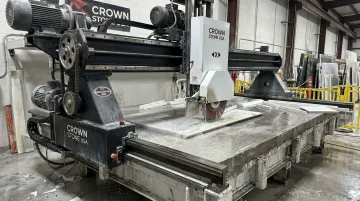
The primary machine for slab sizing and straight cuts. A bridge saw is non-negotiable for any fabrication shop.
What to look for:
- Cutting capacity (minimum 150" cutting length for full-size slabs)
- Integrated water delivery system for dust suppression
- Table precision and stability
- Blade compatibility with multiple stone types
Price range: Entry-level Asian 3-axis models start around $18,000–$30,000; mid-range 5-axis systems run $35,000–$65,000; premium North American/European bridge saws cost $85,000–$350,000+.
Critical consideration: Parts availability and warranty coverage determine real-world cost of ownership, not just the purchase price. A machine that goes down mid-job without a locally available replacement part can cost more in delays than the savings from a cheaper unit.
Crown Stone USA manufactures American-made bridge saws with domestically sourced parts and a 2-year warranty. Their Avalanche Pro bridge saw features a 20 HP blade motor, 150" cutting length, hydraulic lift, and air indexing to exact 90° and 45° angles.
Sink Cutout Station or Router Setup
Essential for faucet holes, undermount sink cutouts, and decorative profiles.
Options include:
- Dedicated CNC router (highest precision, fastest throughput)
- Manual router with jig (low upfront cost, higher labor time)
- CNC machine with integrated cutout capability
Early shops frequently create inconsistency here by underinvesting. Manual routing requires skilled operators and produces variable results; CNC automation delivers repeatable quality.
Edge Finishing Equipment
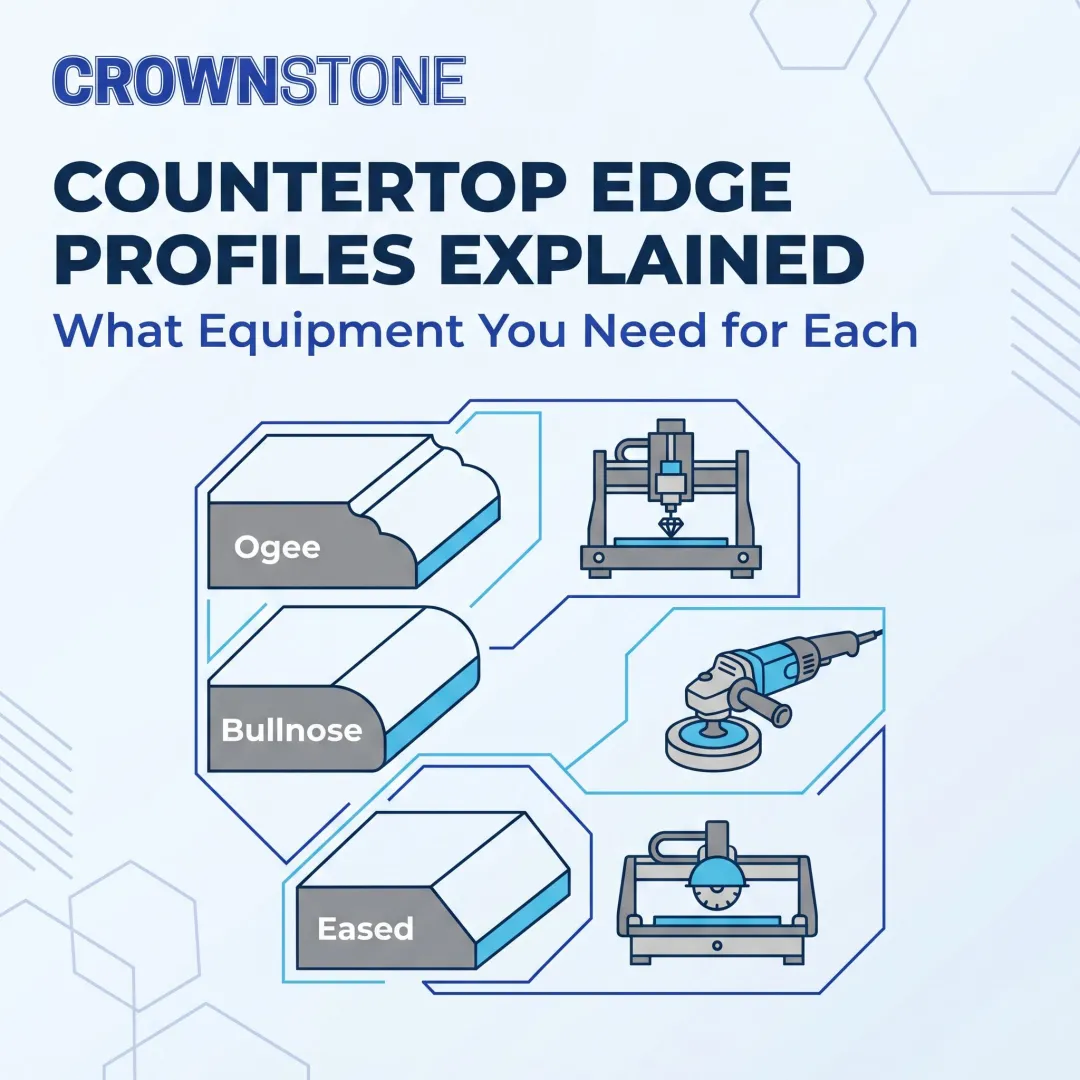
Edge Polisher
Automates edge profiling for consistency across jobs.
Manual grinder approach:
- Low upfront cost ($500–$2,000)
- High labor time per linear foot
- Inconsistent results across operators
- Difficult to scale
Automated inline edge polisher:
- Higher upfront cost (used units start around $27,500; new systems range $40,000–$100,000+)
- Much faster throughput (up to 100 inches per minute)
- Consistent profile quality
- Volume-focused shops recover this cost quickly
Crown Stone USA's Eversplash Flat Edge Polisher delivers up to 100 inches per minute with 6 polishing spindles and dual beveling motors, handling stone thickness from 1 cm to 6 cm.
Material Handling Equipment
Vacuum Lifters and Slab Racks
Improper slab handling is one of the leading causes of material breakage and workplace injury in fabrication shops.
Core material handling equipment:
| Equipment | Price Range | Purpose |
|---|---|---|
| Vacuum lifter/cup assembly | $750–$4,500 | Safe slab lifting and positioning |
| A-frame slab storage racks | $135–$2,000 | Vertical slab storage |
| Transport carts | $500–$1,500 | Moving slabs within shop |
| Forklift boom attachment | $1,300–$3,000 | Heavy slab handling with existing forklift |
Silica dust exposure and slab breakage are the two most preventable cost sources in a new shop. Material handling equipment addresses one; dust control (below) addresses the other.
Water Management and Dust Control
Water Recycling and Filtration System
Cutting stone requires a constant water supply to suppress dust and cool the blade. Wastewater contains silica slurry and cannot be discharged untreated in most jurisdictions.
Options:
- Closed-loop recirculating systems — Filter and reuse water continuously; reduce fresh water consumption by 60–80%
- Settling tanks — Allow slurry to settle; require periodic disposal of settled sludge
Water management is both a compliance requirement and an operating cost variable. Crown Stone USA manufactures flocculant-based automatic water recycling systems in two sizes: a 40 GPM small version supporting one bridge saw, one polisher, and 2–3 hand tools; and a 70 GPM large version supporting three bridge saws, a CNC machine, and 4–5 hand tools.
Dust Collection and Wet Cutting Systems
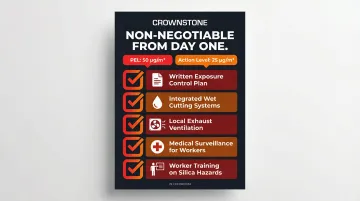
OSHA requires respirable crystalline silica control under 29 CFR 1910.1053. The Permissible Exposure Limit (PEL) is 50 micrograms per cubic meter (8-hour TWA), and the Action Level (AL) is 25 micrograms per cubic meter.
Required controls:
- Integrated wet cutting systems (water delivery at the blade)
- Local exhaust ventilation (LEV) for dry work
- HEPA-equipped dust collectors for finishing operations
- Written exposure control plan
- Worker training and medical surveillance
In August 2024, OSHA cited a Chicago countertop fabricator for 32 violations totaling over $1 million in penalties. Two workers required lung transplants due to silicosis. Silica compliance is mandatory from day one, not something to phase in.
Tooling and Consumables
Stock these from day one:
- Diamond bridge saw blades — Material-specific (granite, quartz, quartzite, sintered stone require different blade specs); $220–$400 per blade
- Polishing pads — Wet and dry, in graded steps from coarse to fine
- Router profile bits — For edge details and decorative profiles
- Core bits — For faucet holes and cutouts
- Seam-setting tools — Clamps, epoxy, and color-matching materials
Blade and tooling quality directly affects cut speed, edge quality, and machine wear. Buying cheap tooling to save money is a common early-stage mistake that shows up in remakes and machine damage.
Phase-Two Equipment to Plan For
Most new shops add these in year one or two as volume grows:
- CNC machining center or sawjet — For complex shapes and high-volume sink cutouts
- Digital templating system — Laser/digital template technology (LT-55 or similar) that eliminates manual measuring error and speeds field-to-shop workflow
- Additional slab storage and staging capacity — As inventory grows
Budget for these before you need them. Each one removes a specific bottleneck that becomes visible once daily volume climbs past a certain point.
How to Start a Countertop Fabrication Business – Step by Step
Most common early-stage mistakes:
- Underestimating startup costs
- Skipping legal setup
- Pricing to win early jobs rather than to sustain the business
- Scaling before the process is stable
Step 1 – Define Your Business Model and Estimate True Startup Costs
Decide whether to focus on residential work, builder volume, commercial projects, or a mix. Each has a different equipment priority, margin profile, and sales cycle.
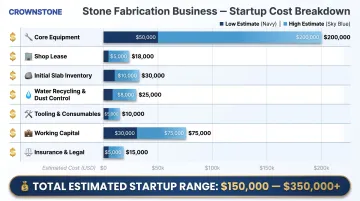
Build a detailed cost estimate covering:
| Category | Typical Range |
|---|---|
| Core equipment (bridge saw, edge polisher, material handling) | $50,000–$200,000 |
| Shop lease (5,000 sqft minimum; 12-month deposit + first month) | $5,000–$18,000 upfront |
| Initial slab inventory | $10,000–$30,000 |
| Water recycling and dust control | $8,000–$25,000 |
| Tooling and consumables | $5,000–$10,000 |
| Working capital (3–6 months) | $30,000–$75,000 |
| Insurance and legal setup | $5,000–$15,000 |
Total startup cost: $150,000–$350,000+ depending on equipment tier and market.
Financing options:
- SBA 7(a) loans — Up to $5 million for equipment and working capital
- SBA 504 loans — Up to $5.5 million for fixed assets; 10-, 20-, or 25-year terms
- Equipment-specific financing — Direct financing through equipment manufacturers
- Partnership structures — Bringing in investors or partners
Lenders require a business plan and projected cash flow — have both ready before approaching any financing source.
Step 2 – Set Up Legal Structure, Licensing, and Compliance
Business Registration
LLC structure for liability protection is common. Register with your state and local authorities.
Permits Specific to Stone Fabrication
- Zoning for industrial use — Verify your location allows stone fabrication before signing a lease
- Water discharge permits — Required if discharging treated wastewater to sanitary sewers
- Dust control documentation — Written exposure control plan under OSHA silica standard
Requirements vary significantly by municipality — a location that looks right on paper can fail on zoning, so confirm before signing anything.
OSHA Silica Dust Compliance (Non-Negotiable)
Federal requirements under 29 CFR 1910.1053 include:
- Written exposure control plan
- Engineering controls (integrated water delivery, LEV)
- Medical surveillance for exposed workers
- Worker training on silica hazards
The August 2024 OSHA enforcement case that resulted in $1 million+ in penalties and two workers needing lung transplants underscores the real-world risk of non-compliance.
Step 3 – Set Up Your Shop and Establish Supplier Relationships
Plan Shop Layout Around Workflow Efficiency
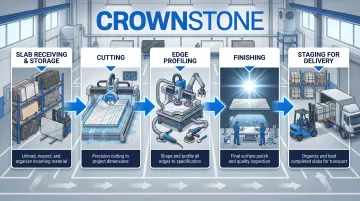
Optimal workflow: Slab receiving and storage → Cutting → Edge profiling → Finishing → Staging for delivery
Plan the layout before equipment arrives. Repositioning a bridge saw after it's anchored costs time and money you don't have in the first year.
Typical facility requirements:
- Minimum total space: 5,000 square feet
- Production floor: 3,000–4,000 square feet
- Ceiling height: 12 feet minimum (16 feet ideal)
- Overhead door height: 12 feet minimum (16 feet recommended)
- Floor loading capacity: Mid-range bridge saws exceed 13,000 lbs
- Exterior yard: At least 100' x 100' paved for flatbed truck maneuvering
Industrial lease rates vary significantly by region:
| Region | Annual Cost per Sqft |
|---|---|
| Secondary Midwest markets | $6–$8 |
| Atlanta, Houston | $8–$12 |
| Denver, Austin | $10–$14 |
| New Jersey/New York metro | $14–$20 |
| Los Angeles Basin | $18–$22 |
For a 5,000 sqft shop, this translates to $30,000–$110,000 annual rent—a $80,000 difference that directly impacts breakeven timeline.
Establish Supplier Relationships Before Opening
Identify and set up accounts with:
- Regional stone slab distributors — Pricing, material quality, lead times, and payment terms directly affect job margins and cash flow
- Tooling suppliers — For blades, pads, and consumables
Getting favorable payment terms from a distributor before you open — net-30 or net-60 — can meaningfully extend your working capital runway in the first few months.
Step 4 – Build Your Pricing Model and Go to Market
Build Pricing from the Bottom Up
Calculate:
- Material cost per square foot (including waste factor)
- Labor time per job (templating, fabrication, installation)
- Overhead allocation (rent, utilities, insurance, equipment depreciation)
- Target margin (30% net margin is a reasonable target)
Consumer-facing installed price ranges (2026 data):
- Granite: $40–$200 per square foot installed (exotic materials up to $400/sqft)
- Quartz: $80–$140 per square foot installed
Don't set prices by matching competitors without understanding your own cost structure. That's a path to margin erosion.
Once your pricing holds up under scrutiny, the next question is where your first jobs come from.
Initial Marketing Channels
Most effective for a new fabrication shop:
- Google Business Profile — Local SEO and map visibility
- Simple website with project photography — Showcases quality and range
- Direct outreach to kitchen designers, cabinet shops, and general contractors — Referral relationships are the highest-value long-term channel
Prioritize referral relationships from the first week. Designers and builders control project flow and can deliver consistent volume.
Step 5 – Track Performance and Stabilize Before Scaling
Key Metrics to Track from Month One
- Jobs completed per week — Throughput indicator
- Material yield (waste per slab) — Cost control metric
- Customer callbacks or remakes — Quality indicator
- Monthly gross margin — Profitability health check
When any of these numbers drift in the wrong direction, find the root cause before adding more volume. Scaling a broken process just makes the losses bigger.
Stabilize Before Scaling
The goal in the first 12–18 months is stability: consistent quality, predictable cash flow, and a growing referral network. Adding capacity—more machines, more staff, second shifts—should only happen once the current process can handle volume without service degradation.
Frequently Asked Questions
Frequently Asked Questions
How much does it cost to start a granite business?
A fully equipped granite fabrication shop typically requires $150,000–$350,000+ in startup capital covering equipment, shop lease, initial slab inventory, insurance, and working capital. A phased equipment approach can reduce upfront costs but limits initial throughput and may extend your timeline to profitability.
What equipment do fabricators use?
Core equipment includes a bridge saw for slab cutting, edge polisher for profiling, sink cutout/router setup, vacuum lifters and slab racks for material handling, water filtration system, dust collection equipment, and tooling such as diamond blades and polishing pads.
Is stone fabrication a good business?
It can be profitable for shops that price correctly, invest in reliable equipment, and build consistent referral relationships. The market rewards quality and communication in most local markets where these are still weak points among competitors. Target net margins of 30% are achievable with disciplined operations.
How to start a stone fabrication business?
Key steps include:
- Define your business model and estimate startup costs
- Handle legal and compliance setup, including OSHA silica regulations
- Invest in core equipment and plan your shop layout
- Establish supplier relationships and build pricing from your cost structure
- Stabilize operations before scaling
SBA financing can support equipment and facility purchases.
What does a countertop fabricator make?
Earnings vary based on business model, volume, and pricing. Employee fabricators earn an average of $43,134 annually ($20.74/hour), with top earners reaching $56,000. Owner-operators running well-managed shops targeting 30% net margins on annual revenue of $500,000–$2 million+ can achieve substantially higher earnings.
How much does it cost to fabricate a countertop?
Installed granite countertops range from $40–$200 per square foot; quartz ranges from $80–$140 per square foot. The fabricator's cost to produce includes material (approximately 30% of revenue), labor, blade wear, overhead, and target margin. Profitability depends heavily on pricing discipline and production efficiency.