
Introduction
Picture a bridge saw cutting through granite, marble, or quartz in a busy fabrication shop. The blade spins at thousands of RPM, generating intense heat while stone dust fills the air around the cutting zone. Without water, that blade would fail in minutes—the stone would crack, the diamond segments would glaze over, and your entire operation would grind to a halt. Water isn't a convenience in stone cutting; it's the lifeblood of the process.
The catch: water recirculated without proper filtration becomes a slurry that's worse than no water at all. Dirty water loaded with abrasive particles destroys blades 2-3 times faster than clean water and clogs pump impellers.
The damage goes further. Contaminated water eats spindle bearings — replacements run $20,000 or more — and without effective filtration, that slurry becomes a compliance problem, a cost drain, and an equipment killer.
This guide covers how water recirculation systems work, the key filtration and sludge management methods available, how to size a system for your shop, and what ongoing maintenance realistically requires.
Why Bridge Saws Need Dedicated Water Recirculation
Water serves two critical functions during stone cutting: blade cooling and particulate removal. As the blade cuts through dense stone, friction generates heat that can thermally crack both the blade and the stone. Water cools the cutting zone, preventing blade segment failure and thermal stress fractures in the material. At the same time, water flushes stone dust and grit away from the blade, protecting the cutting surface and preventing abrasive buildup that ruins cut quality.
What Happens Without Proper Water Management
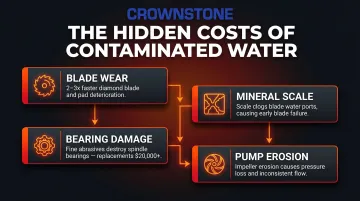
When fabricators recirculate dirty water without adequate filtration, they're sandblasting their own equipment from the inside. Abrasive particles suspended in contaminated water cause:
- Diamond blades and polishing pads wear out 2-3x faster — untreated recirculated water is one of the leading causes of premature blade loss
- Mineral scale builds up in blade water ports, choking cooling flow and driving early blade failure
- Fine abrasive particles destroy spindle bearings — replacements can run $20,000 or more
- Pump impellers erode and clog, causing pressure loss and inconsistent flow across the cutting zone
Poor water quality also shows up directly in finished work. CNC-equipped machines cutting polished edges need exceptionally clean water — cloudy, grit-laden water returns abrasives to the cutting zone, leaving marks on polished stone that require rework.
Why Settlement Pits Alone Aren't Enough
A settling pit handles low-volume cutting, but it can't keep pace once production ramps up. Engineered stone materials like quartz generate slurry that's denser and stickier than natural stone waste. Paula Perry of Water Treatment Solutions notes that "the epoxies used in engineered stone do not settle out" naturally through gravity alone — which is why most professional water-recycling systems add flocculants when processing these materials.
Continuous cutting loads water with fine particles faster than gravity can clear them. Without active mechanical filtration, fine particles stay suspended indefinitely, creating murky, particle-laden water that fails to protect equipment or meet discharge standards.
How a Stone Shop Water Recirculation System Works
A closed-loop recirculation system continuously cleans and reuses water rather than discharging it. Dirty water exits the saw, flows to a collection point, gets filtered through multiple stages, and returns as clean or "gray" water at consistent pressure, which eliminates both water waste and discharge compliance issues.
Collection: The Pit, Flumes, and Sweepers
The system starts at the saw table. Floor flumes channel dirty water from the cutting zone into a collection pit, typically around 5 feet deep by 5 feet wide by 5 feet long (though sizing varies by shop scale). This pit acts as the first stage of separation, where heavier particles begin to settle.
Pit sweeper packages are critical for maintaining system performance. These systems keep particles suspended and directed toward the pump intake rather than allowing them to settle and harden on the pit floor. Without sweepers, fabricators face regular pit cleanouts: draining the water and shoveling or vacuuming out settled mud. It's a labor-intensive task that interrupts production.
Pump mounting matters: Non-submersible pumps mounted above the waterline last significantly longer than submersible alternatives. Submersible pumps sit in abrasive slurry 24/7, leading to accelerated seal and bearing wear. Well-designed systems use horizontal seal-less pumps that, according to BACA Systems, last "years, not months" compared to submersible units.
Filtration: Cyclones, Hydro-Cyclones, and Settling Stages
Multi-stage filtration removes progressively finer particles:
Stage 1: Centrifugal Cyclone Separator
The first stage uses centrifugal force to spin out larger particles. BACA Systems' cyclones remove particles larger than 70 microns, with separated solids purged into a sludge hopper. This stage handles the bulk of coarse grit and prevents downstream components from clogging.
Stage 2: Hydro-Cyclones
Hydro-cyclones provide finer filtration, typically bringing water down to approximately 10 microns. Each hydro-cyclone processes about 20 GPM, and systems use multiple units in parallel to achieve target flow rates. At this stage, water is clean enough for bridge saw cooling, though CNC spindles typically require even finer filtration (1–10 microns) to protect precision bearings and seals.
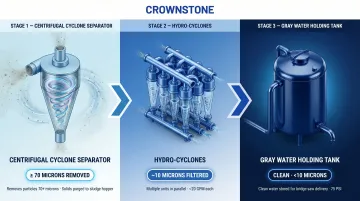
What does "10-micron filtration" actually mean? A micron is one-millionth of a meter, about 70 times smaller than the width of a human hair. Ten-micron water still appears slightly gray but contains particles small enough that they won't scratch polished stone or damage saw components.
CNC routers and sawjets require 1–10 micron water because their spindles have tighter tolerances and seal assemblies that fail when exposed to coarser particles.
Chemical Assistance: Flocculants and Coagulants
Many systems inject flocculants or coagulants at this stage. These chemicals cause fine suspended particles to clump together (flocculate), making them heavy enough to settle out or be captured by downstream filters. Research shows that coagulants can reduce effective settling time by 50 to 70 percent, allowing for smaller tank systems and faster water turnover.
Not all systems use chemicals. Some rely entirely on mechanical separation, avoiding chemical handling at the cost of slightly less clear gray water.
Storage and Delivery
Filtered water flows into a gray water holding tank, typically with a conical-bottom design that allows sediment to settle and be purged periodically. The conical shape prevents sediment from accumulating in corners where it would harden and become difficult to remove.
A delivery pump sends filtered water back to the shop at working pressure, typically around 75 PSI. BACA Systems notes that consistent pressure increases tool life and prevents low-pressure alarms from shutting down machines mid-cut.
Overflow from the holding tank returns continuously to the dirty water pit, completing the closed loop. This means the system never discharges water externally (eliminating most compliance concerns) and never runs out of supply during production.
Optional: Ozone Generators
Some systems add corona discharge ozone generators to the holding tank. Ozone eliminates bacteria, algae, and odors, keeping stored water fresh even during extended periods of inactivity. This is particularly valuable for shops in warm climates where stagnant water can develop foul smells within days.
Filtration Methods and Sludge Handling: Choosing the Right Approach
There's no universal "best" system. The right filtration and sludge management approach depends on your material mix, machine count, cutting volume, and labor availability.
Gravity Settling vs. Active Mechanical Filtration
Gravity settling tanks are the simplest approach: water flows into a series of connected tanks where particles settle over time before the clearest water is drawn off the top. This method has low upfront cost and no complex components to maintain.
The downside: inconsistent water clarity, high labor for cleanout, and poor performance under continuous cutting loads. Academic research found it took 2 hours to reach 95.8% turbidity removal by gravity settling alone without coagulants. With coagulants at optimal dosing, that dropped to approximately 40 minutes—still slower than active filtration.
Paula Perry of Water Treatment Solutions calls gravity settling "antique technology" for modern production shops. Most fabricators working multiple machines have moved to active mechanical filtration using cyclones and hydro-cyclones, which deliver consistent water quality regardless of cutting intensity and require far less manual cleanout labor.
Filter Presses vs. Bag Systems for Sludge
Once solids are separated from water, you need a way to handle the sludge. Two approaches dominate:
Filter Presses:
Filter presses use hydraulic pressure to squeeze water out of sludge, forming dry cakes that are easy to dispose of. Filter presses reduce waste volume by over 90%, with filter cakes containing 80-85% solid material and only 15-20% residual moisture. Dry cakes eliminate slurry haul-off charges and standard waste haulers accept them without issue.
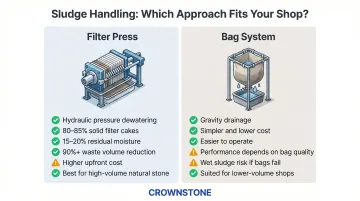
The trade-off: filter presses require periodic plate cleaning, higher upfront investment, and more complex operation. They're best suited for high-volume natural stone operations where the payoff in reduced waste disposal costs justifies the equipment complexity.
Bag Systems:
Bag systems use porous fabric bags to drain water from sludge. They're simpler, lower cost, and easier to operate—but effectiveness depends entirely on bag quality. Poor-quality bags fail to drain properly, causing silo overflow and creating wet sludge that waste haulers often refuse to accept.
The trade-offs are real, though. Paula Perry notes that flocculants are "difficult to measure" and come with practical burdens most shops underestimate:
- Ongoing chemical sourcing and dosing management
- Staff training requirements for safe handling
- PPE and SDS documentation obligations
- Accelerated equipment corrosion ("cause equipment to rust significantly faster")
Chemical-free systems rely entirely on mechanical separation—cyclones, hydro-cyclones, and settling tanks—without adding any chemicals. They eliminate handling concerns and simplify operation, but may produce less-clear gray water and require larger settling volumes to match chemical-assisted output.
Filtration Quality and OSHA Silica Compliance
Properly filtered recirculated water directly affects airborne silica exposure in your shop. Under OSHA's respirable crystalline silica standard (29 CFR 1910.1053), fabrication shops must keep airborne silica below 50 µg/m³ as an 8-hour time-weighted average.
OSHA/NIOSH research found that wet cutting reduced silica concentrations from as high as 770 µg/m³ (dry cutting) down to <100 µg/m³. The same alert warns: "When recycled water is used, it should first be treated to remove solid particles"—making filtration quality a worker safety issue, not just an equipment one.
Sizing a Water Recirculation System for Your Bridge Saw Setup
Undersizing a water system is one of the most common and costly mistakes fabricators make. Systems must be rated to meet peak simultaneous demand across all machines, not just average use.
Calculate Total GPM Demand
Each bridge saw has a cooling water flow requirement, typically ranging from 3-10 GPM at 50 PSI. CNC machines, edge polishers, and hand tools add to the total.
Example calculation:
A shop running two bridge saws (3 GPM each), one CNC router (5 GPM), and three hand polishers (1 GPM each) needs:
- Bridge saws: 2 × 3 = 6 GPM
- CNC router: 5 GPM
- Hand polishers: 3 × 1 = 3 GPM
- Total peak demand: 14 GPM
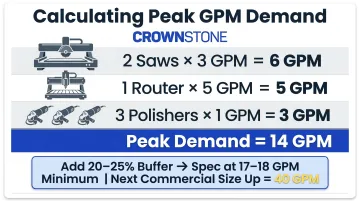
Add a 20-25% buffer to account for future growth and maintain consistent pressure. In this example, a system rated for at least 17-18 GPM would be appropriate, but you'd likely spec a commercial system at the next size up—probably 40 GPM to allow for expansion.
Your saw's documented flow and pressure specs are the essential starting point. Once you have that number, you can size the rest of the system around it.
Commercial System Sizes
BACA Systems offers water filtration systems in the following configurations:
| Model | GPM Flow | Tank Size | Pit Pump HP | Delivery Pump HP |
|---|---|---|---|---|
| SWF3-80 | 80 GPM | 1,000 gal | 10 HP | 7.5 HP |
| SWF3-120 | 120 GPM | 1,500 gal | 10 HP | 10 HP |
| SWF-160 | 160 GPM | 1,500 gal | 10 HP | 15 HP |
| SWF4-200 | 200 GPM | 2,600 gal | 20 HP | 15 HP |
| SWF4-240 | 240 GPM | 2,600 gal | 20 HP | 20 HP |
| SWF4-280 | 280 GPM | 2,600 gal | 25 HP | 20 HP |
| SWF4-320 | 320 GPM | 2,600 gal | 25 HP | 25 HP |
Notice that tank capacity more than doubles between single-saw shops (80 GPM / 1,000 gal) and multi-machine operations (240+ GPM / 2,600 gal). Larger flow rates require more settling volume — water that moves too fast through an undersized tank carries particles into the recirculation loop.
Crown Stone USA offers water recycling systems in 40 GPM (small shops running one bridge saw, one polisher, and 2-3 hand tools) and 70 GPM (larger operations running three bridge saws, a CNC, a polisher, and 4-5 hand tools). Both systems use flocculant-based sediment settling designed for minimal maintenance and compact footprint.
Holding Tank and Silo Capacity
Storage volume must accommodate enough clean water to prevent supply interruptions during peak cutting. Undersized tanks create pressure drop issues that affect cut quality and blade life. Dynamic Stone Tools warns: "Insufficient tank volume means that water moves through the system faster than particles can settle, resulting in turbid water that clogs recirculation pump impellers."
Work with system suppliers to calculate actual requirements based on expected daily water volume, machine count, and hours of operation. As a rule of thumb, systems should hold enough water to supply all machines for at least 15-20 minutes of continuous cutting without recirculation.
Future-Proofing and Modular Systems
Adding machines later is common. Upgrading a water system mid-operation is disruptive and expensive, often requiring new pits, larger tanks, and upgraded electrical infrastructure.
Dinosaw Machine recommends choosing a system with 20-25% more capacity than calculated peak demand. Undersizing leads to "equipment damage, emergency repairs, and higher long-term costs than over-sizing."
Modular systems where additional flow stages can be added offer a practical path for growing shops. Dan Fedrigon of Beckart Environmental recommends filter presses that are "easily and economically expandable" for future growth.
Infrastructure and Site Preparation
Site preparation is the fabricator's responsibility and the most overlooked planning step. Confirm these before ordering equipment:
- Collection pit: Must be installed before the system arrives — dimensions vary by system size
- Floor flume drainage: Plan during shop layout, not after concrete is poured
- Electrical supply: Larger systems require 208-240V or 480V three-phase; smaller units may run on 120V single-phase
- Electrical capacity: Verify your panel can handle the added load before specifying pump horsepower
Maintenance, Water Quality, and Compliance Basics
Well-designed systems require minimal daily attention, but neglecting routine maintenance leads to rapid performance decline.
Routine Maintenance Tasks
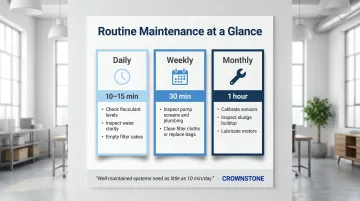
Dinosaw Machine provides realistic time estimates:
- Daily (10-15 minutes): Check flocculant levels, inspect water clarity, empty filter cakes if using a press
- Weekly (30 minutes): Inspect pump screens and plumbing, clean filter cloths or replace bags
- Monthly (1 hour): Calibrate sensors, inspect sludge buildup, lubricate motors
Bag or filter press cleanout frequency depends on cutting volume and material. Shops cutting quartz heavily may service sludge systems every few days; shops working primarily natural stone may go a week or longer between cleanouts.
Beyond cleanout schedules, Dynamic Stone Tools recommends monitoring recycled water conductivity weekly and probing sludge depth monthly. Pump out sludge when "active water depth falls below 50 percent of the tank's total depth."
Crown Stone USA's water systems are built for easy serviceability, with parts stocked domestically in the US. A properly sized, well-designed system typically needs no more than 10 minutes per day for routine checks.
Water Discharge Compliance
In most jurisdictions, stone slurry cannot be discharged directly to storm drains or waterways. Stone fabrication process water is subject to limits on suspended solids, pH, and certain metals concentrations.
Stone slurry is alkaline — pH typically above 7, often approaching 9-10 with lime-based coagulants — due to calcium carbonate and other minerals.
Under EPA pretreatment standards (40 CFR 403.5), discharges to publicly owned treatment works (POTWs) are prohibited if pH falls below 5.0. Many municipalities go further, restricting high-pH discharges and prohibiting "solid or viscous pollutants" that cause obstruction.
A closed-loop recirculation system—where no water is discharged—is typically the safest approach for compliance. Treated water (visually clear) can often be discharged to sanitary sewers under a general industrial wastewater permit, but verify local discharge regulations with your water authority or environmental agency.
Under the Clean Water Act Section 402, industrial stormwater discharges require NPDES permits. Stone fabrication shops fall under general industrial discharge frameworks administered at the state level.
Monitoring Water Quality
Key indicators to monitor:
- Turbidity (cloudiness): Visibly cloudy water indicates filtration is underperforming
- Conductivity: Measures dissolved solids; rising conductivity signals water should be replaced
- Sludge buildup: Excessive accumulation in tanks or bags signals inadequate purging or oversized flow rates
- Blade life and cut quality: Reduced blade life or visible marks on polished stone are practical on-the-floor indicators of poor water quality
The Natural Stone Institute recommends that fabricators "recycle water used in production processes" and notes that certified companies are recycling over 95% of the water used in their facilities. That figure shows closed-loop systems can reach near-zero discharge — and that it's an achievable standard, not just an aspirational one.
Frequently Asked Questions
What is slurry in water treatment?
In stone fabrication water treatment, slurry refers to the mixture of water and fine stone particles—dust, grit, calcium carbonate, silica, and resin binders from engineered stone—generated during cutting and grinding. This slurry must be separated from the water through filtration and settling before the water can be safely recirculated or discharged.
What water treatment methods are used in stone shop recirculation systems?
Stone fabrication shops primarily rely on sedimentation, cyclone filtration, coagulation/flocculation, and in some cases ozone disinfection. Broader water treatment also includes pH adjustment and membrane separation, but those methods rarely apply to standard shop recirculation setups.
How often should a stone shop water recirculation system be maintained?
Maintenance frequency depends on cutting volume and material type. Active shops typically service sludge bags or filter presses every few days to weekly—with about 10-15 minutes of daily checks—and conduct full system inspections monthly.
What micron filtration level does a bridge saw need compared to a CNC machine?
Bridge saws typically operate effectively with gray water filtered to around 10 microns, sufficient for blade cooling and general cutting. CNC routers and sawjets with precision spindles generally require water filtered to 1-10 microns to protect spindle seals and bearings and achieve scratch-free polished finishes.
Can one water recirculation system serve multiple bridge saws?
Yes, a single recirculation system can serve multiple machines if it is correctly sized to the combined GPM demand of all machines running simultaneously. Undersizing the system for multi-machine shops is one of the most common and costly mistakes fabricators make, leading to pressure drops, equipment damage, and poor cut quality.