The stakes are real. A bridge saw typically costs half what a sawjet does, but if your shop cuts multiple sink openings daily, that price difference might represent money left on the table. Conversely, paying sawjet premiums when 90% of your work is straight countertop cuts means overspending on capability you rarely touch.
This guide cuts through the noise. We'll examine what each machine actually does, where each excels, and the specific shop scenarios where one clearly outperforms the other — using real production data, fabricator case studies, and measurable cost-per-hour figures.
TLDR
- **Bridge saws use diamond blades** for precise straight cuts, miter cuts, and basic profiling — lower upfront cost, simpler maintenance, ideal for high-volume slab production
- Sawjets combine blade and waterjet in one machine, enabling fast, precise non-linear cuts (sinks, curves, tight nesting) — roughly double the investment, higher throughput on complex work
- Sawjets earn their price when sink cutouts and tight nesting are daily demands; bridge saws win on volume straight-cutting
- Key factors: weekly job volume, percentage of complex cuts, consumable budget, floor space
- The right machine is whichever one matches your shop's actual daily workload — not the one with more features
Bridge Saw vs Sawjet: Quick Comparison
Cost
Bridge Saw:Lower initial purchase price, typically around half the cost of a comparable sawjet. CNC bridge saws from US/European manufacturers range from $85,000 to $350,000+, while Asian-manufactured 5-axis models run $35,000–$65,000. Operating costs remain low with diamond blades ($220–$400 per 16" blade) as the primary consumable.
Sawjet:Roughly 2x the upfront investment compared to an equivalent CNC saw from the same manufacturer. Stone World reports that "a CNC saw comes in at nearly half of the monthly payment" versus a sawjet. Ongoing consumable costs include:
- Garnet abrasive (0.3–0.6 kg per minute during cutting)
- High-pressure pump components and nozzle replacement
- Higher energy consumption
Total waterjet operating costs run $15–$30 per hour.
Cutting Capability
Bridge Saw:Excels at straight cuts, 45° miter cuts, and standard countertop profiling. Can handle sink cutouts using diamond finger bits in a multi-step toolpath, but the process is slower and limited on complex shapes without incremental bit work.
Sawjet:Handles all straight and miter cuts (using the blade) plus fast, precise non-linear cuts: sinks, arcs, radii, and tight nests using the waterjet. No blade overtravel, no step cutting. The waterjet finishes cuts tight to defined points without the mechanical limitations of circular blade geometry.
Speed on Complex Jobs
Bridge Saw:A 5-axis CNC bridge saw completes a standard sink cutout in approximately 15–25 minutes using diamond tooling. Manual sink cutouts by skilled fabricators take 1–3 hours.
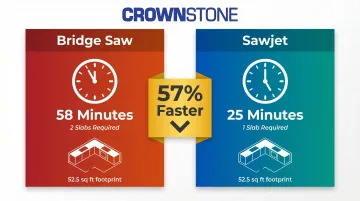
Sawjet:In a published Park Industries comparison, a common 52.5 sq ft kitchen layout took 58 minutes on a CNC saw vs. 25 minutes on a sawjet — a 57% reduction in cutting time. Each slab with all cutouts and faucet holes processes in 20–30 minutes total, well ahead of bridge saw tooling approaches.
Material Yield
Bridge Saw:Blade overtravel (where the circular blade must extend beyond the cut endpoint) and wider kerf reduce usable slab area. Tight nesting may require spreading pieces across two slabs, increasing material costs on premium stone.
Sawjet:The waterjet's narrow cut path (0.030"–0.050" kerf, roughly one-third the width of a saw blade) eliminates blade overtravel. Industry data confirms 10–20% material yield improvement per slab versus blade-only cutting. That's hundreds of dollars saved per premium slab.
Maintenance Complexity
Bridge Saw:Straightforward maintenance: blade changes, lubrication, and cleaning. Parts are widely available, and daily upkeep can be performed during production breaks with no specialized technician required.
Sawjet:Requires regular inspection and replacement of nozzles, seals, and high-pressure pump components. Both programming and daily maintenance demand higher technical skill. That said, most shops run an 80% blade / 20% waterjet split, so waterjet wear applies to only a fraction of total machine time.
What is a Bridge Saw?
A bridge saw is a CNC-controlled cutting machine with a diamond blade mounted on a gantry (bridge) that travels over a tilting table. The system executes programmed straight cuts, miter cuts, and beveled edges on large stone slabs — granite, marble, quartz, porcelain — serving as the primary cutting workhorse for commercial countertop fabrication.
The operational core is simple: fabricators program a cut layout using CNC software; the machine executes the cuts automatically. This eliminates operator fatigue, improves repeatability, and dramatically reduces per-piece labor time compared to manual saws.
Core strengths tied to shop impact:
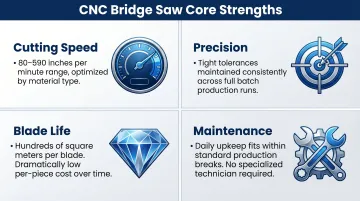
- Cuts 80-590 inches per minute depending on material hardness — quartz at the high end, dense quartzite at the lower end
- Holds tight tolerances on straight and angled cuts through batch production without drift
- Diamond blades handle several hundred square meters before replacement, keeping per-piece operating costs low
- Daily upkeep (cleaning, lubrication, blade checks) fits into normal production breaks with no specialized technician required
This maintenance simplicity matters most for busy shops that cannot afford unplanned downtime. Unlike complex multi-system machines, a well-built bridge saw keeps running with basic operator-level care.
Use Cases of a Bridge Saw
Bridge saws fit shops doing primarily residential and light commercial countertop work where the majority of pieces are straight-cut slabs with standard sink openings processed separately on a CNC router.
They dominate high-volume production environments: slab sizing centers and shops running 50-200+ pieces per week on repeat kitchen and bathroom layouts where straight-cut speed equals profit per shift.
CNC tooling reduces sink cutout time to 15-25 minutes — a 75-80% reduction versus manual methods. One operator can process 20+ automated cutouts daily compared to roughly 4 by hand.
For shops still running stick templates or manual saws, a bridge saw is the most practical first CNC investment. Crown Stone USA builds its bridge saws in America with a 2-year warranty and US-serviceable parts — designed by people who spent years cutting, lifting, and installing stone before they ever built one.
What is a Sawjet?
A sawjet integrates both a saw blade and a waterjet cutting head in a single CNC unit. The saw blade handles all straight cuts and miter cuts; the waterjet takes over for non-linear work (sinks, radii, arcs, tight nesting, and intricate shapes) using ultra-high-pressure water and abrasive garnet to cut without blade contact.
The core advantage: Because the waterjet finishes precisely to a defined point without blade overtravel and without step-cutting, it eliminates the major production bottleneck that holds back CNC saws on complex jobs.
Real-world impact: In the Park Industries kitchen layout comparison, the sawjet not only cut faster (25 minutes vs. 58 minutes) but also used one slab instead of two — demonstrating how the throughput advantage compounds when material savings are factored in.
Material yield benefit: The waterjet's narrow, precise cut path (0.030"–0.050" kerf) allows tighter nesting on each slab. Doug Cicchini of BACA Systems notes that "yields increase by 10 to 20%" due to digital layout optimization and the sawjet's ability to finish cuts tight to adjacent pieces without damaging them.
The cost and operational reality involves real trade-offs:
- Higher upfront price (roughly double a comparable CNC saw)
- Higher consumable costs: abrasive, pump components, and energy
- More technically skilled operator required for programming and maintenance
Shops must weigh these factors against throughput gains and material savings before committing.
Use Cases of a Sawjet
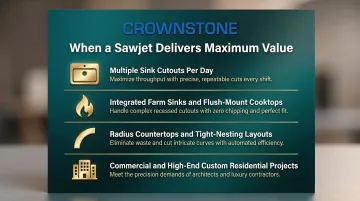
Sawjets deliver maximum value in shops handling significant volumes of complex work. That includes:
- Multiple sink cutouts per day
- Integrated farm sinks and flush-mount cooktops
- Radius countertops and tight-nesting layouts
- Commercial and high-end custom residential projects
Router throughput multiplication: Shops that route high volumes of slab work benefit significantly. Pre-shaping non-linear cuts on the sawjet reduces time each piece spends on the router, freeing capacity across the entire production line. As one fabricator noted, "sink openings, faucet holes and curved cuts" are eliminated from the CNC router queue, and "tooling costs on the CNC are reduced since cuts normally performed by finger bits are no longer required."
Growth consideration: A sawjet allows shops to take on work they currently turn down: large commercial projects, high-end custom designs, and integrated feature pieces. It serves as a production multiplier when demand supports the investment, particularly in markets where skilled fabricators are scarce and labor costs high.
Bridge Saw vs Sawjet: Which Machine Does Your Shop Actually Need?
The decision comes down to three honest questions:
- What percentage of your weekly jobs involve complex non-linear cuts like sinks, curves, or tight nests?
- Is your throughput currently bottlenecked by the time your saw or CNC router spends on these complex cuts?
- Does your current or projected job volume justify the higher upfront and operating cost of a sawjet?
Choose a Bridge Saw If:
- You primarily cut straight countertop pieces
- Your sink work is handled efficiently on a separate CNC router
- You're upgrading from a manual bridge saw or stick templates
- You need a lower capital entry point with simpler maintenance
- Your shop runs production where speed on straight cuts drives profitability
For these shops, a well-built CNC bridge saw — particularly an American-made option like those from Crown Stone USA with readily available domestic parts — remains one of the best investments in stone fabrication. The 15-25 minute automated sink cutout capability eliminates hours of hand labor, while low operating costs and straightforward maintenance keep the machine running shift after shift.
Choose a Sawjet If:
- Sink cutouts and non-linear shapes represent a major share of daily volume
- Your CNC router is becoming a bottleneck
- You have consistent demand for commercial or custom high-complexity work
- Your revenue per job can support higher machine cost and consumable spend
- Material yield improvements (10-20% more usable stone per slab) translate directly to bottom-line savings on premium materials
The sawjet ROI case strengthens rapidly when labor shortages, complex job mixes, or commercial-scale volume enter the equation. State Stone Work solved three bottlenecks with a sawjet: eliminating stick-template errors on miters, efficiently cutting demanding materials like porcelain and quartzite, and automating sinks and faucet holes when "hand labor is getting harder and harder to find."
The Hybrid Reality
Neither choice is permanent. Many well-equipped shops eventually run both: a bridge saw for high-speed straight-cut volume and a sawjet for complex work. When sequencing these investments, start with what solves your biggest current bottleneck. If you're drowning in straight-cut volume, the bridge saw comes first. If sink cutouts and router backup are killing throughput, the sawjet justifies its premium.
Real Shop Scenario: Putting the Numbers in Context
Consider a typical production scenario: a shop processing a multi-sink kitchen layout (52.5 sq ft) with tight material nesting.
Bridge saw approach:
- Total machine time: ~58 minutes
- Slab consumption: Two slabs required (blade overtravel prevents tight nesting)
- Sink processing: 15-25 minutes per sink using CNC tooling
Sawjet approach:
- Total machine time: ~25 minutes (57% faster)
- Slab consumption: One slab (tighter nesting, no overtravel)
- Sink processing: Integrated into total slab program using waterjet
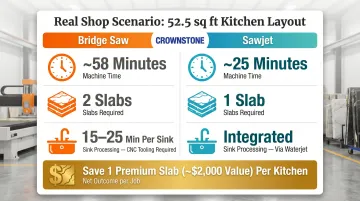
On a $2,000 premium slab, saving one slab per kitchen adds up fast. Multiply that across dozens of kitchens monthly, and the material savings alone offset the sawjet's higher acquisition cost.
The upgrade decision usually comes down to a specific breaking point: CNC router backup, excessive hand labor on sinks, or mounting material waste on premium slabs. NS Motif reported processing each slab with "all cut outs and faucet holes in 20 to 30 minutes" and saving "$85 a pop" by eliminating sink-hole bits.
Takeaway: If you're losing hours to hand-cut sinks or your router can't keep pace with slab output, the numbers point toward a sawjet. If your shop runs efficiently on straight work, a well-built bridge saw remains a cornerstone investment. Consider reaching out to Crown Stone USA to evaluate whether their American-made bridge saw fits your production needs.
Conclusion
There's no universal winner in the bridge saw vs. sawjet decision. A bridge saw is the right tool for shops prioritizing volume, simplicity, low operating cost, and reliability on straight production. A sawjet earns its higher price tag in shops where complex cuts, tight material yield, and reduced router dependency translate directly to revenue.
The key is matching the machine to the work actually on your table — not the most impressive spec sheet.
Crown Stone USA was built by fabricators who've made these exact decisions firsthand. Their American-made bridge saws deliver the reliability, serviceability, and straightforward maintenance that high-volume shops depend on — designed by people who once cut, lifted, and installed stone for a living. If a bridge saw is the right fit for your production line, Crown Stone can help you choose the machine that matches your shop's real-world demands.
Ready to evaluate your options? Contact Crown Stone USA at 727-239-9875 or visit crownstoneusa.com/contact/ to discuss your specific production needs.
Frequently Asked Questions
What is a bridge saw for?
A bridge saw is a CNC machine that makes precise straight cuts, miter cuts, and bevel cuts on large stone slabs including granite, marble, quartz, and porcelain. It serves as the primary cutting workhorse for countertop fabrication shops.
What are the advantages of waterjet cutting?
Waterjet cutting offers several advantages over blade cutting:
- Operates without heat, preventing thermal stress on material
- Handles non-linear shapes (sinks, arcs, inlays) with high precision
- Eliminates blade overtravel for better material yield
- Processes materials a saw blade cannot: glass, metal, ceramics
- Produces a narrow kerf (0.030"–0.050") that maximizes usable material per slab
How much does waterjet cutting cost per hour?
Industry estimates place waterjet operating costs at $15–$30 per hour, including abrasive (garnet), water, energy, and maintenance. This is higher than bridge saw hourly costs, but applies to only ~20% of cutting time in typical sawjet operations since most cuts use the blade.
How to choose the right stone cutter?
Evaluate your production mix (straight vs. complex cuts), weekly volume, budget for machine and consumables, and available floor space. Match those factors to the machine that addresses your biggest current production constraint — not the one with the most features.
What is the best saw for accurate cutting?
For straight and miter cuts on stone, a well-built CNC bridge saw delivers high dimensional accuracy with tight tolerances. For complex curved or non-linear cuts, a sawjet's waterjet function provides superior precision. Accuracy depends on matching the tool to the cut type.
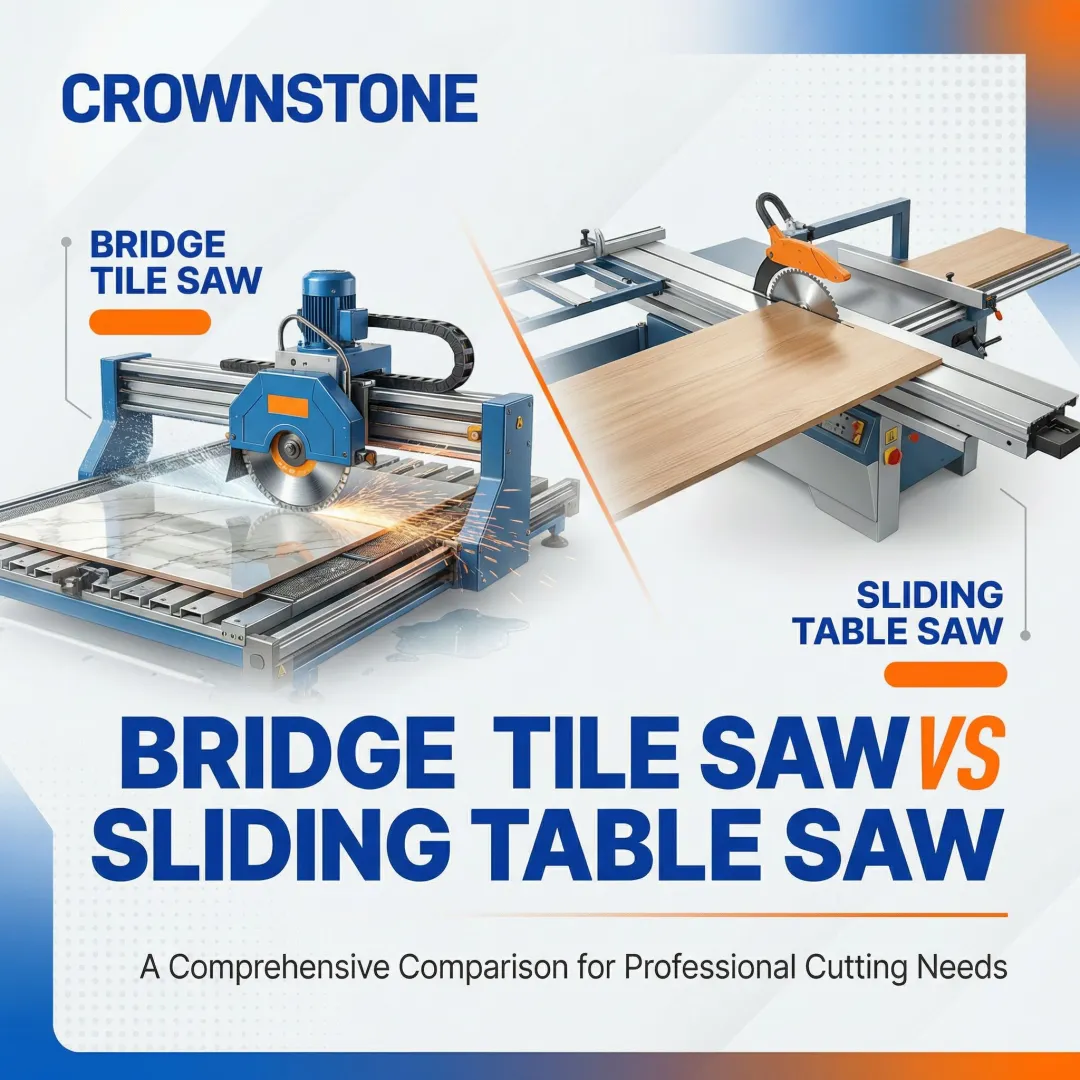
What is the difference between a CNC saw and a sliding table saw?
A sliding table saw requires manual operator guidance for each cut. A CNC saw executes a programmed layout automatically, delivering greater repeatability, speed, and consistency for production stone fabrication. CNC eliminates human error and reduces labor hours per piece.