Introduction
When you're standing on the shop floor comparing CNC bridge saws, both 4-axis and 5-axis machines can cut granite, marble, and quartz. But choosing the wrong configuration means either overpaying for capability you'll never use or walking away from profitable jobs your competitors can handle in-house.
Your decision touches production speed, job acceptance rate, setup complexity, operator training, and total cost of ownership. Getting the configuration wrong can mean leaving money on the table — or spending six figures on axes you never turn on.
A global CNC stone equipment market valued at $1.225 billion in 2024 is growing at 5.5% annually, yet only 28% of stone fabricators indicated CNC purchase intent in the most recent industry survey. Shops making the leap now have one shot to pick the right machine.
TL;DR
- 4-axis saws handle straight cuts, fixed miters, and basic bevels across X, Y, Z, and one rotational axis
- 5-axis adds a second rotational axis — enabling full-angle chamfers, curved profiles, and vertical sink walls
- 4-axis costs less upfront and suits high-volume standard countertop production
- 5-axis pays off for custom architectural work, complex 3D profiles, and eliminating secondary polishing
- The right pick comes down to your job mix, budget, and operator capacity
4-Axis vs 5-Axis CNC Bridge Saw: At a Glance
| Attribute | 4-Axis Bridge Saw | 5-Axis Bridge Saw |
|---|---|---|
| Axes/Motion Range | X, Y, Z linear + one rotational axis (typically A-axis tilt to fixed angles) | X, Y, Z linear + two rotational axes (full 360° rotation + 0-90° tilt) |
| Typical Cut Types | Straight cuts, right angles, fixed 45° miters, basic sink cutouts, rectangular profiles | Full-angle chamfering, curved edges, vertical arc cutouts, compound miters, 3D profiles |
| Positioning System | Servo motors with incremental encoders (requires zero-return on startup) | Servo motors with absolute encoders (no homing sequence required) |
| Price Range | $15,000–$100,000 (Asian entry to mid-tier) | $35,000–$350,000+ (Asian mid-tier to European premium) |
| Ideal Use Case | High-volume residential countertops, standard geometry, predictable repeat setups | Custom architectural stone, curved profiles, waterfall countertops, multi-angle fabrication |

Both machine types cut granite, marble, quartz, and engineered stone — the choice comes down to the complexity of profiles your shop needs to produce.
What is a 4-Axis CNC Bridge Saw?
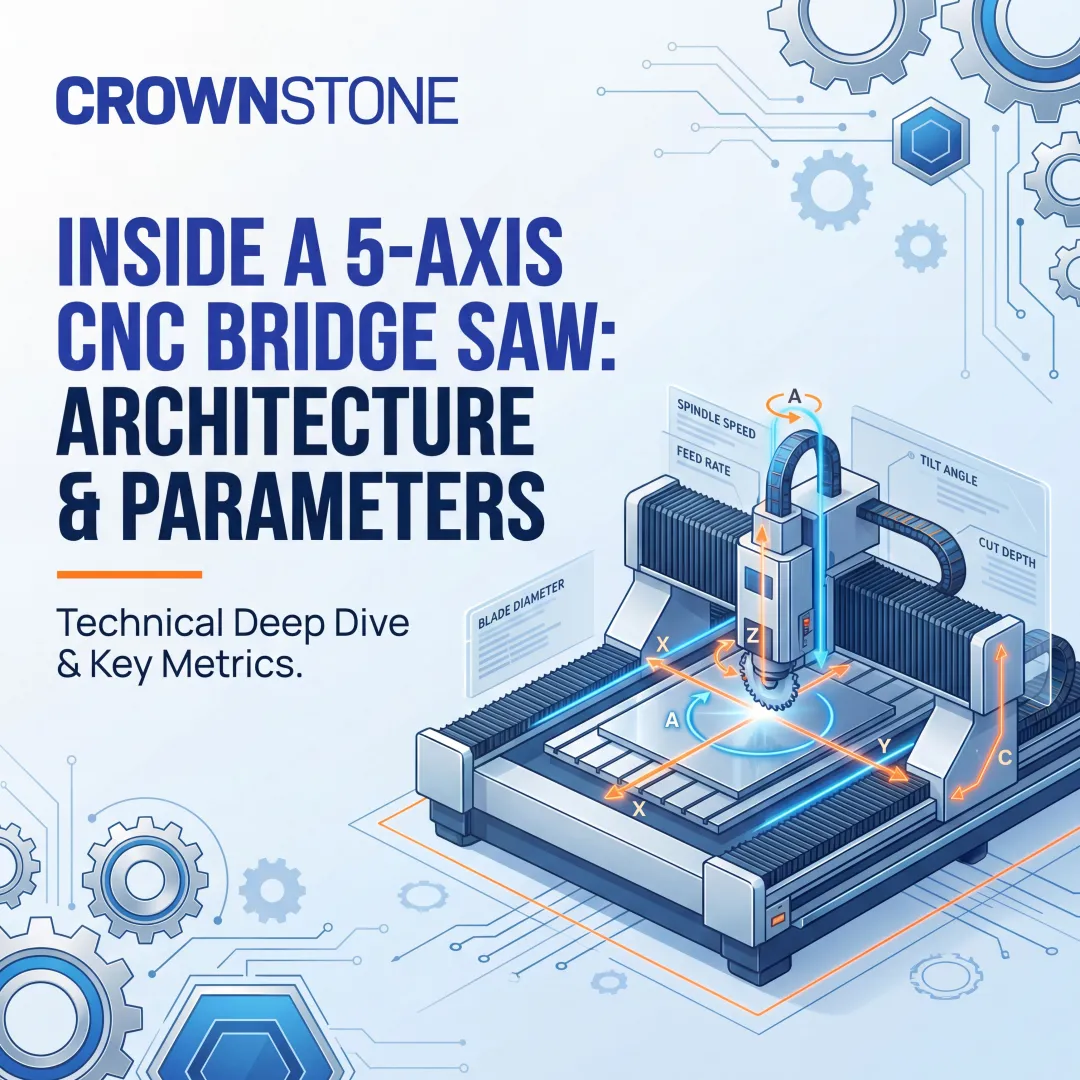
A 4-axis bridge saw controls movement along three linear axes — X (left/right along the bridge), Y (front/back), and Z (up/down) — plus a fourth rotational axis (typically the A-axis) that tilts the cutting head. Most bridge saws achieve 0–45 degree tilt, with some reaching 90 degrees. The 45° tilt is the industry standard for miter and chamfer work.
Most 4-axis machines use servo motors with incremental encoders, which require a zero-return sequence on startup to re-establish the machine's reference position after power-off. It adds roughly 60–90 seconds to the start of every shift — minor, but worth knowing.
Core capabilities:
- Straight cuts and right-angle cuts for countertop blanks
- Fixed-angle bevels (typically 45°) for miter joints and edge chamfers
- Drilling operations for sink clip holes and faucet knockouts
- Basic rectangular sink cutouts with standard geometry
For countertop production where geometry doesn't change much job to job, that capability set covers most of the work. You're cutting to dimension, running standard miters, and moving efficiently through slabs.
Use Cases of a 4-Axis Bridge Saw
The 4-axis configuration fits shops running high-volume residential countertop work: kitchen islands, bathroom vanities, and basic tile processing. If your job board shows primarily rectangular slabs with 45° waterfall miters and standard undermount sinks, a 4-axis machine handles 80% of that work.
4-axis machines also handle monument and tombstone fabrication. Headstones require straight cuts, right angles, and occasional beveled edges — all within the machine's capability range.
Hand-finishing requirement: Inner arc cuts (rounded sink corners, radius edges) on a 4-axis machine produce a slanted edge due to the head tilt limitation. That edge requires hand polishing, adding 30–45 minutes per sink cutout. Factor this into your throughput calculations — CNC bridge saws complete sink cutouts in 15–25 minutes versus 60–120 minutes manually, but a 4-axis machine still requires secondary finishing on curved cuts.
What is a 5-Axis CNC Bridge Saw?
A 5-axis bridge saw adds a second rotational axis (typically the B-axis) to the four-axis configuration. This allows the cutting head to rotate a full 360° and tilt to any angle between 0° and 90°. The blade or router head can approach the stone from virtually any direction without manually repositioning the slab.
The precision advantage comes from higher-spec servo drives with absolute encoders. Absolute encoders retain their shaft position information when the system powers down and resume functionality immediately upon powerup. No zero-return sequence, no homing delay — the machine is ready to cut at startup.
Extended capabilities:
- Chamfering at any angle, not just 45° — enabling custom waterfall profiles and architectural details
- Vertical arc edges that require no post-processing — the cut comes off the machine clean
- Curved profile cuts for fireplace surrounds and radius countertops
- Sink cutouts with true vertical walls, eliminating the beveled edge that 4-axis machines produce
- Edge milling and profiling in a single setup
Those capabilities are only as reliable as the control system behind them. Many 5-axis machines integrate advanced CNC platforms — such as ESA elettronica from Italy — that support per-edge programming. You define speed, depth, cut sequence, and direction independently for each edge, reducing operator intervention and setup errors.

Use Cases of a 5-Axis Bridge Saw
The 5-axis is built for custom kitchen and bath work with non-standard profiles. If your quote list includes waterfall-edge countertops with 22.5° angles, curved backsplashes, or angled sink cutouts for vessel-mount installations, the 5-axis handles those jobs in one pass.
Architectural stone work — curved panels for hotel lobbies, angled facades, fireplace surrounds with radius edges — falls squarely in 5-axis territory. Any job requiring multi-angle cuts that would otherwise take multiple passes or manual finishing is a strong candidate.
Because inner arc edges cut on a 5-axis machine come off vertical and clean, secondary polishing is eliminated. For shops running 10–15 sink cutouts per week, that's 5–7.5 hours of hand-polishing labor recaptured. At $25–$35 per hour in loaded labor cost, that's $125–$262 per week recovered — without touching throughput gains.
Key Differences That Matter for Stone Fabricators
Cutting Angle Flexibility
A 4-axis head tilts to fixed, pre-set angles — most commonly 0° and 45°. If your customer wants a 30° waterfall edge or a 22.5° decorative bevel, the 4-axis can't deliver it without manual slab repositioning or hand finishing. Most bridge saws achieve 0-45 degree tilt, with the 45° position locked for miter work.
A 5-axis head rotates freely to any angle. You program the exact tilt and rotation, and the machine executes it. Glue-joint miters at non-standard angles, compound cuts for complex architectural installations, and profiles that would be impossible on a 4-axis all become routine.
Bottom line for custom work: On a 4-axis, jobs requiring uncommon angles either get declined or absorbed into overtime. For fabricators bidding custom residential or commercial work, that's direct margin loss — either through turned-down work or hand-finishing labor that wasn't in the quote.
Arc and Profile Quality
When cutting inner circles or sector shapes — sink cutouts, rounded corners, radius edges — a 4-axis machine produces a beveled edge. The head tilts at a fixed angle, so as the blade moves through a curve, the cut wall isn't vertical. That edge needs polishing.
A 5-axis produces a clean, vertical edge straight off the machine. The cutting head adjusts its angle continuously as it moves through the arc, maintaining a true 90° wall. 5-axis machines use ramping toolpaths and can automatically create beveled, bullnose, or custom edge profiles around the cutout, with initial polishing performed automatically.
Cycle time and labor impact:
| Method | Time per Sink Cutout | Secondary Polishing |
|---|---|---|
| 4-axis CNC | 20-30 minutes | 30-45 minutes (manual) |
| 5-axis CNC | 15-25 minutes | 0 minutes |

The 75-80% reduction in total processing time compounds across production days. For a shop running 50 sink cutouts per month, that's 25-37.5 hours of labor saved monthly.
Control System and Software Intelligence
5-axis machines run more advanced CNC control platforms. Premium systems like ESA from Italy support photo layout and positioning, automated cut sequencing, and per-edge parameter programming. The operator loads the slab, scans it with an onboard camera, and the system optimizes nesting to reduce waste.
4-axis machines often use simpler PLC or basic CNC controls — well-suited for straightforward cutting programs. You define X, Y, Z movements and trigger the tilt axis at preset positions.
The tradeoffs come down to a few practical factors:
- Automation level: 5-axis systems reduce manual intervention at nearly every step
- Operator dependency: 4-axis relies more on operator input, which means more control — but also more variability
- Complexity overhead: Advanced software reduces the 5-axis learning gap but doesn't eliminate it
Ease of Operation and Operator Training
A 4-axis machine is more straightforward to set up and program. The learning curve is shorter — a trained operator can be productive within a few weeks. For shops with newer CNC operators or smaller teams, this matters.
A 5-axis machine's expanded capability comes with a steeper learning curve. Programming compound-angle cuts, managing per-edge parameters, and optimizing toolpaths require deeper CNC knowledge. Intuitive control software reduces this gap, but it doesn't eliminate it. Budget for additional training time and potentially higher operator wages.
Maintenance, Parts Availability, and Downtime
More mechanical complexity on a 5-axis means more components that can require service. RV (rotary vector) reducers serve as standard components in 5-axis rotary heads, delivering the low backlash and positioning accuracy needed for compound-angle work. These are durable precision parts, but they may require manufacturer-specific sourcing when replacement is needed.
For US fabricators, parts availability is a real operational risk. Machines tied to overseas-only supply chains can sit idle for weeks waiting on a single component. Crown Stone USA's bridge saws source parts primarily from the US, Americas, Korea, Japan, and Taiwan — less than 2% of components by value originate from China — so parts are stocked domestically and service turnaround is faster.

Annual maintenance contracts typically cost 3-8% of machine value yearly, per industry pricing guides. A $200,000 machine at 3% runs $6,000 annually; a $65,000 machine at 8% runs $5,200 annually. Factor both upfront cost and ongoing maintenance into your TCO calculation.
Which Bridge Saw is Right for Your Shop?
When a 4-Axis Bridge Saw is the Right Call
Choose a 4-axis bridge saw when:
- Your shop primarily produces residential countertops with standard geometry
- Your job board shows mostly straight cuts, 45° miters, and rectangular sink cutouts
- Your operators are newer to CNC equipment and need a shorter learning curve
- Your capital budget is constrained and you need to maximize ROI on bread-and-butter work
- You're comfortable with secondary hand-polishing on curved cuts
A 4-axis machine handles the work that makes up the majority of most fabrication shops' revenue — reliably and at a lower operating cost. It's the workhorse for high-volume countertop production.
When a 5-Axis Bridge Saw Becomes the Right Investment
Choose a 5-axis bridge saw when:
- Your shop bids on custom architectural work, curved profiles, or specialty edge treatments
- You're losing jobs to competitors who can produce complex cuts in-house
- Your current workflow involves significant secondary hand-polishing or slab repositioning
- You want to eliminate 30-45 minutes of hand labor per sink cutout
- You need to accept non-standard angles (waterfall edges at 30°, compound miters, decorative bevels)
If you're seeing more custom jobs in your quote queue, the 5-axis pays back in recovered labor hours and opens jobs a 4-axis simply can't take.
A Note for Growing Shops
Not every shop falls cleanly into one category — and that's where the decision gets expensive if you get it wrong. Fabricators scaling up should factor in where their capability ceiling sits. If you expect to quote more complex commercial or custom residential work in the next 2-3 years, consider whether a 4-axis will still cover it. Upgrading later means absorbing three real costs:
- A second capital purchase
- Additional operator training
- Lost production time during the switchover
Research the job types you'll be quoting 24-36 months out, not just what's on your shop floor today.
If you're working through that decision, the Crown Stone USA team can walk through your actual job mix with you and help match the right machine to your production needs. Reach them at 727-239-9875 or info@crownstoneusa.com.
Frequently Asked Questions
What is the difference between 4-axis and 5-axis bridge saws?
A 4-axis bridge saw tilts its cutting head to fixed angles along three linear axes plus one rotational axis, while a 5-axis adds a second rotational axis enabling full 360° head movement and cuts at any angle. This unlocks curved profiles, vertical arc edges, and complex shapes without repositioning the slab.
Is 5-axis CNC worth the investment?
For shops running high-volume standard countertop work, the added cost rarely pays off quickly. For shops doing custom architectural, curved, or multi-angle work, the elimination of secondary labor steps and the ability to take on higher-margin jobs typically justifies the cost within 12-24 months.
What is the difference between 3+2 and full 5-axis cutting?
3+2 (positional 5-axis) rotates the cutting head into a fixed angle and then runs 3-axis cutting moves from that position — faster to program but limited to flat surfaces at set angles. Full simultaneous 5-axis moves all five axes at the same time, enabling true curved and compound-geometry cuts in a single continuous pass.
Which is more accurate — 4-axis or 5-axis?
Accuracy depends on both the machine's servo drive system and its control software. 5-axis machines with absolute-value encoders and advanced CNC controllers offer the highest repeatability, but a well-maintained 4-axis machine with quality components will hold tight tolerances for standard straight and miter cuts in most countertop production environments.
Can a 4-axis bridge saw cut mitered edges and angled cuts?
Yes, a 4-axis bridge saw can cut miter edges — typically at fixed angles like 45°. But it cannot chamfer at arbitrary angles or produce compound cuts without manually repositioning the slab. For non-standard miter angles or combinations of angles on a single piece, a 5-axis machine is required.
How much more does a 5-axis bridge saw typically cost than a 4-axis?
4-axis machines typically range from $15,000-$100,000 depending on tier, while 5-axis systems run $35,000-$350,000+ based on origin and control system quality. At comparable build quality, expect a 2-5x price multiplier — with premium European and North American models sitting at the high end.