Introduction
Stone fabricators are actively shopping for bridge saws in 2026—and for good reason. The U.S. countertop market is valued at $28.65 billion in 2024 and projected to hit $32.44 billion by 2030, with granite holding 36% market share. Shop capacity is strained, job backlogs are growing, and many fabricators are evaluating whether their current equipment can keep up.
Bridge saw prices span a wide range: entry-level manual models start around $13,000, mid-range CNC machines run $30,000–$60,000, and high-end 5-axis systems exceed $100,000. The sticker price, though, is only part of what you'll actually spend.
Three budgeting mistakes consistently catch fabricators off guard:
- Underestimating total cost of ownership — blades, maintenance, and water systems add thousands per year
- Mismatching machine capability to shop volume — buying too little capacity, or overbuying for a low-volume shop
- Overlooking installation and recurring costs — electrical upgrades, parts lead times, and unplanned downtime
This guide breaks down the real numbers—upfront and ongoing—covering machine tiers, hidden expenses, and what to ask before you sign.
TL;DR
- Bridge saw prices range from $13,000 for manual models to $100,000+ for 5-axis CNC systems.
- Axis count, table size, build quality, and origin drive the biggest price differences.
- Small shops can run profitably on a mid-range 4-axis CNC ($30,000–$60,000); high-volume operations need 5-axis capability.
- Total cost of ownership includes water recycling, tooling, and routine maintenance—budget $2,000–$10,000 annually.
- Lower-priced machines often carry higher long-term costs: parts failures and unplanned downtime can erase weeks of margin.
How Much Does a Bridge Saw Cost in 2026?
There's no single price for a bridge saw—costs vary dramatically by machine type, automation level, and vendor. Getting the budget wrong in either direction hurts your business.
Shops that underbudget end up buying underpowered machines they outgrow within 12–18 months, forcing a second purchase that exceeds what the upgrade would have cost upfront. Others overspend on 5-axis capability they won't use for years, tying up capital that could go toward marketing or hiring.
Here's what each price tier typically delivers.
Entry-Level Bridge Saws ($13,000–$23,000)
At this price, expect:
- Manual or semi-automatic operation with basic 2–3 axis movement
- Limited automation — operators manually position the blade for each cut
- Straight cuts and basic miters only
- Imported machines from European or Asian suppliers
- Example: The Achilli AFR 300 C Manual Bridge Saw lists at $13,311, while semi-automatic models like the Achilli AFR 300-A run around $21,125.
Best for: Startup fabrication shops, low-to-moderate slab volume operations, or shops adding a secondary cutting station. Consumable and maintenance costs may be higher due to build quality trade-offs — less durable rails and spindles wear faster.
Mid-Range CNC Bridge Saws ($30,000–$60,000)
This is where most production shops operate. Typical features:
- 4-axis CNC capability with programmable cutting sequences
- Table sizes typically in the 130–160 inch cutting capacity range
- Water cooling systems and more durable construction
- Touchscreen controls and automatic cutting modes
Examples: The Achilli TFM 3000 lists at $32,481, while the Achilli MSA Monoblock miter-cutting bridge saw runs $45,398. Crown Stone USA's Avalanche Pro Manual + Automatic Bridge Saw falls in this range, featuring a 20 HP blade motor, dual cutting modes, and a standard 126" × 77" table—American-made with a 2-year warranty and parts stocked domestically.
Best for: Established fabrication shops cutting granite, quartz, or marble at regular volumes; shops looking to reduce labor dependency and improve cut consistency. For most shops, this is where the math on labor savings and throughput starts to work in the machine's favor.
High-End CNC Bridge Saws ($60,000–$100,000+)
Top-tier machines deliver:
- 5-axis or 4+1-axis capability (saw head plus rotating spindle)
- Full CNC machining center functions — milling, chamfering, arc cuts
- Camera-assisted positioning for automated slab alignment
- High-power spindles and advanced software integration
- Examples: The Achilli MBS TS Mobile Bridge CNC Machine lists at $93,017, while the Emmedue DISCOVERY 5-Axis CNC Plus Saw runs $195,000.
Who buys these: High-volume fabrication operations, shops doing custom architectural stonework or complex sink cutouts, and any shop where downtime cost exceeds the machine premium.
Key Factors That Affect Bridge Saw Pricing
Pricing depends on technical specs, production needs, and practical considerations like parts availability and origin. Each factor below can shift your total investment by tens of thousands of dollars.
Axis Count and Machine Configuration
The number of axes directly affects price:
- 2–3 axis manual machines ($13,000–$23,000): Cheapest option; rely on operator skill for positioning
- 4-axis CNC machines ($30,000–$60,000): Mid-tier; programmable cuts reduce labor and improve consistency
- 5-axis or 4+1 axis machines ($60,000–$200,000+): High-end; combine saw and spindle for complex shapes and edge work
Moving from 4-axis to 5-axis typically adds tens of thousands of dollars. For example, the Emmedue ASTRA Pro 3-axis lists at $115,000, while the Emmedue DISCOVERY 5-axis lists at $195,000: an $80,000 difference driven by the added spindle and software capability.
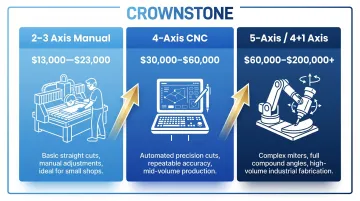
Table Size and Cutting Capacity
Larger work tables and deeper cutting depth require heavier structural frames and more powerful motors. Standard production tables (roughly 126" × 77") cost less than extended-capacity tables for large-format slabs.
Crown Stone USA offers a standard 126" × 77" table with 150" cutting length on the Avalanche Pro, with extended widths of 132" or 138" available upon request.
Build Quality and Country of Origin
Cost and operational implications vary widely:
- Chinese-manufactured machines often offer the lowest sticker price but may incur Section 301 tariffs of 7.5–25% on imported stone machinery, plus freight of $2,000–$6,000 for container shipping. Parts availability and warranty support can be limited.
- European-made machines (Italian, German) offer premium build quality and precision engineering but come at a price premium — expect $100,000+ for 5-axis models.
- American-made machines like Crown Stone USA's Avalanche Pro prioritize domestic parts availability, US-based support, and supply chain transparency. Less than 2% of Crown Stone's components by value originate from China — parts are sourced primarily from the U.S., North and South America, Korea, Japan, and Taiwan. This reduces tariff exposure and ensures faster parts fulfillment.
Tariff note: Base MFN duty on HTSUS 8464.10 (sawing machines) is Free, but Chinese-origin machines may face Section 301 surcharges. A temporary 10% global surcharge was invoked in February 2026 under Section 122, adding volatility to import costs.
Automation Level and Software
Manual operation, touchscreen CNC, and camera-assisted automated positioning each represent a distinct cost tier. More capable software lowers operator skill requirements and cuts error rates — both of which translate to measurable savings over the machine's lifespan.
Crown Stone USA's Avalanche Pro uses a Kinco HMI touchscreen control system with automatic and manual operation modes, allowing shops to run pre-programmed cuts or switch to manual control as needed.
After-Sales Support and Parts Availability
Machines with US-based support, domestically stocked parts, and strong warranty terms reduce total cost of ownership even if the sticker price is higher. Long lead times on imported parts during a breakdown can cost more in lost production than the savings on the original purchase.
Crown Stone USA stocks parts domestically, so a repair that might sideline an import-dependent shop for weeks gets resolved in days.
Full Cost Breakdown: What You'll Actually Pay Over Time
The purchase price is only a fraction of what a bridge saw costs over its operating life. Shops that compare sticker prices alone routinely underestimate total spend by 30–50% or more once installation, consumables, and maintenance are factored in.
Initial Purchase (One-Time)
The quoted machine price rarely covers everything that lands in your facility. Budget separately for shipping, freight, customs, and any site-specific upgrades.
Freight costs:
- Ocean freight from China: $2,000–$6,000 for a 20–40 ft container, plus customs clearance ($100–$500), cargo insurance (0.3–0.5% of value), and inland trucking ($200–$1,000+).
- Domestic U.S. freight varies by distance and weight but is generally lower and faster.
Installation and Infrastructure Setup (One-Time)
Common site requirements include:
- 3-phase electrical service—often the largest cost. If power is nearby, expect $10,000–$20,000; for line extensions, $30,000–$60,000; complex or rural installations can exceed $100,000. Alternative: rotary phase converters run $639–$9,697 depending on horsepower.
- Floor reinforcement or leveling—gantry-style bridge saws require reinforced concrete foundations costing "tens of thousands of dollars" and weeks of install time. Monoblock designs like Crown Stone's Avalanche Pro install in 1–3 days and avoid foundation costs entirely.
- Water supply and drainage for the cooling system—costs vary by site but are essential for blade cooling and dust suppression.
- Compressed air lines (80–120 PSI)—required for pneumatic brakes and indexers.
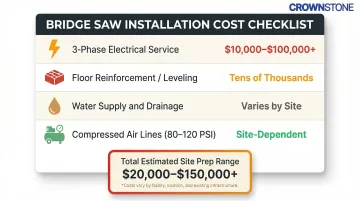
One startup cost model for stone fabrication budgets $40,000 for shop floor modifications, including electrical upgrades, floor reinforcement, and utility work.
Blades and Consumables (Recurring)
Diamond blades are the primary consumable. Blade life depends on stone hardness and cutting speed:
- Bridge saw blades (14–18 inch) typically achieve 3,000–8,000 linear feet under normal conditions; water use can extend life by 30–50%.
- Cost per linear foot example: A $180 premium blade lasting 1,500 ft equals $0.12/ft; a $90 economy blade lasting 400 ft equals $0.23/ft—the cheaper blade costs nearly twice as much per cut.
Annual blade spend varies by shop volume. High-volume shops cutting harder stone (granite, quartz) will replace blades more frequently than shops working primarily with marble.
Beyond blades, recurring costs break down into two main categories: routine maintenance and water management.
Maintenance, Water Systems, and Repairs (Recurring)
Annual maintenance costs:
- Set aside 1–3% of machine purchase price annually for replacement parts—a useful baseline for any CNC equipment.
- Vendor estimates run $2,000–$10,000 per year for maintenance/repairs, plus ~$200/month for routine lubricants and filters.
Water recycling systems:
- Small shops (1 bridge saw + 1 polisher + 2–3 hand tools): 40 GPM system
- Large shops (3 bridge saws + 1 polisher + CNC + 4–5 hand tools): 70 GPM system
- Additional cost: Sludge dehydrator systems run around $7,990
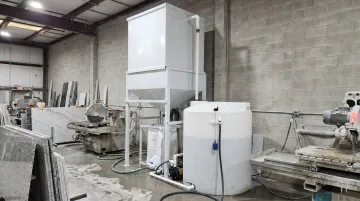
For shops looking to reduce water management labor, Crown Stone USA's Automatic Water Recycling systems—available in 40 GPM and 70 GPM configurations—use flocculant-based settling with automatic float switches to keep ongoing maintenance minimal.
Low-Cost vs. High-Cost Bridge Saws—What's the Real Difference?
The gap between a $13,000 machine and a $60,000 machine isn't just features—it shows up in cut precision, reliability, labor dependency, and long-term operating cost.
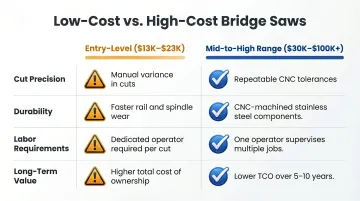
1. Cut Precision
- Manual or semi-auto models require a skilled operator for every cut, resulting in more variance across tolerances.
- CNC automation holds tighter, repeatable tolerances—reducing waste and rework on each job.
2. Durability and Downtime Risk
- Lower-cost machines use lower-grade rails and spindles that wear faster, leading to more frequent repairs and unplanned downtime.
- Higher-cost machines use CNC-machined rolling surfaces, stainless steel components, and brushless AC motors—features that reduce maintenance intervals and extend service life.
3. Labor Requirements
- Lower-cost machines require a skilled operator for every cut.
- CNC automation lets one operator supervise multiple jobs simultaneously, cutting per-cut labor costs over time.
4. Long-Term Value
A well-built mid-range machine can outperform a cheaper imported alternative in total cost of ownership over 5–10 years. Crown Stone's American-made Avalanche Pro, for instance, carries a 2-year warranty with parts sourced domestically—so you're not waiting weeks for an international shipment when something needs replacing. That downtime erases upfront savings fast.
Used bridge saws: Can lower upfront cost by 30–50% but carry risks—worn components, lack of warranty, outdated software. Prices on the used market typically range from $25,000–$70,000 depending on brand, age, and condition. They're best suited for shops with in-house maintenance capability to handle repairs without manufacturer support.
How to Estimate the Right Budget for Your Shop
The right budget isn't the lowest price that technically works—it's the investment level that matches your current production volume, growth trajectory, and operational infrastructure.
Ask yourself:
- How many slabs per week do you process? High-volume shops (20+ slabs/week) need automation and durability; low-volume shops (5–10 slabs/week) can start with manual or semi-auto models.
- What stone types dominate your work? Harder stones (granite, quartz) demand more machine durability and blade life; softer stones (marble) are less punishing.
- Do you have the electrical and water infrastructure for a larger CNC machine? 3-phase power and water recycling can add $10,000–$40,000+ if not already in place.
- What is the true cost of downtime in your shop? If a breakdown costs you $500–$1,000 per day in lost revenue, warranty and parts availability are worth paying for upfront.
Your answers to those questions will point you toward a number. For most mid-size US fabrication shops in 2026, that number lands between $30,000–$60,000 for a capable 4-axis CNC machine—enough to handle real production volume without over-investing in capacity you won't use. Shops doing high-complexity work or projecting rapid growth should consider 5-axis options; the higher upfront cost typically pays back through faster throughput and fewer manual setups.
What Most Buyers Get Wrong About Bridge Saw Costs
Focusing only on the purchase price leads to costly mistakes:
1. Buying too small, too soon
Entry-level machines that bottleneck production within 12–18 months force a second purchase that exceeds what the upgrade would have cost initially. If your shop is growing or you're adding countertop jobs, don't buy the cheapest machine—buy the one that handles next year's volume.
2. Ignoring the operating cost of poor parts availability
A machine that sits idle for 2–3 weeks waiting on an imported part costs more in lost jobs than the savings on the machine price. Machines built with readily sourced, non-proprietary parts — from US, Korean, Japanese, or Taiwanese suppliers — mean you're not waiting weeks on a single imported component when something breaks.
3. Over-specifying for current needs
A solo fabricator or small shop doesn't need an $80,000 5-axis machine. Match capability to actual volume and complexity—don't pay for features you won't use for years.
4. Skipping the manufacturer's support check
Response time, warranty terms, and how quickly you can get a technician on the phone matter just as much as spec sheets. A machine with great numbers and no backup support is a liability the moment something goes wrong.
Conclusion
Bridge saw costs in 2026 range from $13,000 to $100,000+ depending on machine type, configuration, and origin—but the real cost extends well beyond the purchase price to include installation, consumables, maintenance, and the cost of downtime.
The right investment matches machine capability to your shop's actual volume and growth trajectory. Strong parts availability and responsive support matter as much as the spec sheet — because a saw that runs reliably every day returns far more value than the lowest sticker price ever will.
Frequently Asked Questions
What is the cost of a CNC beam saw machine?
CNC beam saw machines are designed for wood and panel cutting—not stone—and typically range from $30,000–$100,000+ depending on capacity and automation level. Stone bridge saws are purpose-built for granite, marble, and quartz fabrication and are a separate category entirely.
How much does a granite cutter machine cost?
Granite cutter machines range from a few thousand dollars for manual bench saws to $30,000–$100,000+ for production-grade CNC bridge saws. The right choice depends on your slab volume, cut complexity, and production frequency.
How much does a 5-axis waterjet cost?
5-axis waterjet machines typically cost $150,000–$500,000+, significantly more expensive than bridge saws. Waterjets handle intricate shapes and heat-sensitive materials; bridge saws excel at straight and bevel cuts in stone at higher throughput. Each serves different fabrication needs.
What is the best stone cutter machine brand?
The right brand depends on your budget, support needs, and supply chain priorities. American-made options like Crown Stone USA offer domestic parts availability, responsive support, and supply chain transparency — less than 2% of their components originate from China. European brands vary widely in after-sales service, and Asian brands often prioritize low upfront cost over long-term reliability.
How much does a CNC machine typically cost?
CNC machines range from $5,000 to $500,000+ depending on type and industry. For stone CNC bridge saws specifically, expect $30,000–$100,000+ for production-capable machines. Entry-level manual bridge saws start around $13,000; high-end 5-axis systems exceed $100,000.
Is it worth buying a used bridge saw?
Used bridge saws can run 30–50% below new pricing, but the trade-offs are real: worn components, no warranty, and limited service history transparency. For shops without in-house mechanical capability, unexpected downtime often erases the savings. Crown Stone USA sells new equipment only — built with a 2-year warranty and US-available parts for exactly this reason.