Introduction
Stone fabrication shops face a costly equipment decision: both bridge tile saws and sliding table saws promise precision cuts on granite, quartz, and porcelain—but choosing the wrong one creates downtime, rework, and wasted material on expensive slabs.
The stakes are practical. A sliding table saw that loses precision from slurry buildup can cost more in ruined slabs than you saved on the initial purchase. A bridge saw your shop rarely needs at full capacity is money tied up in a machine doing half a job.
Getting this decision right comes down to three things: what materials you're cutting, how much volume you're pushing daily, and how much maintenance bandwidth your crew actually has.
This guide breaks down how each saw works, where each one earns its place on the shop floor, and how to choose without second-guessing yourself six months later.
TL;DR
- Bridge saws move the cutting head across a stationary slab—ideal for heavy stone and countertop fabrication
- Sliding table saws move material across a fixed blade—compact and suited for lighter tile work
- Slurry buildup in sliding table guide rails accelerates accuracy loss—a real issue in busy shops
- Bridge saws cost more upfront but offer better durability for high-volume shops
- Your call comes down to what you're cutting, how often, and how your shop handles daily maintenance
Bridge Tile Saw vs Sliding Table Saw: Quick Comparison
Here's how these two saw types compare across the factors that matter most to fabrication shops:
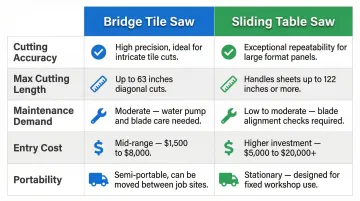
| Category | Bridge Tile Saw | Sliding Table Saw |
|---|---|---|
| Cutting Accuracy | Consistently high; workpiece stays stationary | Degrades faster as slurry builds in guide rails |
| Max Cutting Length | 49–126+ inches | Up to ~57 inches |
| Maintenance Demand | Moderate; elevated rails stay cleaner | High; daily guideway cleaning required |
| Entry Cost | $2,200–$5,800+ | $2,245–$2,999 |
| Portability | Shop-fixed | Some models job-site portable |
Cutting Accuracy
Bridge tile saw: The fixed workpiece design reduces vibration and maintains accuracy consistently, even under heavy daily use. The stone stays clamped and stationary while the cutting head travels overhead on elevated rails, so there's no material movement to introduce error.
Sliding table saw: Stable under normal conditions due to wider guideway spacing, but accuracy degrades faster if slurry paste builds up in guide rails or rollers. Research shows abrasive wear mechanisms dominate the lifespan of tribological systems in wet cutting environments. Fine stone dust mixed with water acts as a grinding paste that erodes guides and creates play in the table over time.
Material & Size Capacity
Bridge tile saw: Handles large-format slabs and thick countertop material with cutting lengths commonly ranging from 49 to 78+ inches. Professional models like the Raimondi ZOE 150 ADV offer 61-inch capacity with 4.75-inch depth. Heavy-duty models like the Battipav Supreme 320S reach 126 inches, which matters when processing modern Gauged Porcelain Tile Panels (GPTP) measuring up to 127.5 inches.
Sliding table saw: Better suited for standard tile formats. Most professional sliding table saws max out around 60 inches of rip capacity: the Husqvarna TS 90 offers 36.2 inches, while the IMER Combicut 250/1500 VA reaches 57 inches. Oversized stone slabs are a problem because the material physically clashes with the blade support arm.
Maintenance Sensitivity
Bridge tile saw: Less prone to accuracy loss from dust and slurry accumulation because the guide rails sit elevated above the cutting surface. More forgiving in busy fabrication environments where daily deep cleaning isn't always feasible.
Sliding table saw: Requires rigorous daily cleaning of guideways and rollers. IMER mandates daily water changes and sediment removal, and MK Diamond explicitly warns operators to clean guide rails after each use. Skip that routine and slurry hardens into a paste that destroys bearing surfaces.
Upfront Cost
Bridge tile saw: Higher initial investment, typically ranging from $2,200 to $5,800+ depending on capacity and build quality. The Battipav Supreme 200S retails around $4,695, while the Raimondi SMS 220 lists at approximately $5,599.
Sliding table saw: Generally lower entry cost makes them accessible for smaller operations. The IMER Combicut 250/1500VA ranges from $2,799 to $2,999, and the Husqvarna TS 70 lists at $2,245, roughly half the cost of comparable bridge saws.
Footprint & Portability
Bridge tile saw: Requires dedicated floor space with stationary setup best suited for shop environments. The gantry-style bridge structure and heavy-duty table aren't designed for transport between job sites.
Sliding table saw: Typically more compact with some models portable enough to transport between job sites, which gives tile contractors working across multiple locations a real logistical edge.
What is a Bridge Tile Saw?
A bridge tile saw is a wet saw where the cutting head—motor and blade assembly—travels along a fixed bridge or rail system above a stationary work table. The material stays completely still while the blade moves through it.
This design is particularly well-suited for stone fabrication because moving heavy granite or quartz slabs through a blade introduces instability and breakage risk. When you're cutting a 600-pound slab of granite, keeping it stationary eliminates the micro-movements that cause blade deflection and chipped edges.
Mechanical Advantages
The bridge design distributes cutting force evenly across a rigid frame, minimizing blade deflection for clean, accurate cuts on dense, heavy materials. Professional bridge saws like the Battipav Supreme use extruded aluminum rails with steel ball bearings on interchangeable stainless steel tracks, delivering the torsional rigidity that long cuts on stone demand.
The motor is typically enclosed to withstand continuous wet cutting environments—a critical feature since water spray is constant during operation.
Motor Power and Capacity Specifications
Fabricators should look for:
- Motor power: 1.5 to 3+ HP for standard models, up to 4.5 HP for heavy-duty commercial machines
- Blade sizes: 10 to 14 inches diameter
- Cutting depths: Up to 6 inches in a single pass
- Cutting lengths: 49 to 78+ inches, with specialized models reaching 126 inches
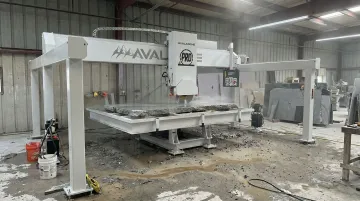
These parameters determine whether a saw can handle countertop-grade stone and large-format panels. For high-volume commercial work, machines like Crown Stone USA's Avalanche Pro step up to a 20 HP motor with 150-inch cutting capacity, built for full-size slabs of granite, quartz, and marble.
Use Cases of Bridge Tile Saws
Bridge saws handle the heaviest, most demanding cuts in a stone shop. Common applications include:
- Cutting countertop blanks from full slabs
- Processing large-format porcelain panels (24×48 inches and larger)
- Natural stone slab fabrication
- Engineered stone cutting for commercial installations
These machines are standard equipment in granite, marble, and quartz countertop shops, commercial stone installation operations, and custom architectural stonework — anywhere repeatable precision on expensive material is non-negotiable.
Operational impact: Because the workpiece is stationary, there's no risk of heavy slabs shifting mid-cut. This reduces material waste, eliminates chipped edges, and minimizes costly rework on stone that can cost $50–150 per square foot.
What is a Sliding Table Saw?
A sliding table saw (in the tile and stone cutting context) is a wet saw where the material sits on a sliding table or tray that travels along guide rails toward a fixed blade. The blade stays stationary; the operator pushes the workpiece through the cut.
This is fundamentally different from a woodworking table saw—this is a wet-cutting machine specifically designed for tile, stone, and masonry materials.
How the Sliding Mechanism Works
The table rides on rollers or linear bearings along guideways. Wider guideway spacing provides initial stability and smooth travel when the machine is new.
There's a critical maintenance vulnerability, though: tile-cutting slurry—fine dust mixed with water—accumulates in the guideways and hardens into paste. This abrasive paste erodes the guides and gradually introduces "play" or wobble that compromises cut accuracy over time. Left unattended, slurry buildup can rapidly degrade the guides and produce jerky, unreliable table movement, according to industry analysis of sliding vs. bridge saw performance.
Core Advantages
Despite maintenance sensitivity, sliding table saws offer:
- Cost 40–50% less than comparable bridge saws upfront
- Fit in smaller shops and job site trailers with a compact footprint
- Deliver clean, accurate cuts on ceramic and porcelain tile in standard formats
- Light enough on some models to transport between job sites
Use Cases of Sliding Table Saws
Primary workflow applications:
- Cutting ceramic tile for residential remodels
- Standard-format porcelain for bathroom renovations
- Kitchen backsplash installations
- Light natural stone for smaller commercial tile projects
Sliding table saws are a natural fit for tile contractors working across job sites who need reliable cuts on standard formats (under 36 inches) without the floor space or capital investment of a bridge saw.
That said, they struggle with heavy granite or quartzite slabs, very large formats, and thick countertop material. The sliding table mechanism simply isn't built to support the weight or size of full stone slabs—pushing those limits risks instability and accelerated guideway wear.
Bridge Tile Saw vs Sliding Table Saw: Which is Right for Your Stone Shop?
Decision Factors to Weigh
Before choosing, answer these honestly:
- Are you cutting ceramic tile or 3cm granite slabs? Standard porcelain or thick stone blocks?
- Do you regularly process full 126-inch slabs, or mostly work with tiles under 36 inches?
- Are you running 5-10 slabs per day or 20-30 tile cuts per week?
- Can your shop commit to daily guideway cleaning, or do you need equipment that tolerates occasional maintenance lapses?
- What's your true cost of ownership? Factor in downtime, blade wear, guide replacement, and material waste — not just purchase price.

Choose a Bridge Tile Saw If:
- Your shop regularly processes large-format stone slabs or countertop material
- You run high daily volume that demands consistent accuracy
- You can't afford accuracy drift from maintenance lapses
- You're investing in production-grade equipment that needs to hold tolerance across thousands of cuts
- You process expensive materials (granite, quartz, imported porcelain) where a single bad cut costs hundreds of dollars
Example scenario: A countertop fabrication shop cutting 8-12 granite slabs daily needs the stationary workpiece stability and maintenance forgiveness of a bridge saw. The accuracy retention alone prevents enough material waste to justify the higher upfront cost.
Choose a Sliding Table Saw If:
- Your work is primarily standard-size ceramic or porcelain tile (under 36 inches)
- You operate in a space-constrained or mobile environment
- Your volume is lower (under 50 cuts per week)
- You have a disciplined maintenance routine to clean guideways after every use
- Budget constraints make a bridge saw cost-prohibitive
Example scenario: A tile installation contractor working residential remodels needs portability and sufficient accuracy for backsplash and bathroom tile. A sliding table saw delivers the required precision at half the cost and fits in a job site trailer.
Long-Term Cost of Ownership
A sliding table saw that loses accuracy from neglected guideway maintenance may ultimately cost more in wasted material and rework than the price difference saved upfront.
When you're cutting $4,500 slabs of imported quartzite, a single wandering cut caused by worn rollers destroys your profit margin on that job. According to Stone World's bridge saw buying guide, bridge saws reduce cost per cut and rework rates — two figures that compound quickly at production volume.
Maintenance Tolerance Reality
In busy stone fabrication shops, downtime for guideway cleaning and adjustment is a real productivity cost. Bridge saws are inherently more forgiving in this regard because their elevated rail systems sit above the slurry zone.
In busy production shops, guideway sensitivity is where bridge saws consistently outperform sliding table saws over the long run. Less time on maintenance means more time cutting — and in a high-volume shop, that difference shows up directly in throughput.
Conclusion
The right saw comes down to your actual workflow. Bridge tile saws are the professional's choice for stone fabrication shops processing heavy, large-format material at volume—they offer superior durability, accuracy retention, and lower sensitivity to maintenance lapses.
Sliding table saws serve a legitimate role for tile contractors with lighter workloads and tighter budgets, provided the operator commits to rigorous daily guideway maintenance.
For granite, quartz, and marble fabricators specifically, that choice carries real weight. Cut quality on expensive material, shop throughput, and long-term equipment reliability all trace back to the saw on your floor. Base the decision on how your shop actually runs—volume, material type, and maintenance capacity—not the purchase price alone.
If you're processing slabs daily, a well-built bridge saw pays for itself in consistency and uptime. Crown Stone USA builds its bridge saws from hands-on fabrication experience—designed by people who have cut, lifted, and installed stone. Reach out at 727-239-9875 or info@crownstoneusa.com for guidance on selecting the right saw for your shop.
Frequently Asked Questions
What is a bridge tile saw?
A bridge tile saw is a wet saw where the cutting head moves along a fixed bridge or rail above a stationary workpiece. It's designed for precise, stable cuts on large-format stone, porcelain, and tile without needing to move the material through the blade.
What are the benefits of a sliding table saw?
Sliding table saws offer lower upfront cost, compact footprint, and portability for some models—making them practical for standard tile formats. That said, maintaining accuracy requires regular guideway cleaning, since slurry buildup can wear down precision over time.
Is a wet tile saw the same as a table saw?
No. A wet tile saw uses water to cool the diamond blade and suppress dust while cutting stone or tile, whereas a woodworking table saw is a dry-cutting machine for lumber. They are fundamentally different tools designed for different materials.
What do professional tilers use to cut tiles?
Professionals typically use bridge tile saws or sliding table wet saws for precision cuts on stone, porcelain, and ceramic. Bridge saws are favored in stone fabrication shops for large-format materials, while sliding table saws are common among tile installation contractors working with standard formats.
Is it better to use a tile cutter or tile saw?
Manual tile cutters work for straight cuts on standard ceramic or porcelain, but a tile saw (wet saw) is necessary for thick stone, large-format tiles, angled cuts, and any material where precision and a clean edge are critical.
Will a tile table saw cut pavers?
Yes, most wet tile saws can cut pavers, but the saw must have sufficient motor power and blade capacity for the material's thickness and hardness. Professional-grade bridge tile saws—with higher horsepower motors and larger blade capacities—handle thick pavers more reliably than lighter sliding table models.