A quality table saw anchors precision woodworking. Accurate rip cuts, reliable dado joints, repeatable bevel angles, and the ability to handle both hardwoods and sheet goods without bogging down all depend on choosing the right machine. With approximately 30,600 table saw blade-contact injuries occurring annually in the U.S., selecting a saw with proper safety mechanisms isn't just about precision—it's about protecting yourself.
This guide covers the top 5 table saws for woodworking in 2025 across different use cases, plus a clear buying framework covering fence systems, motor specifications, safety features, and the critical distinctions between woodworking saws and specialized stone fabrication equipment.
TL;DR
- Table saws fall into three categories: jobsite (portable), hybrid (shop-ready), and cabinet (production-grade precision)
- Prioritize fence accuracy and motor consistency under load — those two factors separate capable saws from frustrating ones
- DeWalt DWE7491RS leads for all-around portable value; SawStop dominates safety and precision woodworking
- Stone fabricators require wet-cutting bridge saws—woodworking table saws cannot safely cut granite, marble, or quartz
- Match saw type to your material and workflow before comparing specs
Types of Table Saws: What You Need to Know Before You Buy
Understanding the four main table saw categories helps you eliminate options that don't match your workflow.
- Jobsite/Benchtop: 45–130 lbs, 120V direct-drive motors (15 Amp), aluminum or composite tables, open stands — built for contractors and DIYers moving between job sites
- Contractor: 200–400 lbs, belt-driven 1–1.5 HP motors, stamped-steel wing extensions, open frame design — adequate portability for shop-based woodworkers who occasionally move equipment, though dust collection suffers
- Hybrid: 250–400 lbs, enclosed cabinets for better dust control, still runs on 120V — delivers near-cabinet-saw performance without requiring a dedicated 220V circuit
- Cabinet: 300–1,000 lbs, heavy cast-iron tables, enclosed base, 3–5 HP motors on 220V–240V — stationary workhorses built for production shops that prioritize precision and minimal vibration

Most portable and contractor saws use 10-inch blades, which cut 3.5 inches deep at 90°—sufficient for 4×4 lumber. Compact models use 8.25-inch blades to reduce weight and meet table size regulations, but this limits cut depth and project scope. For plywood and sheet goods, you need at least 25 inches of rip capacity to cut a full sheet lengthwise.
The picks below span jobsite to premium woodworking categories, each matched to specific shop setups and use cases.
Best Table Saws for Woodworking in 2025
These selections represent the strongest options across distinct use cases: best overall portable, best safety, most powerful jobsite saw, best contractor value, and best for stone fabrication. Each was evaluated on cutting performance, fence accuracy, durability, and real-world usability.
DeWalt DWE7491RS
DeWalt has dominated the jobsite table saw category for over a decade, and the DWE7491RS remains the benchmark. This 10-inch corded model delivers consistent performance through its 15 Amp motor running at 4,800 RPM, handling both hardwoods and sheet goods with reliable accuracy.
The standout feature is the rack-and-pinion fence system. Unlike T-style fences that require constant recalibration, the rack-and-pinion design locks precisely and holds position under load. The 32.5-inch rip capacity handles full sheets of plywood, the 13/16-inch dado capacity supports joinery work, and the included rolling stand makes this the most complete portable package available.
| Motor / Blade Speed | Rip Capacity / Blade Diameter | Price Range |
|---|---|---|
| 15A, 120V / 4800 RPM | 32.5 inches / 10 inches | $599 |
SawStop JSS-120A60 Jobsite Saw Pro
SawStop revolutionized table saw safety with flesh-detection technology that stops the blade in under 5 milliseconds upon skin contact, limiting cuts to under 3.5mm. The JSS-120A60 bridges portable and cabinet saw capabilities for serious woodworkers who won't compromise on safety or precision.
The safety system isn't the only thing this saw borrows from stationary models. It also includes:
- Smooth T-style fence with ErgoLock
- Micro-adjust bevel control in 1-degree increments
- One-Turn Elevation for fast blade height changes
The 15 Amp motor handles hardwoods confidently, and the 4,000 RPM blade speed balances cutting power with control for fine woodworking applications.
| Motor / Blade Speed | Rip Capacity / Blade Diameter | Price Range |
|---|---|---|
| 1.5 HP continuous (4 HP peak), 15A, 120V / 4000 RPM | 25.5 inches / 10 inches | $1,699 |
Skilsaw SPT99-11 Worm Drive Table Saw
Skilsaw is the only brand offering worm drive motor design in a portable table saw. The SPT99-11 leverages the same gearing found in professional worm drive circular saws to deliver more torque than any direct-drive competitor at the same 15 Amp power draw.
The practical advantage shows when cutting thick hardwoods: the worm drive maintains blade speed under load where direct-drive saws bog down. At 5,000 RPM with a 30.5-inch rip capacity, it handles demanding jobsite work without hesitation. The oversized 16-inch wheels on the rolling stand also navigate uneven terrain more easily than competitors with smaller casters—a real advantage on active construction sites.
| Motor / Blade Speed | Rip Capacity / Blade Diameter | Price Range |
|---|---|---|
| 15A, 120V / 5000 RPM | 30.5 inches / 10 inches | $749 |

Bosch GTS15-10 Jobsite Table Saw
Bosch's GTS15-10 is a notable step forward from their previous 4100 series. Key upgrades address the most common complaints about earlier models:
- Rack-and-pinion fence system with improved accuracy
- Blade speed increased to 3,800 RPM
- 3-9/16 inch cutting depth handles 4× lumber in one pass
- Gravity-rise wheeled stand sets up and collapses quickly
At this price point, the GTS15-10 delivers the best overall value for professional contractors who need dependable daily performance. The 32.125-inch rip capacity matches the DeWalt, and the improved fence usability makes accurate cuts accessible for operators at any skill level.
| Motor / Blade Speed | Rip Capacity / Blade Diameter | Price Range |
|---|---|---|
| 15A, 120V / 3800 RPM | 32.125 inches / 10 inches | $649–$699 with stand |
Crown Stone USA Bridge Saw — Best for Stone Fabrication
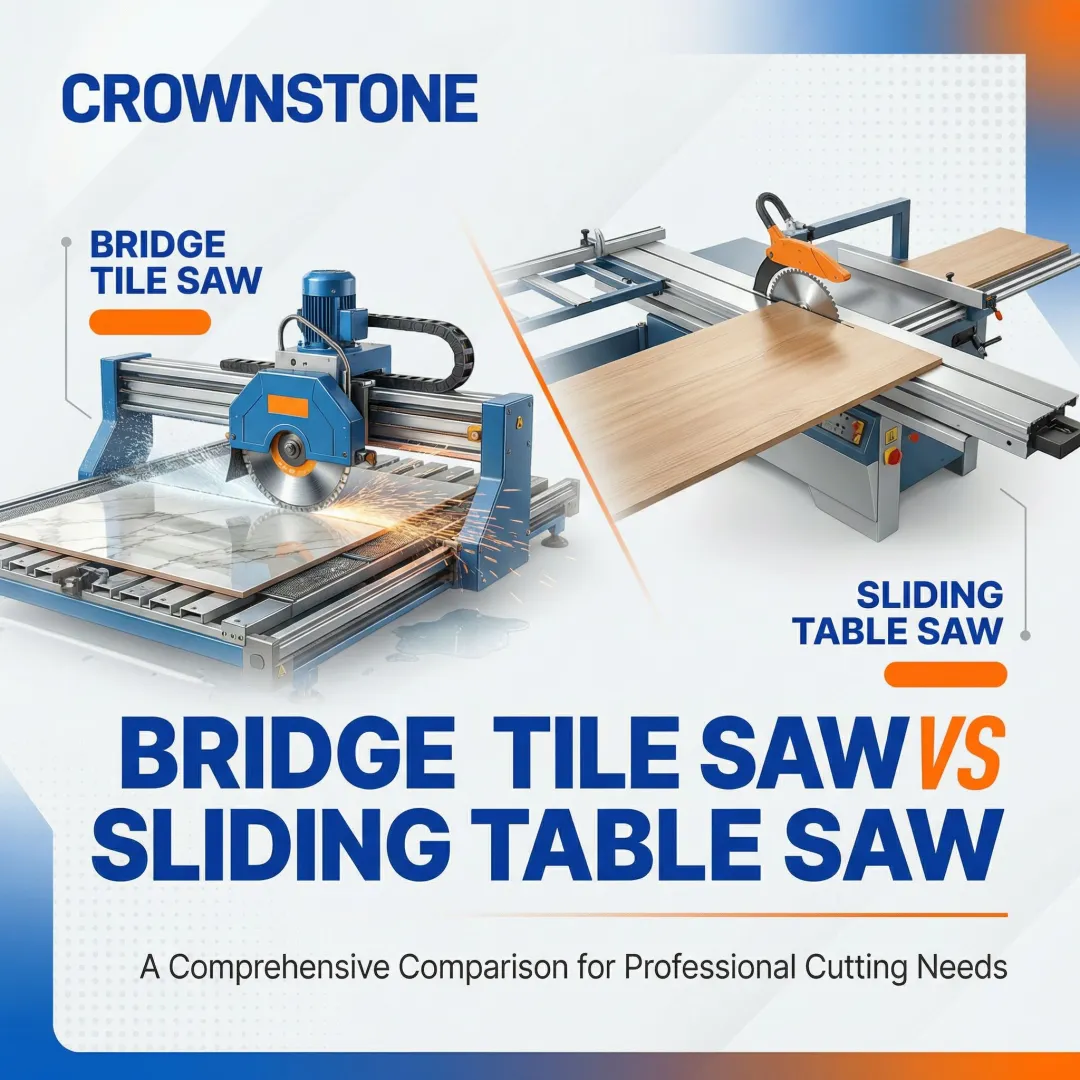
Crown Stone USA manufactures American-made bridge saws specifically engineered for cutting granite, marble, and quartz. Unlike woodworking table saws, bridge saws use diamond blades, integrated water-cooling systems, and heavy-duty frames built to handle the density and abrasiveness of stone materials.
Designed by fabricators with hands-on experience in stone cutting, lifting, and installation, these machines prioritize reliability above all else. Crown Stone backs every saw with a 2-year warranty and keeps parts readily available in the U.S.
Component sourcing reflects the same standards: parts come primarily from the U.S., North and South America, Korea, Japan, and Taiwan, with less than 2% of component value from China—ensuring supply chain transparency and domestic availability.
Attempting to cut stone with a woodworking table saw risks blade failure, material damage, and serious safety hazards. Stone fabrication requires purpose-built equipment with continuous water delivery to suppress respirable crystalline silica dust below OSHA's 50 µg/m³ limit and prevent thermal blade failure.
| Build Origin / Warranty | Target Material | Key Value Proposition |
|---|---|---|
| Made in USA / 2-year warranty | Granite, marble, quartz, and engineered stone | Designed by working fabricators; parts available in the U.S.; less than 2% Chinese components by value |

How to Choose the Right Table Saw
Fence Quality: The Non-Negotiable Factor
Fence accuracy determines cut precision more than any other feature. A poor fence causes consistent dimensional error that no blade upgrade or technique adjustment can fix.
Rack-and-pinion systems (found on DeWalt, Bosch, and Skilsaw models) are the easiest to calibrate and maintain accuracy. The gear-driven mechanism locks the fence parallel to the blade and holds position under lateral pressure as stock passes through.
T-style fences (SawStop's High-Low design, Biesemeyer on premium saws) offer maximum stability under load when properly adjusted. These require more initial setup but deliver superior rigidity for production work.
Before purchasing any saw, verify the fence system has positive locking mechanisms and can be adjusted square to the blade. Fences that drift during cuts waste material and create safety hazards.
Motor Power and Blade Speed
Motor requirements differ between portable and cabinet saws:
- Portable corded saws: 15 Amp is the professional standard; 13 Amp works for softwoods and occasional use but struggles with hardwood rips and dado stacks
- Cabinet saws: 3 HP covers most woodworking applications; 5 HP suits production environments with heavy sheet goods
- RPM vs. torque: Raw RPM matters less than load performance — the Skilsaw's worm drive maintains torque better than direct-drive competitors at the same amperage, despite only a 200 RPM advantage over the DeWalt (5,000 vs. 4,800)

Rip Capacity and Blade Size
Rip capacity and blade size affect what you can cut without awkward workarounds:
- 25-inch minimum: Needed for cutting plywood lengthwise in one pass
- 32+ inches (DeWalt, Bosch): Handles full sheets without flipping or multiple passes
- 10-inch blades: 3.5-inch depth at 90° — sufficient for dimensional lumber and most hardwood stock
- 8.25-inch compact blades: Trade cut depth for portability; fine for trim and plywood, limiting for thick stock
Dado Compatibility
Not all portable saws accept dado blade sets. The DeWalt DWE7491RS accommodates up to 13/16-inch dado width, supporting common joinery applications. Verify dado compatibility before purchasing if rabbets, grooves, or box joints are part of your workflow.
Safety Features
Standard protections should include blade guards, riving knives, and anti-kickback pawls. Every saw reviewed here includes these basics.
SawStop's flesh-detection system goes further: it stops the blade within milliseconds of skin contact, triggering a replaceable brake cartridge instead of a trip to the ER. Given that approximately 9.1%–10.7% of table saw blade-contact injuries result in amputations, the premium cost is worth considering for high-use environments.
Stone Fabrication Requires Different Equipment
If your work involves granite, marble, or quartz rather than wood, none of the saws above are the right tool. Stone cutting requires wet-cutting bridge saws with continuous water delivery to prevent thermal blade failure and suppress silica dust — a hazard standard table saws aren't built to handle. Using a woodworking table saw on stone creates both serious safety risks and immediate equipment damage.
How We Chose the Best Table Saws
Selections were evaluated on cutting accuracy in hardwoods and sheet goods, fence reliability under load, motor consistency during extended use, and overall value at each price point. We excluded models with documented quality control issues across multiple units and prioritized saws with established track records.
Understanding where buyers go wrong is just as useful as knowing what to look for. Common mistakes include:
- Prioritizing low price over fence quality
- Overlooking dado compatibility until after purchase
- Choosing saws too compact for their typical material dimensions
- Using woodworking equipment for stone applications, where specialized bridge saws are required instead
Conclusion
The right table saw matches your specific work. A $299 jobsite saw serves weekend DIYers perfectly, while a SawStop cabinet saw belongs in fine woodworking shops where precision and safety justify the investment. For stone fabrication, purpose-built bridge saws are the only appropriate equipment—nothing else is engineered for the material.
Before finalizing your purchase, evaluate fence precision through hands-on testing if possible, research motor performance under real load (not just no-load RPM specs), and verify parts and service availability in your region. A saw that bogs down in hardwoods or a fence that drifts will cost you more in wasted material than you saved buying down a tier.
For stone fabricators specifically, reach out to Crown Stone USA at crownstoneusa.com or 727-239-9875 to learn about American-made bridge saws built by people who have cut, lifted, and installed stone themselves—machines backed by a 2-year warranty, with parts sourced domestically so downtime stays low and service stays simple.
Frequently Asked Questions
What are the best brands of table saws?
DeWalt, SawStop, Bosch, Skilsaw, and Milwaukee consistently rank highest across professional reviews. The best brand depends on use case: DeWalt and Bosch lead in portable contractor applications, SawStop dominates precision woodworking and safety, and specialized manufacturers like Crown Stone USA serve stone fabrication with purpose-built bridge saws.
Who makes the most accurate table saw?
SawStop leads in fence precision and out-of-box alignment for portable and mid-range saws; Powermatic earns top marks for cabinet saw accuracy. Either way, calibration and blade quality matter—even premium saws need proper setup to deliver consistent results.
What is the difference between a jobsite saw and a cabinet saw?
Jobsite saws are portable (50–130 lbs), feature open stands, and run on 120V household power with compact motors suited for on-site work. Cabinet saws are stationary (400–600 lbs), feature enclosed cast-iron bases, run on 220V–240V power with 3–5 HP motors, and deliver significantly greater precision for dedicated shop environments.
How much should I spend on a table saw?
Three general tiers exist: under $400 for DIY/beginner models, $500–$800 for professional contractor saws, and $1,500–$4,000+ for premium woodworking or cabinet saws. Spend as much as your workflow justifies, prioritizing fence quality and motor reliability over flashy specifications.
Can I use a woodworking table saw to cut stone?
No—woodworking table saws are not built for stone. Cutting granite, marble, or quartz requires a wet-cutting bridge saw with diamond blades and continuous water cooling. Using a standard table saw on stone risks blade failure and serious safety hazards. Manufacturers like Crown Stone USA build purpose-designed bridge saws for these applications.
What safety features should I look for in a table saw?
Look for blade guards, riving knives, anti-kickback pawls, and an emergency stop switch as baseline requirements. SawStop's flesh-detection brake—which halts the blade in under 5 milliseconds on skin contact—is the most advanced option available and worth the premium for high-use shops.