Introduction
Buying a bridge saw is one of the biggest capital decisions a stone fabrication shop makes — and the used vs. new debate can cost (or save) tens of thousands of dollars if approached wrong. This isn't just about upfront price. It affects downtime, parts availability, warranty coverage, and how long before the machine pays for itself. At $1,500 per hour of unplanned downtime, according to Crown Stone USA's maintenance research, a single day of stoppage can erase a week's profit margin.
This guide cuts through the sales noise to give fabricators a clear framework based on actual shop realities, not dealer pitches. Here's what it covers:
- The real cost differences between used and new machines
- Which option fits different shop sizes, budgets, and production demands
- Red flags to watch for when evaluating used equipment
- When new equipment pays for itself faster than the sticker price suggests
TLDR
- Used bridge saws save 30–50% upfront but carry real unknowns: maintenance history, worn components, limited warranty, and retrofit costs that erode that savings fast
- New saws cost more and deliver warranty coverage, current technology, and full parts traceability — worth it when the machine and the manufacturer both stand behind what they sell
- Bridge saws can operate reliably for 15–25 years, meaning both options can deliver strong ROI when chosen correctly
- The right choice depends on your shop's production volume, cash flow, in-house mechanical capability, and risk tolerance
- What tips the scales is who you're buying from, what condition the machine is actually in, and what support follows the sale
Used vs. New Bridge Saw: Quick Comparison
Upfront Cost
Used: Active marketplace listings show used bridge saws ranging from $16,400 to $215,500. Entry-level manual or basic CNC models from the early 2000s sell for $16,000-$40,000, while used 5-axis CNC models from 2017-2023 cluster at $88,000-$150,000. The purchase price represents only the starting point — budget an additional 15-25% for inspection, reconditioning, missing accessories, and freight.
New: New bridge saw pricing varies dramatically by origin and capability. Asian entry-level 3/4-axis saws start at $18,000-$30,000, while European and North American premium brands range from $85,000 to $350,000+. The sticker price covers more than the machine: OEM margins, distributor infrastructure, demo facilities, and sales overhead all factor in.
Warranty and Support
Used: Warranty varies by seller. Most used saws sell as-is or with limited third-party coverage. Independent service engineers are available but not guaranteed. You're buying the machine's current condition, not future protection.
New: Manufacturer warranties typically cover 1-2 years of parts coverage. However, warranty often means parts shipped for self-installation rather than a technician on-site. According to Alibaba's industrial equipment TCO analysis, manufacturers build 3-5% into product price for 1-year coverage and 6-10% for 2-year coverage.
Parts Availability
Used: Parts may be discontinued for older models, especially foreign-made machines. Availability varies dramatically by brand and age. North American CNC lead times have extended to 22-26 weeks, while Japanese precision spindles require 8-10 weeks. For a shop losing $1,500 per hour of downtime, those lead times are the real cost of older equipment.
New: Parts are generally available during the production run, but overseas manufacturers can face sourcing delays that extend weeks. American-made machines with U.S.-stocked parts close that gap significantly — especially when downtime has a dollar figure attached to every hour.
Technology and Precision
Used: Older models may lack CNC functionality, multi-axis capability, or current control systems. Machines from the early 2000s typically offer manual or basic automatic operation without the toolpath flexibility of modern CNC.
New: New machines offer the latest axis configurations (3, 4, and 5-axis), current control software, and cutting capabilities that include complex curved profiles and automated production sequences.
Depreciation and Resale Value
Used: Has already depreciated; resale value is lower but so is the loss if you upgrade. CNC machine tools lose 15-20% of value immediately upon delivery and 30-40% total within five years, then stabilize at 50-60% of original cost. Buying at the 5-year inflection point avoids the steepest depreciation curve.
New: Depreciates faster in early years; long-term value depends on build quality and brand. New owners take the full 30-40% depreciation loss across the first five years before values begin to level off.
Buying a Used Bridge Saw: What You're Really Getting
The Used Bridge Saw Spectrum
"Used" in the bridge saw market covers a wide spectrum. At one end: lightly used, recently traded-in machines from 2018-2023 with verifiable low hours and known service history. At the other end: older, high-hour equipment from the late 1990s and early 2000s that may need significant work before it's production-ready.
The market data reveals machines still actively listed for resale after 25+ years of service — 1998 Park Industries Eagles with condition ratings of 8.1 out of 10 prove these machines can last. But longevity doesn't mean turn-key readiness.
Real Cost Beyond Purchase Price
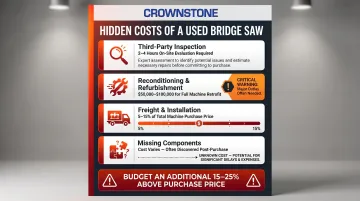
The purchase price is just the entry point. Hidden costs include:
- Third-party inspection: Professional CNC pre-purchase inspection services run 2-4 hours on-site, covering mechanical systems, electrical integrity, spindle performance, and dimensional tolerances. Pricing is quote-based by machine type and location.
- Reconditioning/refurbishment: Retrofitting modern controls onto older CNC machines costs $50,000-$100,000 and can extend machine life by 15-20 years. Replacing worn rails, bearings, and water delivery components costs less — but still adds thousands to the total.
- Freight and installation: Expect 5-15% of the machine price for shipping and installation. Bridge saws weigh 3,000-10,000+ lbs depending on model, requiring flatbed transport and professional rigging.
- Missing components: Verify that tooling, water delivery systems, control panels, and safety guards are included. Replacement parts add up quickly.
The Maintenance History Problem
When buying used, fabricators rarely get a full service record. Worn bearings, spindle play, coolant system issues, and table levelness problems may not surface until the machine is running in production — and then the downtime costs begin.
Stone fabrication environments are among the harshest for equipment. Abrasive silica dust and slurry act as a grinding compound on bearings, seals, and rails — wear that a visual inspection won't catch. A machine that looks clean can harbor serious internal damage that only shows up three months into production.
Parts Availability Risk
Older imported bridge saws — Italian, Chinese, Taiwanese — may have limited domestic parts support. The longer the wait for a part, the more revenue a shop loses. At $1,500/hour downtime cost over an 8-hour production day, a single unplanned failure represents approximately $12,000 in lost capacity.
North American CNC lead times for multi-axis equipment have extended to 22-26 weeks, with spindle bearings and linear scale encoders among the longest waits. For machines no longer in active production, that wait stretches further — and each delay stacks directly on top of the last.
Before committing to a used machine, a thorough inspection is the only way to know what you're actually buying.
Pre-Purchase Inspection Checklist
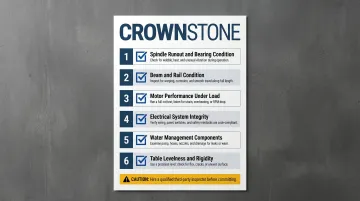
A proper used bridge saw inspection should cover:
- Spindle runout and bearing condition — Use a dial indicator to check for play; excessive runout indicates worn bearings
- Beam and rail condition — Inspect for wear, corrosion, or damage; check rail straightness and levelness
- Motor performance — Test blade motor under load; listen for unusual noise or vibration
- Electrical system integrity — Verify all controls, safety interlocks, and emergency stops function correctly
- Water management components — Check pumps, valves, nozzles, and drainage systems for leaks or blockages
- Table levelness and rigidity — Measure table flatness and verify hydraulic lift operates smoothly across full range
Use Cases for a Used Bridge Saw
A used bridge saw makes sense when:
- Strong in-house mechanical capability — Your team can evaluate, refurbish, and maintain the machine without outside help, turning problems into projects rather than emergencies.
- Startup or lower-volume operation — Preserving upfront capital matters more than minimizing long-term risk, and occasional downtime won't stall a customer base you're still building.
- Secondary or backup capacity — The machine handles overflow or specialty cuts rather than primary production, so downtime doesn't shut down the whole shop.
Buying a New Bridge Saw: What You Actually Get for the Premium
What You're Really Paying For
When you buy new, you're not just buying the machine. The price includes OEM margins, distributor margins, demo facilities, and sales infrastructure. Research on industrial equipment pricing shows that higher European and North American pricing reflects R&D investment, brand equity, local service networks, and higher labor costs — not necessarily better cutting performance.
The price gap is wide:
- Asian entry-level machines: $18,000–$30,000 — basic functionality, lower support infrastructure
- European brands: $85,000–$350,000+ — extensive service networks and brand positioning built into the price
That spread reflects distribution and brand investment, not necessarily proportional differences in cutting capability.
Warranty Reality Check
Most machine tool warranties cover parts, not necessarily on-site service. In practice, fabricators often troubleshoot over the phone, receive parts to install themselves, and wait for resolution. The "peace of mind" premium is real but often overstated.
Warranty costs manufacturers 3-5% of product price for 1-year coverage and 6-10% for 2-year coverage. Buyers should request written warranty terms specifying parts, labor, travel, and duration before purchasing — not all warranties are created equal.
Genuine Advantages of Buying New
New machines deliver real benefits:
- Current technology — CNC controls, multi-axis capability, advanced toolpath software, and automated cutting sequences unavailable in older used inventory
- Known zero-hour condition — No prior wear, no hidden bearing damage, no mystery maintenance history
- Compliance with current safety standards — Modern safety interlocks, blade guards, and emergency systems
- Access to manufacturer support while the model is in active production — Parts availability, software updates, and technical documentation
The Parts and Service Supply Chain Issue
Machines manufactured overseas with components from difficult-to-source regions can still leave fabricators stranded despite being "new." Global CNC lead times vary dramatically by region: North America at 22-26 weeks, Europe at 12-18 weeks, China at 8-12 weeks.
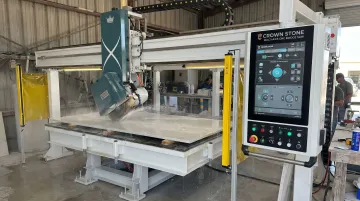
Crown Stone's bridge saws source components primarily from the U.S. and allied manufacturing partners — North and South America, Korea, Japan, and Taiwan — with less than 2% of components by value originating from China. Crown Stone stocks parts domestically and backs them with a 2-year warranty, cutting the wait times that strand fabricators running imported machines.
Evaluating Whether the New Machine Premium is Justified
The key questions to ask before signing:
- Does the manufacturer hold domestic parts inventory, or are you waiting on international shipments?
- What does actual service response look like — phone support, remote diagnostics, or field dispatch? Get specifics, not marketing language.
- Do the warranty terms cover parts and labor, or just parts? Read the exclusions before committing.
Use Cases for a New Bridge Saw
A new bridge saw makes sense when:
- You're scaling production and need reliable throughput from day one — no inherited wear, no mystery maintenance history slowing you down.
- You need multi-axis CNC capability that simply isn't available in used inventory at the spec level your work demands.
- Your current machine is the bottleneck, and downtime risk at your production volume makes a used gamble too costly.
Used vs. New Bridge Saw: How to Choose What's Right for Your Shop
The Decision Framework
The choice isn't simply used vs. new — it's about matching the machine's risk profile to your shop's production volume, cash flow, mechanical resources, and growth trajectory.
Choose Used If:
- You have in-house mechanical capability to evaluate and maintain the machine — turning upfront savings into real value, not deferred problems
- The role is secondary: vanity cuts, installer returns, overflow capacity — situations where unplanned downtime is inconvenient but not catastrophic
- The machine has a documented track record — known service history, maintenance records, and a condition inspection by a qualified third party
Choose New If:
- You're running 10-20 jobs per week — at $1,500/hour in downtime costs, a single bad stretch erases upfront savings from buying used
- You need specific CNC or multi-axis functionality — used inventory rarely offers the axis configuration, software version, or precision tolerances you require
- You don't have in-house repair capability — reactive service calls run 3-9x more than preventive maintenance, and that gap eats your savings within the first year
Total Cost of Ownership Calculation
Total Cost of Ownership Calculation
Those decision criteria only hold up when you run the full numbers. The sticker price tells part of the story — purchase price represents only 15-30% of the true cost of owning industrial equipment, with 70-85% hidden in energy consumption, unplanned downtime, maintenance contracts, and labor.
Simple 3-Year TCO Framework:
| Cost Category | Used Saw Example | New Saw Example |
|---|---|---|
| Purchase price | $60,000 | $120,000 |
| Shipping/installation (10%) | $6,000 | $12,000 |
| Reconditioning (est.) | $8,000 | $0 |
| Annual maintenance (5%) | $3,000/year | $6,000/year |
| Downtime cost (40 hrs/year @ $1,500/hr vs. 10 hrs/year) | $60,000/year | $15,000/year |
| 3-Year Total | $263,000 | $177,000 |
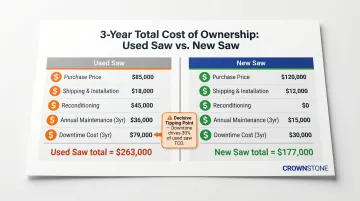
This example illustrates the tipping point: if a used machine generates even 30 additional hours of unplanned downtime per year compared to new, the upfront savings evaporate. Your actual numbers shift based on how much downtime risk your shop can absorb — and how much repair capacity you have in-house.
Real-World Scenario
A mid-size fabrication shop evaluates both options. Path 1: they buy a used 2016 model at $48,500. Six months in, unexpected spindle bearing failure costs $6,500 in parts and 3 days of downtime — $36,000 in lost capacity.
Path 2: they buy new from a domestically-supported manufacturer at $115,000 and run without interruption for 18 months, processing 15 jobs per week.
The used machine saved $66,500 upfront but cost $42,500 in repairs and downtime within 6 months — a net savings of only $24,000. The new machine cost more but delivered uninterrupted revenue generation worth far more than the price premium.
The takeaway: a saw that sits idle for repairs costs you more than one that never broke down — regardless of what either one cost to buy.
Conclusion
Neither used nor new is categorically better — the right answer lives at the intersection of your shop's budget, risk tolerance, production needs, and ability to evaluate and support the machine you buy.
If you have mechanical expertise and can absorb occasional downtime, a used bridge saw from the 4-6 year sweet spot offers genuine value. If production reliability is non-negotiable and you need current technology, the new machine premium pays for itself in uptime and parts availability.
The most expensive bridge saw decision isn't the one with the highest sticker price — it's the one that sits idle. Whether buying used or new, prioritize reliability, parts access, and support.
If that calculus points toward new, Crown Stone's American-made bridge saws are built by fabricators who've cut, lifted, and installed stone themselves — with US-sourced parts, a 2-year warranty, and machines designed to start up and not let down. Contact Crown Stone at 727-239-9875 or visit crownstoneusa.com/contact/ to talk through what your shop actually needs.
Frequently Asked Questions
What is a bridge saw?
A bridge saw is a specialized stone-cutting machine used in fabrication shops to make precise straight cuts through granite, marble, quartz, and other hard stone materials. The diamond blade mounts on a gantry that traverses a fixed table, enabling repeatable, accurate cuts for countertop fabrication.
Are used bridge saws worth buying?
Used bridge saws can be worth it when the machine has a verifiable service history, is purchased from a reputable seller, and the buyer has the mechanical knowledge to inspect and maintain it. However, cost savings can be offset by hidden repair and downtime costs if these conditions aren't met.
What is the lifespan of a bridge saw?
A well-maintained bridge saw can last 15-25 years in a production environment. Active marketplace listings show Park Industries equipment from 1998-2005 still operating with condition ratings of 6.5-8.1 out of 10, proving that quality used machines from reputable shops can still offer many productive years.
How much does a new bridge saw cost compared to a used one?
New bridge saws range from $18,000 for Asian entry-level models to $350,000+ for premium European/North American brands. Used saws typically sell for 30-50% less, with recent 5-axis CNC models at $88,000-$150,000 compared to new equivalents at $195,000+.
What should I inspect before buying a used bridge saw?
Key areas to inspect include:
- Spindle runout and bearing condition (use a dial indicator)
- Beam and rail wear for corrosion or damage
- Motor performance under load
- Electrical system integrity, including all safety interlocks
- Water management components for leaks
- Table levelness and hydraulic lift operation across the full range
What is the best saw for accurate cutting in stone fabrication?
For precision stone cutting, a bridge saw with a rigid cast or welded beam, quality spindle components, and a stable worktable delivers the most consistent accuracy. Whether new or used, these structural elements matter more than brand name alone — verify beam rigidity, spindle runout specs, and table flatness before purchasing.