Introduction
If you're staring down a new bridge saw purchase, you already know the tension: this isn't a hand tool—it's a capital commitment that will either pay for itself many times over or become a costly mistake sitting underutilized in your shop. The question isn't just "can we afford it?" It's "will it pay off, and how fast?"
The answer depends on running the right numbers. This guide walks through how to calculate bridge saw ROI using the inputs that actually matter in stone fabrication: throughput, labor, blade life, rework rates, and job capacity. Specifically, you'll learn:
- Which costs shop owners most often underestimate
- Which returns they routinely overlook
- How to build a realistic payback timeline before signing anything
TLDR
- ROI = (Total Returns − Total Investment Cost) ÷ Total Investment Cost × 100
- Total investment includes purchase price, installation, tooling, utilities, and maintenance—not just the purchase price
- Expect returns from higher throughput, labor savings, less material waste, reduced rework, and access to higher-margin jobs
- Payback periods for stone shops typically range from 18 to 36 months depending on utilization and job mix
- Machines with high uptime and easy-to-source parts compress the payback window—unplanned downtime directly erodes your return
What Goes Into a Bridge Saw ROI Calculation: The Cost Side
Most shop owners underestimate "total investment cost" because they focus on the sticker price and ignore everything else. Every dollar that walks out the door before and during operation belongs in the denominator of your ROI formula.
Upfront Costs
- Machine purchase price – The baseline, but not the whole story
- Freight and rigging – Getting a multi-ton saw into your shop isn't free; industry estimates typically run 5–15% of machine price
- Installation and commissioning – Professional setup ensures accuracy and warranty compliance
- Infrastructure upgrades – Full-sized bridge saws typically require 220–240 volts three-phase power. If your shop doesn't have it, utility conversion work can cost up to $15,000
Ongoing Operating Costs
- Blade consumption – Diamond bridge saw blades are expensive, and life varies by material. Segment height, bond type, and cutting application all affect cost-per-linear-foot
- Electricity – Bridge saw motors typically range from 20–60 HP; expect meaningful monthly utility costs under heavy use
- Water supply and recycling – Stone cutting requires water cooling, and most shops invest in water recycling systems to minimize waste and comply with local regulations
Maintenance is the critical variable. Scheduled preventative maintenance keeps machines running; unscheduled downtime bleeds money. Saws built with globally available, non-proprietary parts reduce maintenance expenses because replacement components arrive in days, not weeks.
Crown Stone USA designs machines with parts readily available in the U.S., sourcing primarily from North America, Korea, Japan, and Taiwan — with less than 2% of components by value from China — specifically to compress service lead times.
Financing Costs
If you finance the machine, monthly interest adds to total investment. But U.S. shop owners should also research Section 179 tax deductions, which allow businesses to deduct the full purchase price of qualifying equipment in the year it's placed in service. According to IRS Publication 946, machinery and equipment used in business generally qualify. This can substantially lower your effective cost basis in year one — a direct improvement to your calculated ROI.
Quantifying the Returns: Where a Bridge Saw Earns Its Keep
This is the numerator in your ROI equation—what the machine actually generates in financial value. Most shops undercount returns by focusing only on throughput and ignoring the four other income streams.
Throughput Gains
A modern bridge saw processes more slabs per shift than manual cutting or outdated equipment. Calculate your gain:
(Slabs per shift with new saw − current slabs per shift) × average revenue per completed job × working days per year
Even 2 additional slabs per day, across 250 working days, can translate to $50,000 or more in added revenue depending on your average job value.
Labor Savings
Skilled stone fabrication labor is scarce and getting more expensive. The NAHB reported in Fall 2025 that labor shortages cost the construction sector roughly $10.8 billion annually, with wages for non-supervisory workers rising 9.2% in July 2025 alone. Deloitte projects a need for 3.8 million manufacturing workers by 2033—with nearly half those positions potentially unfilled.
A well-designed bridge saw reduces operator requirements per shift or frees skilled labor for higher-value tasks: templating, installation, and custom fabrication. According to the Bureau of Labor Statistics, cutting and slicing machine operators earn a median $21.31/hour (May 2023)—roughly $44,700 annually. Saving even half an operator's time across a year puts over $20,000 back into the business.
Material Yield and Waste Reduction
Cut precision directly reduces scrap. Even a 2–3% improvement in material yield across dozens of expensive slabs per month compounds into thousands of dollars saved annually. Slabs vary widely in cost, but reducing waste on high-end materials delivers immediate margin protection.
Access to Higher-Margin Jobs
A capable bridge saw opens doors to complex work that commands premium pricing. Miter edges, waterfall countertops, radius cuts, and sink cutouts require precision and capability. Without that capability, shops turn away this work or sub it out at a margin loss—while shops that can execute it in-house routinely charge 20–40% more than standard straight-cut jobs.
Rework Reduction and Callback Costs
Inaccurate cuts lead to rework, wasted stone, and worst-case job site callbacks. Cutting rework from 5% of jobs to 2% has a direct effect on the bottom line. Fewer callbacks mean less wasted stone, less labor spent redoing work, and fewer conversations no shop owner wants to have.
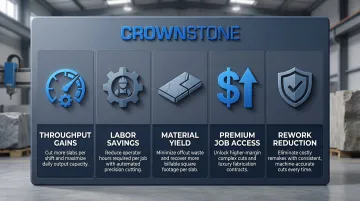
At a glance, the five return streams to quantify:
- Throughput gains — additional slabs processed per shift × annual working days
- Labor savings — reduced headcount or redeployment to higher-value tasks
- Material yield — fewer costly offcuts from precision cutting
- Premium job access — 20–40% price premiums on complex fabrication work
- Rework reduction — lower material waste, labor, and callback costs
Step-by-Step: Running the Numbers for Your Stone Shop
This is the practical walkthrough — five steps, no accounting software required. Just honest estimates, realistic numbers, and a calculator. Work through each step and you'll have a defensible ROI figure you can actually act on.
Step 1: Tally Your Total Investment Cost
Build your line-item list:
- Machine purchase price: $________
- Freight & rigging: $________
- Installation & commissioning: $________
- Infrastructure upgrades (electrical, plumbing): $________
- First-year tooling (blades, consumables): $________
- Estimated annual maintenance: $________
- Financing interest (if applicable): $________
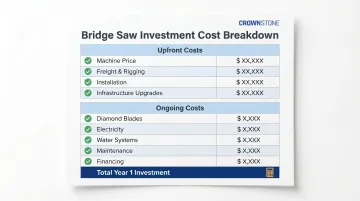
= Total Year 1 Investment
Step 2: Estimate Your Annual Net Returns
Walk through each return stream:
- Throughput gains (additional slabs × incremental margin per job): $________
- Labor savings (reduced operator hours × hourly rate): $________
- Material yield savings (waste reduction × slab costs): $________
- New job revenue (premium jobs now accessible): $________
- Rework reduction (avoided costs): $________
= Total Annual Return
Step 3: Apply the ROI Formula
ROI (%) = [(Total Annual Returns − Total Annual Operating Costs) ÷ Total Investment Cost] × 100
Example scenario:A mid-sized granite countertop shop processing 15 slabs/day moves to 18 slabs/day with a new bridge saw. Average revenue per completed job is $2,500, with a 45% gross margin after direct materials and labor. Working 250 days/year:
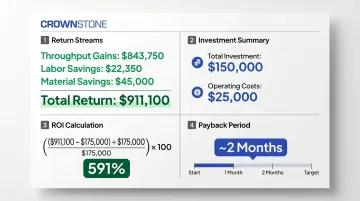
- Throughput gain: 3 slabs/day × $1,125 margin × 250 days = $843,750 incremental margin
- Labor savings: 0.5 operator × $44,700/year = $22,350
- Material yield savings: 2% improvement on $500/slab × 4,500 slabs/year = $45,000
- Total annual return: $911,100
- Total investment cost: $150,000
- Annual operating costs (blades, utilities, maintenance): $25,000
ROI = [($911,100 − $25,000) ÷ $150,000] × 100 = 591%
Step 4: Calculate the Payback Period
Payback Period = Total Investment Cost ÷ Annual Net Benefit
Using the example above:
- Annual net benefit: $911,100 − $25,000 = $886,100
- Payback period: $150,000 ÷ $886,100 = 0.17 years (about 2 months)
Payback period is often more useful than raw ROI percentage because it tells you exactly when the machine stops costing money and starts making it. But any single scenario is just one version of reality — Step 5 shows you how to stress-test it.
Step 5: Run a Sensitivity Check
Stress-test your calculation by running a conservative scenario. What if throughput only improves by half of projected? What if labor savings are 25% lower?
Conservative scenario:
- Throughput gain reduced by 50%: $421,875
- Labor savings reduced by 25%: $16,763
- Material yield unchanged: $45,000
- Total annual return: $483,638
ROI = [($483,638 − $25,000) ÷ $150,000] × 100 = 306%Payback period: $150,000 ÷ $458,638 = 0.33 years (about 4 months)
If your conservative scenario still clears 12–18 months to payback, the machine is worth serious consideration.
The Hidden Cost of Waiting
Delaying an equipment upgrade is still a financial decision — just not a conscious one. Every month you delay the upgrade, you pay the opportunity cost of jobs you turn away, work you subcontract at a margin loss, or orders you lose to better-equipped competitors.
Concrete scenario: Your shop subcontracts complex miter work because you lack cutting capability. If the subcontractor charges you $300 per job and you send out 10 jobs per month, that's $3,000/month or $36,000/year in margin you're handing to someone else. Over three years, that's $108,000—often more than the cost of the saw itself.
That number keeps growing for another reason: labor costs trend upward, not down. The gap between manual production costs and automated production costs widens every year you wait. At some point, the ROI calculation that looks borderline today becomes straightforward — but by then, a competitor has already made the move.
What's a Good ROI—and When Should You Pull the Trigger?
Manufacturing equipment ROI benchmarks vary, but stone fabrication shops should look for payback periods that make the investment viable relative to machine lifespan—typically 10–15 years for quality equipment. Payback periods in the 18–36 month range are common and financially sound.
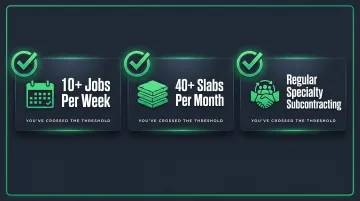
Volume threshold: A bridge saw starts making financial sense when your shop is processing enough volume that manual cutting or older equipment creates bottlenecks. You've likely crossed the tipping point if you're seeing:
- 10+ jobs per week with your current setup
- 40+ slabs per month through the shop
- Regular subcontracting of specialty cuts you could handle in-house
Machine quality matters. A saw that runs consistently with minimal unscheduled downtime reaches payback faster than one that bleeds time and money in repairs. Reliability and serviceability directly affect your ROI timeline—they're not secondary concerns.
Crown Stone USA's machines reflect this thinking. Designed by fabricators who spent years running stone shops, they're built around details that reduce downtime: CNC-machined rolling surfaces, moisture-resistant table designs, and parts that are easy to source in the US.
Frequently Asked Questions
How to calculate ROI on equipment?
Use the formula: ROI = [(Net Returns − Total Investment Cost) ÷ Total Investment Cost] × 100. Net returns should cover labor savings, throughput gains, material savings, and new revenue. Total investment includes purchase price, installation, tooling, and ongoing operating costs—not just the sticker price.
What is a good ROI for manufacturing?
For capital equipment in stone fabrication, payback periods of 18–36 months are a solid target. The real measure is whether that payback falls well within the machine's working lifespan—leaving years of profitable operation after you've broken even.
What is a typical payback period for a bridge saw?
Payback depends heavily on how well you use the machine. Shops running consistent volume with a mix of countertop, tile, and custom work tend to hit break-even faster than those running narrow job types at lower utilization. Workflow integration matters just as much as raw throughput.
How does machine reliability affect my bridge saw ROI?
Every hour of unscheduled downtime cuts throughput and pushes your payback period out. Reliability is a core financial variable, not just an operational one. Machines built with durable components and globally available parts keep downtime costs predictable and low.
Should I buy new or used to get a better ROI?
Used machines reduce upfront cost but often carry unknown maintenance needs, no warranty, and outdated capability. Those gaps can quietly consume the savings you thought you were getting. New equipment with warranty coverage gives you a predictable cost structure from day one.