Thanks to the One, Big, Beautiful Bill Act (P.L. 119-21), signed into law on July 4, 2025, 2026 is an unusually favorable year to purchase, upgrade, or expand fabrication equipment. This legislation restored 100% bonus depreciation, increased Section 179 expensing limits to $2.56 million, made the Qualified Business Income (QBI) deduction permanent, and created retroactive opportunities for shops to amend 2022–2024 returns.
This guide covers the key provisions that matter most to fabrication shop owners and decision-makers—not tax professionals. While these incentives can meaningfully reduce the net cost of major equipment purchases, their exact value depends on your shop's tax situation, entity type, and income level. Always consult with a CPA familiar with manufacturing before making final decisions.
TLDR:
- Section 179 allows immediate write-offs up to $2.56 million for qualifying equipment placed in service in 2026
- 100% bonus depreciation is restored for property acquired and placed in service after January 19, 2025
- Shops under $32 million in average annual gross receipts can amend 2022–2024 returns to claim retroactive deductions
- Equipment must be operational and ready to use before December 31, 2026 to qualify for 2026 deductions
- Pass-through entities can claim a permanent 20% QBI deduction on qualified business income
What the 2026 Tax Bill Means for Stone Fabrication Shops
If your shop is structured as a sole proprietorship, S-corp, or LLC, the One, Big, Beautiful Bill Act (P.L. 119-21) — signed into law on July 4, 2025 — has provisions written for businesses exactly like yours. Several of its manufacturing and equipment expensing rules apply directly to stone fabrication operations.
The Retroactive Opportunity Many Fabricators Missed
Businesses that meet the small business gross receipts threshold—$32 million in average annual gross receipts for the prior three years—can amend 2022, 2023, and 2024 returns to claim previously unavailable deductions. This is particularly valuable for shops that incurred research and experimental expenses during those years or made equipment purchases that weren't fully expensed. The deadline to file amended returns is July 6, 2026, making this a time-sensitive opportunity.
Why Stone Fabricators Specifically Benefit
The bill's manufacturing provisions, equipment expensing rules, and pass-through deductions align closely with how most fabrication shops are structured and how they invest in equipment.
Stone fabrication operations — cutting, edging, and polishing raw stone into finished countertops — qualify as manufacturing activities under IRS definitions. That classification matters: it means shops can access the full range of incentives without navigating the complex restrictions that apply to service businesses.
Purchase Date vs. Placed-in-Service Date: A Critical Distinction
Eligibility for depreciation and expensing provisions hinges on when equipment was placed in service — not when it was ordered or paid for. The IRS defines this as the point when equipment is fully operational and available for its assigned function. That means delivered, installed, and ready to cut before December 31, 2026.
For shops planning late-year purchases, the risks of missing that date include:
- A bridge saw ordered in November but installed in January falls into the 2027 tax year
- Missing or backordered parts can push the placed-in-service date past December 31
- Incomplete installation or unresolved mechanical issues delay the deduction — even if the machine is on-site
- Coordination delays between delivery and your electrician or installer add up fast
Order early and confirm your installation timeline with your equipment supplier before year-end.
Section 179 Deduction: Immediate Write-Offs Up to $2.56 Million
Section 179 lets businesses deduct the full purchase price of qualifying equipment in the year it's placed in service—not spread across a 7-year depreciation schedule. Instead of recovering that $150,000 bridge saw cost a little at a time, you write off the entire amount in year one.
2026 Updated Limits
The deduction limit has increased to $2.56 million for 2026, with the phase-out threshold beginning when total property placed in service exceeds $4.09 million. Practically speaking, most stone fabrication shops will be well under the phase-out threshold. Even a shop making a significant multi-machine investment—say, a new bridge saw, CNC router, and edge polisher totaling $400,000—still has plenty of headroom.
What Stone Fabrication Equipment Qualifies
Section 179 applies to tangible personal property used in a trade or business, which includes machinery and equipment used as an integral part of manufacturing. For stone fabricators, this covers:
- Bridge saws (4-axis and 5-axis models)
- CNC stone routers and work centers
- Waterjet cutters and hybrid saw-jet systems
- Edge polishing machines
- Material handling equipment
- Water recycling systems
Equipment must be new to the buyer—not necessarily brand-new, but newly purchased. Used equipment qualifies as long as it wasn't acquired from a related party and wasn't obtained through gift, inheritance, or a similar non-arm's-length transfer.
Purchasing an American-made machine like those from Crown Stone USA—with clear supply chain traceability—can simplify the record-keeping process when filing Form 4562, since cost basis and business use are straightforward to document.
The Income Limitation Rule
Section 179 deductions cannot exceed your business's taxable income for the year. You cannot use Section 179 to generate a tax loss. If your shop has $100,000 in taxable income and you purchase $150,000 in qualifying equipment, you can deduct $100,000 under Section 179 in the current year. The remaining $50,000 can be carried forward to future years or claimed under bonus depreciation (if eligible).
Simplified Example: Real Dollar Savings
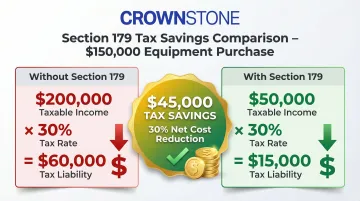
That income cap matters less than it sounds for most shops—the numbers still work strongly in your favor. Consider a fabrication shop that purchases $150,000 of qualifying equipment in 2026 and has $200,000 in taxable income.
Under Section 179, the shop can deduct the full $150,000, reducing taxable income to $50,000.
Assuming a combined federal and state effective tax rate of approximately 30% (common for profitable small businesses):
- Without Section 179: $200,000 taxable income × 30% = $60,000 tax liability
- With Section 179: $50,000 taxable income × 30% = $15,000 tax liability
- Tax savings: $45,000 in the first year
This represents a 30% reduction in the net cost of the equipment, putting $45,000 back into working capital the same year you buy the machine.
100% Bonus Depreciation Is Back for 2026
Bonus depreciation allows businesses to immediately deduct a percentage of the cost of qualifying assets in the first year, with any remaining balance depreciated on a standard schedule. The new legislation restores bonus depreciation to 100% for property acquired and placed in service after January 19, 2025, meaning the full cost can be expensed in year one.
Key Advantage Over Section 179
Unlike Section 179, bonus depreciation is not capped by the business's taxable income. It can create or increase a net operating loss (NOL), which can then be carried forward to offset future profits. This is particularly valuable for a shop that has a lower-income year but makes a major equipment investment.
For example, if your shop has $50,000 in taxable income but purchases $200,000 in qualifying equipment, Section 179 would be limited to $50,000. Bonus depreciation, however, would allow the full $200,000 deduction, creating a $150,000 NOL that can be carried forward to reduce taxes in profitable future years.
What Equipment Qualifies
Most new tangible business property with a recovery period of 20 years or less qualifies for bonus depreciation. Stone fabrication machinery falls within qualifying categories, as these assets carry a 7-year MACRS recovery period. Common qualifying equipment includes:
- Bridge saws and CNC routers
- Waterjet cutting systems
- Polishing and edge finishing equipment
- Water recycling and filtration systems
Used equipment also qualifies under the restored 100% bonus depreciation, provided it meets statutory requirements: the original use must commence with the taxpayer, or the used property must not have been previously used by the taxpayer or acquired from a related party. This "new to the taxpayer" standard means a fabrication shop can purchase a used bridge saw and claim 100% bonus depreciation as long as they haven't used that specific machine before.
Manufacturing-Specific Provision: Qualified Production Property
The new bill includes an additional first-year depreciation benefit for "Qualified Production Property" (QPP) used in manufacturing. QPP covers the portion of nonresidential real property used as an integral part of a qualified production activity — specifically, manufacturing that results in a substantial transformation of the material.
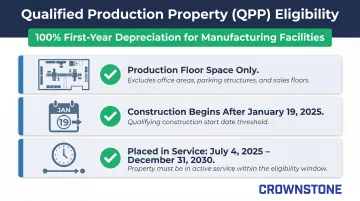
Stone fabrication operations meet this definition — raw slab in, finished countertop out qualifies as substantial transformation. For shops building or expanding production facilities, the QPP provision allows 100% depreciation of the production-area portion. Key eligibility conditions:
- Applies to production floor space (excludes office, parking, and sales areas)
- Construction must begin after January 19, 2025
- Property must be placed in service after July 4, 2025 and before January 1, 2031
Three More Tax Incentives Stone Fabrication Shops Shouldn't Overlook
Qualified Business Income (QBI) Deduction Made Permanent
The QBI deduction allows pass-through entities—sole proprietors, S-corps, LLCs, and partnerships—to deduct up to 20% of qualified business income. This deduction was made permanent under P.L. 119-21, and the income thresholds that previously phased out the deduction are increasing in 2026.
For 2026, the phase-in thresholds are:
- Married Filing Jointly: $403,500 (full deduction) to $553,500 (full phase-out)
- Single/Head of Household: $201,750 to $276,750
The SSTB exclusion is worth understanding here: certain service businesses lose access to the deduction at higher income levels, but manufacturing and fabrication operations are not classified as Specified Service Trade or Business (SSTB) activities. Stone fabricators can claim the deduction regardless of income, subject only to W-2 wage and property basis limitations above the threshold amounts.
A fabrication shop with $300,000 in qualified business income could deduct $60,000 (20%), directly cutting taxable income.
Research and Experimental Expense Deductions
For tax years beginning after December 31, 2024, domestic research and experimental expenditures are once again immediately deductible. Previously, the IRS required shops to amortize these costs over five years. For fabrication shops investing in process innovation, tooling development, or new cutting techniques, this change reduces the cost of R&D-adjacent activities.
The retroactive opportunity is worth acting on quickly. Shops that qualify can amend prior returns to recapture deductions they were forced to spread out:
- Applies to R&E expenses incurred in 2022–2024
- Available to shops with average annual gross receipts under $32 million
- Amended returns must be filed by July 6, 2026
Qualified Opportunity Zone Funds
Opportunity Zone funds offer a way to defer capital gains taxes—relevant for fabricators who have sold equipment, property, or a business. By reinvesting those gains in a Qualified Opportunity Zone Fund, you defer the tax liability. Hold the investment for at least 10 years and you eliminate capital gains tax on any post-investment appreciation entirely.
This is a more complex strategy that requires a tax advisor, but for shop owners sitting on significant gains from asset sales, the relief can be substantial.
Section 179 vs. Bonus Depreciation: Which Is Better for Your Shop?
The core strategic difference comes down to control versus coverage:
| Section 179 | Bonus Depreciation | |
|---|---|---|
| Application | You choose which assets to expense | Applies automatically to all qualifying property |
| Loss creation | Cannot create a net loss | Can create a net operating loss (NOL) |
| Flexibility | Expense any amount up to the limit | All-or-nothing per asset class (elect out to exclude) |
| Best for | Predictable income years | Large purchases in lean revenue years |
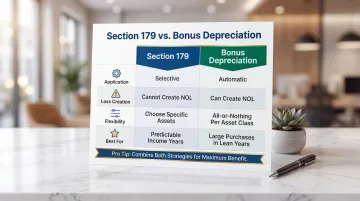
For most small fabrication shops with consistent taxable income, Section 179 is often the more predictable and flexible choice. You can select exactly which equipment to expense, optimize the deduction to match your income, and carry forward any unused amounts.
When Bonus Depreciation Is Advantageous
Bonus depreciation becomes strategically useful in these situations:
- Large equipment purchase in a lean revenue year: Your shop is making a $300,000 investment but only has $75,000 in taxable income. Section 179 maxes out at $75,000, but bonus depreciation can claim the full $300,000, creating a $225,000 NOL to carry forward.
- Multi-year tax planning: You expect higher profits in future years and want to bank NOLs now to offset future tax liability.
- Exceeding Section 179 limits: While rare for most fabricators, shops making investments exceeding $2.56 million can use bonus depreciation on amounts above the Section 179 cap.
In many cases, though, the strongest move isn't choosing one or the other — it's combining them.
Using Both Together: A Combined Approach
You can apply Section 179 first on selected equipment up to your taxable income limit, then apply bonus depreciation to any remaining eligible property cost.
Example:
- Taxable income: $100,000
- Equipment purchase: $250,000
- Step 1: Claim $100,000 under Section 179 (reduces taxable income to $0)
- Step 2: Claim $150,000 under bonus depreciation (creates a $150,000 NOL)
- Result: Full $250,000 expensed in year one, with $150,000 NOL carried forward
For fabrication shops planning a major equipment buy — a bridge saw, edge polisher, or water recycling system — running this scenario with your accountant before year-end can meaningfully change what you owe.
How to Maximize Your Equipment Deductions Before Year-End
The "Placed in Service" Deadline
To claim 2026 deductions, equipment must be installed and operational before December 31, 2026—not just ordered or paid for. Account for delivery lead times, installation, and any missing parts or mechanical issues that could delay operational status.
For shops considering year-end purchases, start planning in Q3. Contact equipment manufacturers to confirm current lead times, delivery schedules, and installation requirements. A machine ordered in October with a 6-week lead time and 2-week installation window can comfortably meet the year-end deadline. A machine ordered in December may not.
Practical Steps to Take Now
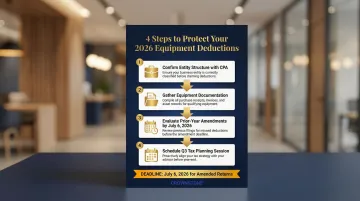
Four actions that protect your deductions and prevent last-minute scrambles:
- Confirm entity structure with your CPA to verify QBI eligibility and optimal deduction strategy. Pass-through entities benefit most from these provisions, but the mechanics vary by structure.
- Gather documentation for every equipment purchase: invoices with purchase price and date, placed-in-service dates, business-use percentages (must exceed 50%), and serial numbers with asset descriptions.
- Evaluate prior-year amendments if your shop qualifies under the $32 million gross receipts threshold and had R&E expenses or equipment purchases in 2022–2024. Amending returns could recover significant tax dollars—the deadline is July 6, 2026.
- Schedule a Q3 tax planning session with your accountant. Review projected income and planned purchases before Q4. Decisions made in November and December can carry five-figure tax implications.
Crown Stone USA: A Timely Investment to Consider
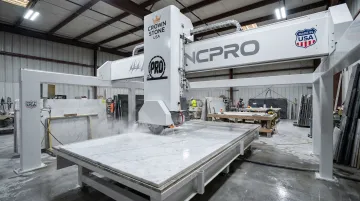
Once your planning timeline is set, equipment selection becomes the next variable. For shops upgrading cutting capacity in 2026, a domestically manufactured machine with a clear bill of materials and solid warranty coverage directly supports the documentation requirements above. Crown Stone USA manufactures bridge saws, edge polishers, water recycling systems, and bridge saw tables in the United States, with less than 2% of components by value originating from China.
Because Crown Stone machines are built in the USA with traceable components and a 2-year warranty, they're designed to ship and install on a predictable schedule—reducing the supply chain uncertainty that causes year-end deadline misses.
The Avalanche Pro Bridge Saw ships from their Clearwater, Florida facility and includes straightforward installation designed by fabricators who've run shops themselves.
If you're planning a 2026 equipment purchase, contact Crown Stone USA at 727-239-9875 or [email protected] to discuss equipment options, lead times, and delivery schedules that align with your tax planning timeline.
Frequently Asked Questions
Can you write off stone fabrication machinery for business taxes?
Yes, stone fabrication machinery qualifies as a depreciable business asset. Fabricators can use Section 179 expensing, 100% bonus depreciation, or standard MACRS depreciation to write off the cost, with 2026 offering particularly favorable terms under the restored bonus depreciation and increased Section 179 limits.
What is the Section 179 deduction limit for 2026?
The 2026 Section 179 deduction limit is $2.56 million, with the phase-out threshold beginning at $4.09 million in total equipment purchases. Most stone fabrication shops will qualify for the full deduction.
Does the 100% bonus depreciation apply to used stone fabrication equipment?
Yes, the restored 100% bonus depreciation applies to used equipment that is "new to the taxpayer." As long as the used property was not previously used by your business and was not acquired from a related party, it qualifies for the 100% first-year deduction.
What does "placed in service" mean for equipment tax deductions?
"Placed in service" means the equipment is ready and available for use in the business—not just purchased or delivered, but fully operational. Missing parts, incomplete installation, or unresolved mechanical issues can push back the placed-in-service date and delay your deduction.
Can I amend past tax returns to claim deductions on stone fabrication equipment?
Yes. Businesses with average annual gross receipts under $32 million may amend 2022, 2023, and 2024 returns to claim retroactive deductions—primarily for research and experimental expenses previously required to be amortized. Amended returns must be filed by July 6, 2026.
What business structures qualify for the QBI deduction?
Pass-through entities—sole proprietorships, partnerships, S-corporations, and LLCs taxed as pass-throughs—qualify for the 20% QBI deduction. Stone fabrication manufacturing operations are not subject to the SSTB income restrictions that limit service businesses, so most shops under these structures qualify.