Introduction
Porcelain slabs have become one of the fastest-growing materials in stone fabrication. The U.S. countertop market reached $28.65 billion in 2024, with sintered stone and high-performance porcelain driving significant growth as large-format slabs gain traction in commercial and residential design.
Porcelain is harder, denser, and far less forgiving than granite or quartz. According to Stone World, the material "tends to be fragile" due to "tension in the material from baking and curing" — creating a high risk of cracking and breakage during cutting and polishing.
Chipping is the most common — and costliest — mistake fabrication shops face when processing porcelain. A single miscut on a $500+ slab can wipe out an entire job's profit margin.
This guide walks you through the exact process for cutting porcelain slabs without chipping — covering pre-cut setup, execution parameters, and how to diagnose edge fractures before they cost you a slab.
TL;DR
- Use a blade specifically rated for porcelain (soft bond, fine grit)—granite and marble blades will chip the surface
- Detension first: trim 1–2 cm off all four edges before primary cuts to release internal stress
- Slow your entry speed to 30% of normal for the first 10 cm — feed rate errors cause most glaze fractures
- Maintain steady water flow; inadequate coolant causes blade glazing and chipping within minutes
- Interior cutouts need radiused corners (3–8 mm minimum) and at least 5 cm clearance from any slab edge
Equipment and Setup: What You Need Before the First Cut
Porcelain does not forgive marginal equipment. The bridge saw's table must be level, the fence must be square, and the water delivery system must deliver consistent flow to both sides of the blade.
A Crown Stone USA bridge saw, for example, provides the stable platform and reliable water management that porcelain demands. Their bridge saw tables are CNC-machined with stainless steel rolling surfaces, refined through 10 design iterations to create a foundation as precise and durable as the saw itself.
Blade Requirements for Porcelain Slabs
Blades must be rated explicitly for porcelain stoneware. The wrong blade is the fastest way to ruin a slab.
Critical blade specifications:
- Soft bond only — not hard bond (more on why below)
- Medium to fine diamond grit — typically 80–220 mesh
- Continuous rim or sector disc configured for dense ceramics
- 12–16 inch diameter for bridge saw work (14 in at 2,200 rpm; 16 in at 2,000 rpm are common benchmarks)
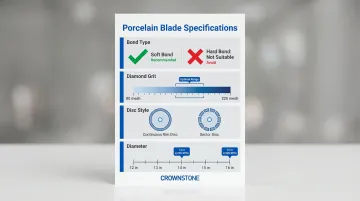
The soft bond requirement catches many fabricators off guard. Porcelain's low abrasion means it won't wear the bond matrix fast enough — so you need a soft bond that releases spent diamonds quickly and exposes fresh ones. Hard bonds (designed for soft, abrasive materials like marble) trap diamonds, causing the blade to glaze, overheat, and fracture the surface instead of slicing cleanly.
Blades NOT suitable for porcelain:
- Granite blades (hard or soft bond)
- Marble blades
- Quartz blades
Using the wrong blade generates heat, causes surface microfractures, and chips both the top glaze and exit edge.
Workspace and Support Requirements
The slab must be fully and evenly supported across its surface before any cut begins.
Pre-cut checklist:
- Clean, debris-free cutting table (no dust, no stone chips)
- Proper slab support on both sides of the blade path, especially the exit side
- PPE: safety glasses, cut-resistant gloves, respirator for dry environments
- Stable platform with no flex or vibration
Skill and Safety Readiness
Good equipment and the right blade only matter if the operator is ready. Every fabricator running porcelain must understand detensioning cuts (stress-relief passes along the slab edge), feed rate control, and water management before processing production pieces. Improper technique on a $500+ slab is a costly mistake.
Recommendation: Fabricators new to porcelain should practice parameter control on scrap pieces before running production work. Spend two hours on test cuts to dial in feed rate, water flow, and blade condition monitoring. The cost of scrap material is far less than the cost of ruining a client's slab.
How to Cut Porcelain Slabs Without Chipping, Step by Step
This process applies to bridge saw cutting of large-format porcelain slabs—the appropriate method for fabrication-grade work on countertops, vanity tops, and cladding panels.
Step 1: Inspect the Slab and Perform Detensioning Cuts
Lay the slab on a clean, level cutting surface and visually inspect for pre-existing cracks, delamination, or surface defects. Document any damage to avoid disputes.
Perform detensioning cuts along all four edges:
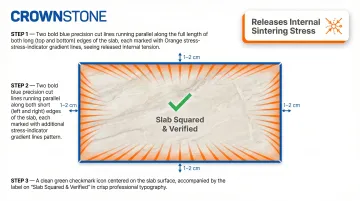
Manufacturer guidelines specify removing 1–2 cm of material from all edges before any primary cuts. These cuts release internal stress built up during the sintering process.
Order matters:
- Remove 1–2 cm from the long sides first
- Remove 1–2 cm from the short sides second
- Verify the slab is now squared
Detensioning cuts are mandatory, not optional. Porcelain slabs contain tension from the baking and curing process, and cutting into an unstressed slab can cause unexpected cracks far from the blade path.
Step 2: Verify Machine Setup and Blade Condition
Mount a porcelain-rated blade and confirm correct rotation direction. Check for wobble, warping, or uneven wear before the first cut.
Water flow verification:
- Confirm steady, unobstructed coolant delivery hitting both sides of the blade rim
- Recommended flow: 10–12 liters per minute at 2–4 bar pressure
- Water must be clean, fresh, and under enough pressure to flush cutting waste
Machine alignment:
- Verify table fence is square to the blade path
- Check that the sliding mechanism moves without binding
- Confirm table is level under load
Dress the blade if new or idle:
Make 5–10 passes through a dressing stone to expose fresh diamonds. Glazing is the dull coating that forms when the bond melts over the diamonds—if the blade spins but doesn't cut, and segments feel smooth to the touch, it's glazed.
Step 3: Mark Cuts and Configure the Fence
Mark cut lines with a wax pencil or fine-tip marker directly on the slab surface. For precision cuts, tape the cut line with a single layer of masking tape to reduce surface micro-chipping at the entry point.
Set the fence and verify the dimension against the mark at both the entry and exit points of the blade path. Check both ends — even slight misalignment multiplies into visible gaps and wasted material.
Step 4: Execute the Cut
Most edge chipping happens at entry and exit, so begin with a slow, controlled feed for the first 10 cm (approximately 4 inches).
Entry/exit speed management:
Reduce feed rate to 30% of normal speed for the first and last 10 cm of the cut. This prevents the blade from fracturing the glaze as it enters and exits the material.
Feed rate benchmarks:
Once the blade is fully engaged, maintain a steady, moderate feed rate:
- Straight cuts: 800–2,000 mm/min (approximately 30–80 inches/min) for most porcelain slabs
- 45° miter cuts: 500–1,400 mm/min (approximately 20–55 inches/min)
- 12 mm slabs: 1.5 m/min; 20 mm slabs: 1.0 m/min
Never force the blade through resistance. If the cut slows, reduce feed pressure and check water flow before pushing harder. Forcing the feed is the primary cause of both edge chipping and blade damage.
At the exit side of the cut, slow the feed rate again and ensure the offcut piece is fully supported. Unsupported exit pieces deflect under blade pressure and snap, causing large chips or full slab cracks.
Step 5: Interior Cutouts (Sink Holes, Outlets, Drains)
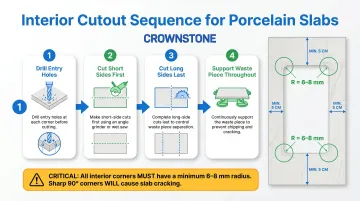
Mark all interior cutout geometry and confirm a minimum 5 cm clearance between any cutout edge and the slab perimeter.
Avoid 90° interior corners:
Specify a minimum radius at all interior corners to prevent stress concentration and cracking:
- 6.5 mm slabs: Minimum 6 mm radius
- 12 mm slabs: Minimum 8 mm radius
- General minimum: 3–8 mm depending on brand and application
Cutout sequence:
- Drill entry holes at corners before executing straight cuts
- Cut the short sides first
- Cut the long sides last
- Support the waste piece throughout to prevent it from dropping and snapping the slab
Step 6: Edge Finishing
After a clean cut, use a fine diamond hand pad or polishing wheel to ease the cut edge. This removes micro-chips, sharpens the visual finish, and eliminates sharp handling hazards.
Even a visually clean cut leaves microscopic fractures along the edge. Skipping finishing means those fractures stay — and they show up later as edge degradation, callbacks, or sharp edges that cut through silicone beads during installation.
Key Parameters That Affect Cut Quality in Porcelain Slabs
The difference between a chip-free cut and a ruined slab comes down to four interacting variables: blade selection, feed rate, water flow, and machine stability. Each one affects the others — get one wrong and the defects compound fast. Here's what to control and why.
Blade Bond and Diamond Specification
Porcelain is sintered at extremely high density, which means blade bond selection is non-negotiable. Soft bond blades release diamonds quickly to maintain cutting efficiency; hard or medium bond blades trap diamonds, causing the blade to drag, heat up, and fracture the glaze rather than slice it. The wrong blade causes chipping on both the top surface and the exit edge — a diamond-glazed blade segment builds heat that microfractures the glaze ahead of the cut line.
Use the correct specification:
- Soft bond matrix for hard, low-abrasion materials
- Medium to fine diamond grit (80–220 mesh)
- Porcelain-rated continuous rim or sector disc
Feed Rate
Feed rate controls how much force hits the blade per unit of contact. Too fast and the blade deflects, vibrates, and fractures the glaze. Too slow and you glaze the blade, burning the material instead of cutting it.
Consistent, moderate feed produces a clean cut. Erratic feed — common when operators push through hard spots — creates visible chipping patterns along the cut line. For dense porcelain, approximate feed rates range from 800–2,000 mm/min for straight cuts (roughly 30–80 inches/min). Drop that rate for mitered cuts and thicker slabs.
Water Flow and Coolant Management
Water does three things: cools the blade bond, flushes slurry out of the kerf, and lubricates the cut. Loss of water causes the blade bond to overheat, diamonds to glaze over, and the cut surface to fracture.
At the start of every session, verify:
- Flow rate is at spec for your blade diameter
- Slurry is clearing cleanly from the cut path
- No dry or dusty conditions at the blade (immediate stop if so)
Crown Stone USA's water recycling systems deliver 40 or 70 gallons per minute depending on the model, maintaining clean water circulation through flocculant-based sediment settling.

Machine Stability and Table Levelness
Any flex, vibration, or movement in the saw table goes straight into the blade path. Porcelain tolerates vibration far less than granite or marble — what passes unnoticed on softer stone shows up as micro-fractures in porcelain.
A level, rigid table and properly tensioned blade carriage are prerequisites for any porcelain job. Verify table levelness before the first cut. Crown Stone USA's bridge saw tables use CNC-machined rolling surfaces and hydraulic-powered lift systems — the table design went through 10 iterations before it met the stability standard the shop work actually demands.
Common Mistakes That Cause Chipping
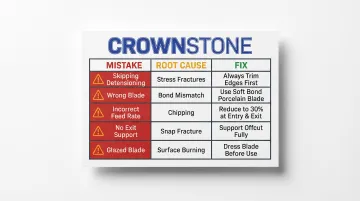
Skipping or Rushing the Detensioning Cut
Cutting straight into a full slab without detensioning first is the single biggest contributor to unexpected cracks and run-out chips. Internal tension in large-format porcelain slabs can redirect cut lines and cause fractures far from the blade path.
Always remove 1–2 cm from all four edges before dimensioning primary cuts.
Using the Wrong Blade for Porcelain
Fabricators who switch from granite to porcelain without changing blades are the most frequent source of callbacks. Granite blades cut aggressively with the wrong bond for dense sintered ceramic, generating heat and fracturing the surface rather than slicing it.
Use a soft bond, fine-grit blade rated explicitly for porcelain stoneware.
Incorrect or Inconsistent Feed Rate
Pushing through resistance with heavy feed pressure — instead of pausing to check blade condition or water flow — chips the top surface and fractures the exit edge. When the cut slows or feels rough, reduce pressure, dress the blade, and verify coolant flow before continuing.
Inadequate Exit-Side Support
Unsupported offcuts flex under blade pressure in the last 30–50 mm of the cut. That deflection creates a stress fracture that snaps the piece and chips both cut faces. Keep the primary piece and the waste piece fully supported all the way through the exit — no exceptions.
Ignoring Blade Dress and Condition
New blades and blades used on soft stone both need dressing before they're ready for porcelain. A glazed blade drags across the surface instead of cutting it. Watch for the warning signs — slowing cut speed, a burning smell, or unusually discolored slurry — then dress the blade with an abrasive block to expose fresh diamonds.
Troubleshooting Chipping and Cut Problems
Even with proper setup, chipping and cut problems happen in production. When they do, diagnose the root cause first — adding force or speed almost always makes it worse. The three most common failure points are covered below.
Chips Along the Top Surface Glaze
Common causes:
- Glazed or dull blade
- Feed rate too high
- Insufficient water flow
- Blade installed in wrong rotation direction
Steps to resolve:
- Dress the blade immediately
- Verify rotation direction
- Reduce feed rate by approximately half
- Confirm water jets are hitting both sides of the blade rim before restarting
Chips or Fractures at the Exit Edge
Common causes:
- Offcut piece unsupported and deflecting
- Feed rate not reduced at cut exit
- Blade catching or deflecting the exit edge
Steps to resolve:
- Ensure full support under the offcut piece for the final 2 inches of the cut
- Slow feed rate on exit to 30% of normal speed
- Consider making a shallow back-cut from the opposite edge to meet the kerf
Cut Drifting Off Line or Blade Wander
Common causes:
- Fence misalignment
- Blade wobble or warping
- Excessive lateral force from uneven feed pressure
Steps to resolve:
- Re-square the fence
- Check blade for warping or loose flange
- Reduce feed pressure and allow the blade to self-guide
- If wander persists, replace the blade
Frequently Asked Questions
Is porcelain difficult to cut?
Porcelain is one of the more demanding materials in stone fabrication due to its density and brittleness. However, clean cuts are consistently achievable with the right blade (soft bond, fine grit), controlled feed rate, proper water flow, and correct machine setup.
How much does it cost to cut a porcelain slab?
Cutting costs vary by shop, cut complexity, and slab size—typically priced per linear foot or per cutout. Material waste from chipping or miscuts is often the larger cost driver, since porcelain-specific blades and slower feed rates raise operating costs compared to granite or quartz.
How are porcelain countertops fabricated?
Fabrication starts with detensioning the slab (removing 1–2 cm from all edges), then making primary cuts on a bridge saw. Interior cutouts require radiused corners and 5 cm clearance from slab edges, using porcelain-rated blades with controlled water cooling. Edge finishing follows with fine diamond pads.
How much does it cost to fabricate a porcelain slab?
Porcelain slab fabrication typically costs more per square foot than granite or quartz due to blade wear, slower feed rates, and higher skill requirements. Cutout count, edge profile complexity, and slab thickness are the biggest variables—intricate jobs with multiple sink cutouts or mitered edges will push costs significantly higher.
How thin can you cut porcelain tile?
Strips under 3–4 cm wide are prone to fracture under blade pressure, regardless of slab thickness. For very narrow pieces, use controlled entry/exit speeds and ensure full support throughout the cut.