Introduction
Stone fabrication shops make major capital investments—bridge saws, CNC machines, waterjet cutters, edge polishers—often spending $200,000 or more on a single piece of equipment. Standard depreciation spreads that deduction across seven years. Section 179 lets you take it all in year one.
For fabricators weighing a purchase before year-end, the updated 2026 rules matter. The gap between a modest multi-year write-off and an immediate reduction in taxable income can be tens of thousands of dollars in cash flow.
Below, you'll find what qualifies under Section 179, the inflation-adjusted 2026 limits from the One Big Beautiful Bill Act, and how to stack Section 179 with restored 100% bonus depreciation before December 31.
TL;DR
- Section 179 lets stone shops deduct qualifying machinery costs immediately, not over seven years
- The 2026 deduction limit is $2,560,000, with phase-out beginning at $4,090,000 in total equipment purchases
- Bridge saws, CNC routers, waterjet cutters, edge profilers, polishers, and dust collection systems qualify
- Both new and used equipment qualify for the deduction
- Financed equipment counts toward your deduction even if you haven't paid cash yet
- 100% bonus depreciation stacks with Section 179 for maximum first-year savings
What Is Section 179 and Why Stone Fabricators Should Care
Section 179 is a provision in the U.S. Internal Revenue Code that lets businesses elect to immediately expense—rather than depreciate—the cost of qualifying business property placed in service during the tax year, subject to annual limits. This is an election you make when filing your tax return, not an automatic deduction.
Here's what that means for your shop: instead of writing off an $80,000 bridge saw at roughly $11,400 per year over seven years, you can deduct the full $80,000 in the year you buy and put it to work. Seven years of depreciation, compressed into one. That's a direct hit to your taxable income right when cash flow pressure is highest—the year you make the investment.
Stone fabrication equipment falls under Asset Class 32.3, which sets the standard MACRS depreciation period at seven years. Section 179 lets you bypass that schedule entirely.
Key eligibility requirements:
- Property must be tangible business equipment used in manufacturing or production
- Used more than 50% for business purposes
- New or used equipment is fine, as long as it's new to your business
- Placed in service—meaning installed and operational—within the tax year being claimed
- Equipment must be ready and available for its intended use by December 31 to qualify for that year's deduction
For full details on these rules, see IRS Publication 946.
2026 Section 179 Limits: What Changed With the One Big Beautiful Bill
The One Big Beautiful Bill Act (H.R. 1, P.L. 119-21), signed into law on July 4, 2025, permanently doubled Section 179 benefits. The base deduction increased from $1,000,000 to $2,500,000, with the phase-out threshold jumping from $2,500,000 to $4,000,000.
2026 inflation-adjusted limits (per IRS Publication 946):
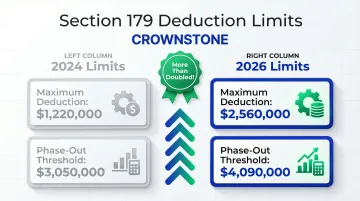
- Maximum deduction: $2,560,000
- Phase-out threshold: $4,090,000
These figures are more than double the 2024 limits of $1,220,000 and $3,050,000, a meaningful shift for any shop planning a major equipment purchase in 2026.
How the phase-out works: For every dollar spent on qualifying equipment above $4,090,000, your maximum Section 179 deduction decreases by one dollar. For a typical stone fabrication shop investing $300,000 to $800,000 in equipment annually, you're well under this threshold and can capture the full deduction.
Section 179 cannot exceed your business's net taxable income from all business activities for that year. If your shop has $150,000 in net taxable income, you can't deduct $300,000 under Section 179—but the excess carries forward to future tax years, applied when income supports it.
Bonus depreciation restored: The same legislation permanently reinstated 100% bonus depreciation for qualifying assets placed in service after January 19, 2025. This reversed the scheduled phase-down that had reduced bonus depreciation to 60% in 2024 and 40% in 2025. Unlike Section 179, bonus depreciation has no dollar cap and can create net operating losses—making it a powerful complement when Section 179 limits are reached.
Stone Fabrication Equipment That Qualifies for Section 179 in 2026
Most tangible machinery and equipment purchased and placed into service for stone fabrication qualifies under Section 179. The IRS classifies this equipment under Asset Class 32.3 (Manufacture of Other Stone and Clay Products) with a seven-year recovery period.
Equipment that typically qualifies:
- Bridge saws (manual, semi-automatic, and fully automatic models)
- CNC routers and machining centers
- Waterjet cutting systems
- Edge profilers and polishing machines
- Material handling equipment (vacuum lifters, stone carts, overhead cranes)
- Dust collection and water recycling systems
- Shop air compressors used exclusively in fabrication
- Hydraulic bridge saw tables with precision indexing systems
New or used—both qualify: The equipment can be new or used, as long as it's "acquired by purchase" from an unrelated party. A used bridge saw purchased from a third-party dealer qualifies; equipment inherited or purchased from a family member or related business entity does not, per IRS Publication 946.
Financed equipment counts: The IRS does not require equipment to be paid for in cash. Stone shops financing a bridge saw through a lender still claim the full Section 179 deduction in the year the machine is placed in service. The deduction is based on the full purchase price, not the amount you've paid down. The critical requirement is that the machine is operational—not merely ordered, delivered, or sitting uninstalled.
Computer software qualifies too: Off-the-shelf computer software used in your business—including CAD/CAM software for stone fabrication like Alphacam or Slabsmith—qualifies if it's commercially available to the general public and not custom-built exclusively for your company.
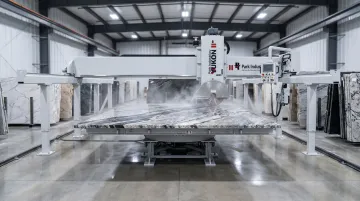
American-made equipment qualifies: Bridge saws, edge polishers, water recycling systems, and bridge saw tables manufactured in the U.S.—such as those made by Crown Stone USA—qualify as tangible personal property used in a trade or business. As long as the machine is purchased from an unrelated party and placed into operational service within the tax year, domestic or imported origin has no bearing on Section 179 eligibility.
What Doesn't Qualify — Common Pitfalls for Stone Shops
Understanding exclusions helps avoid costly mistakes when planning year-end equipment purchases.
Categories that don't qualify:
- Real property: The building or land your shop sits on
- Land improvements: Parking lots, exterior fencing, landscaping
- Property used 50% or less for business: Mixed-use equipment that falls below the business-use threshold
- Inventory held for resale: Stone slabs are inventory, not equipment
- Property acquired by gift, inheritance, or from a related party: Purchases from family members or related business entities don't qualify
Building improvements are a gray area. Adding a concrete floor or expanding your shop bay typically doesn't qualify under Section 179 the way equipment does.
That said, certain qualified improvement property to nonresidential buildings—interior improvements, HVAC upgrades, fire suppression, security systems—may qualify under specific IRS definitions. Work with a CPA who knows manufacturing facility rules before claiming these.
Watch the 50% business-use rule. If any piece of equipment falls below 50% business use during its recovery period, the IRS requires recapture — you'd owe back a portion of the deduction as ordinary income. Keep documentation proving business use, especially for equipment with potential dual purposes.
For most stone shops, this isn't a real concern. Bridge saws, CNC machines, and waterjet cutters are 100% commercial assets with no residential application.
Combining Section 179 With Bonus Depreciation: A One-Two Punch
How to Stack Section 179 and Bonus Depreciation for Maximum Savings
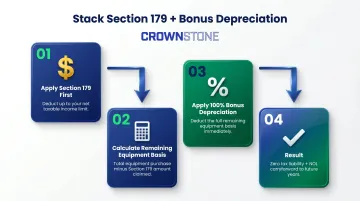
Section 179 and bonus depreciation work together, not in competition. Section 179 applies first — and when its limits or income cap are reached, bonus depreciation picks up the rest.
Key differences:
| Feature | Section 179 | Bonus Depreciation |
|---|---|---|
| 2026 dollar limit | $2,560,000 | No limit |
| Phase-out threshold | Begins at $4,090,000 | No phase-out |
| Business income limitation | Yes (cannot exceed net income) | No (can create NOL) |
| Asset classes covered | Tangible property used in business | Property with recovery period ≤20 years |
| Carryforward | Unused amounts carry forward | N/A (applies automatically) |
Unlike Section 179, bonus depreciation can create a net operating loss (NOL) that carries forward to offset future income — useful for fabricators who invest heavily in equipment during a leaner revenue year.
Consider a stone fabrication shop that buys $600,000 in qualifying equipment in 2026, with $400,000 in net taxable income before depreciation:
- Apply Section 179 first: The shop deducts $400,000 (limited by business income), reducing taxable income to $0
- Remaining equipment basis: $200,000 ($600,000 purchase − $400,000 Section 179)
- Apply 100% bonus depreciation: The remaining $200,000 is deducted via bonus depreciation, creating a $200,000 net operating loss
- Result: Zero tax liability for 2026, with a $200,000 NOL carryforward to offset future years' income
In short: Section 179 eliminates your current-year tax bill, and bonus depreciation turns any remaining equipment cost into a carryforward asset — not a write-off you lose.
How to Claim Section 179 on Your Stone Shop's Tax Return
Section 179 is claimed by filing IRS Form 4562 (Depreciation and Amortization) with your annual tax return. The election must be made by the due date of the return, including extensions. Stone fabrication shops carry specialized equipment inventories, so working with a CPA familiar with manufacturing or trade businesses will help you maximize deductions and satisfy documentation requirements.
Documentation to have ready:
- Purchase invoices or financing agreements showing full equipment cost
- Delivery and installation dates confirming the placed-in-service date falls within the tax year
- Brief written description of each equipment item's business use
- Financing documents (if applicable) showing the purchase was made at arm's length from an unrelated party
December 31 deadline is firm: Equipment must be installed and operational by December 31 to count for that tax year. "Operational" means ready and available for its specific use. Complex systems like bridge saws or water recycling units can take several weeks from delivery to full commissioning — factor that lead time into your year-end purchase planning so you're not scrambling in late December.
Frequently Asked Questions
What type of equipment qualifies for Section 179?
Tangible business equipment and machinery—including manufacturing equipment, office furniture, computers, and off-the-shelf software—generally qualifies, as long as it's used more than 50% for business and placed in service during the tax year.
What is the Section 179 limit for 2026?
The 2026 deduction limit is $2,560,000 (inflation-adjusted from the $2,500,000 base established by the One Big Beautiful Bill Act), with phase-out beginning at $4,090,000 in total qualifying equipment purchases for the year.
Does Section 179 apply to leased equipment?
Equipment financing through a loan or installment purchase qualifies—the full cost is deductible even if not paid in cash. True operating leases are treated differently and typically don't qualify; confirm your lease structure with your tax advisor.
What is not eligible for Section 179?
Key exclusions include real property (land and buildings), inventory held for resale, property used 50% or less for business, and equipment acquired from related parties or by gift or inheritance.
What equipment qualifies for bonus depreciation?
Bonus depreciation applies to tangible property with a cost recovery period of 20 years or less, which includes most stone fabrication machinery. Bonus depreciation has been restored to 100% for assets placed in service after January 19, 2025.
What equipment can I write off on my taxes?
Stone fabricators can write off the following using Section 179 or bonus depreciation, provided they meet business-use and placed-in-service requirements:
- Bridge saws and CNC machines
- Waterjet cutters
- Polishing and edge-profiling equipment
- Material handling tools
- Dust collection and water recycling systems
- Qualifying shop software