
Introduction
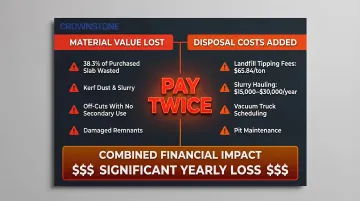
Material waste in stone fabrication is not just a disposal problem — it's a profit leak. According to the Life Cycle Assessment of Natural Stone Countertops commissioned by the Natural Stone Institute, fabricators convert only 61.7% of purchased slab material into finished countertop, with 38.3% becoming waste through kerf dust, slurry, and offcuts.
For a mid-sized shop processing 500 square feet of granite weekly at $50 per square foot, that waste rate represents roughly $9,575 in lost material value each month — before factoring in disposal fees, water costs, and labor time spent handling scrap. The average construction and demolition (C&D) landfill tipping fee is now $65.84 per ton, with some regions exceeding $124 per ton.
This waste is not an inherent cost of working with stone. Most material loss originates from decisions made before and during the cut — layout planning, slab selection, equipment precision — and from how shops manage workflow around fabrication.
The sections below break down each waste driver and give fabricators concrete steps to address them, starting where the biggest losses actually occur.
TL;DR
- Granite fabrication waste reaches 38% of purchased material when kerf dust and slurry are included, making waste one of the largest controllable cost drivers
- Waste hides across scrap stone, slurry disposal, damaged remnants, and landfill fees — most shops don't see the full cost until they track yield per slab
- The biggest waste reduction levers are upstream: digital layout planning, careful slab selection, and precision equipment
- Active shop management — remnant tracking, job batching, operator training — reduces waste during production
- Recycling partnerships and closed-loop water systems turn remaining disposal costs into recovered value
Where Waste Costs Actually Hide in a Granite Shop
Material waste costs in granite fabrication rarely show up as a single line item. They accumulate across several categories most shops never track together:
- Scrap stone and off-cuts with no secondary use
- Damaged remnants sitting in storage, consuming space and handling labor
- Slurry disposal fees and vacuum truck scheduling
- Water usage tied to wet cutting and polishing operations
- Weekly or monthly landfill and C&D tipping charges
Most shops don't see the full financial picture until they track yield per slab or pull a full quarter of disposal invoices.
The cost build-up compounds. Unused remnants consume valuable storage space and require handling labor every time they're moved. Disposal fees add up regardless of volume — shops in high-cost regions face C&D tipping fees exceeding $124 per ton in states like Alaska, while even low-cost areas now charge over $34 per ton.
Slurry is often the biggest surprise. A mid-sized shop running one bridge saw and two CNC routers can spend $15,000–$30,000 annually on slurry management — vacuum trucks, disposal fees, pit maintenance — before any water recycling system is in place. In one documented case, $800 in monthly hauling costs dropped to zero after installation.
Shops pay for waste twice: once when they lose the material value, and again when they pay to remove it. Cut waste, and you recover margin on both ends — less stone purchased, less disposal paid.
The Real Drivers of Material Waste in Granite Fabrication
Waste in granite fabrication is driven by planning choices, process execution, and equipment condition working together. Addressing only one factor rarely produces meaningful improvement because these drivers interact and reinforce each other.
Layout decisions made before the first cut are the primary driver. Jobs planned without optimizing cut sequences against actual slab dimensions consistently leave larger off-cuts than necessary. When fabricators default to ordering full slabs for jobs that could be nested together or matched to remnants, they structurally embed waste into every project. Digital layout tools that visualize multiple jobs on a single slab can reduce material waste by 12-22%.
Operator technique is the second major contributor. Breakage, mis-cuts, and oversized safety margins vary by skill and experience — and when fabricators add extra margin to every cut to compensate for equipment variability or uncertainty, those cumulative additions compound into significant material loss across a year of production.
Equipment condition affects waste at the blade level. A well-maintained $200 diamond blade can cut approximately 400 square feet of stone, while an identical glazed blade may fail at only 150 square feet — a 62.5% reduction in usable life. Saws running out of alignment or with worn blades create wider kerfs, irregular cuts, and higher breakage rates, turning precision problems into material losses.
This is where saw design has a direct impact on yield. Crown Stone USA's bridge saws are built with CNC-machined rolling surfaces and air-cylinder powered indexing to hold cut accuracy across a full day of production — the kind of consistency that keeps kerf widths predictable and breakage rates low.
The final driver is what happens to waste after it's generated. Shops without remnant tracking systems or recycling partnerships end up treating recoverable material as a disposal cost. Poor floor layout damages slabs during handling, and without diversion outlets, stone that could serve as aggregate or landscaping material goes to the landfill at $65.84 per ton instead.
Waste Reduction Strategies for Granite Fabrication Shops
Waste reduction strategies vary by where waste originates. Prevention strategies work upstream before cutting begins, management strategies reduce waste during active production, and downstream strategies address what remains after fabrication is complete.
Strategies That Reduce Waste by Changing Decisions
The following approaches target decisions made before or at the start of fabrication: layout, procurement, slab selection, and equipment investment.
Digital slab layout and nesting: Plan cut sequences digitally before touching the slab. Layout tools allow fabricators to visualize multiple jobs on one slab, identify optimal cut patterns, and quantify expected yield and off-cut sizes before any material is committed. AI-powered nesting software reports waste reductions of 12-22% with monthly savings of $3,000-$15,000 depending on volume. Digital templating systems capture measurements down to the millimeter, eliminating manual data entry errors and reducing remakes from mis-cuts.
Deliberate slab-to-job matching: Match slabs to job cut lists by dimension, not just material type. Selecting a slab whose usable area closely aligns with the cut list reduces structural off-cuts and avoids ordering oversized material for small jobs. This requires maintaining visibility into both job pipeline and slab inventory dimensions.
Consolidated ordering and inventory control: Audit purchasing patterns to avoid over-stocking slabs that sit in inventory, get damaged in storage, or are eventually discarded as unsellable. Right-sizing orders to confirmed job pipelines reduces the volume of material that never reaches a countertop. Track how long slabs remain in inventory and which materials move quickly versus those that accumulate.
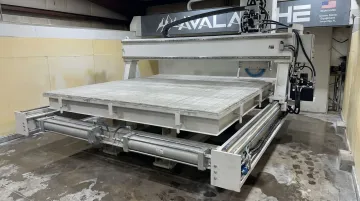
Precision equipment as a waste prevention decision: A saw that holds calibration, delivers consistent kerf width, and performs reliably on varied materials reduces the margin fabricators must add to every cut to account for equipment variability. Crown Stone USA's bridge saws are designed with this operational reality in mind, built by fabricators who understand how equipment precision directly affects material yield.
The bridge saw table, refined through 10 rigorous design iterations, features CNC-machined rolling surfaces for long-term precision, air-cylinder powered indexing for repeatable angle cuts, and hydraulic systems engineered for stability under load. Each of these features targets the cut-to-cut variability that forces fabricators to add protective margins.
Strategies That Reduce Waste by Improving How the Shop Is Managed
Control, visibility, and consistency during active fabrication determine how much waste compounds across a production week. These approaches tighten all three.
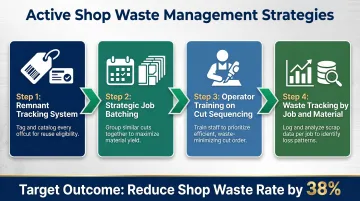
Remnant tracking and utilization system: Every off-cut should be photographed, dimensioned, labeled with material and batch ID, and stored in a designated area organized by size range. A live remnant inventory makes it possible to assign remnants to smaller jobs — vanities, shelves, backsplashes — rather than defaulting to new slabs. Online remnant marketplaces like CountertopSmart and SRTops enable shops to monetize offcuts that would otherwise be landfilled.
Strategic job batching: Group jobs by material type and size profile and plan them onto slabs together rather than running each job independently. Batching small vanity jobs frequently allows multiple pieces to come from a single slab that would otherwise be partially wasted. This requires advance planning and coordination with templating and sales teams to align job timing.
Operator training on cut sequencing and material conservation: Establish standard operating procedures for cut order, edge allowances, and material handling. Fabricators who understand how sequencing decisions affect yield make better real-time choices at the saw, reducing unnecessary waste from over-cutting and breakage. Training should cover blade maintenance — a 30-60 second dressing procedure can restore a glazed blade and extend its life by 50-100 square feet.
Waste tracking by job and material type: Track yield percentage per slab, per material type, and per job category on a regular cadence. Without measurement, waste reduction has no baseline to improve against, and problem areas — specific materials, job types, or operators — remain invisible. Track both solid off-cuts and total material input versus finished output to capture the full 38% waste rate, not just visible remnants.
Strategies That Reduce Waste by Changing the Context Around Fabrication
Even well-run shops generate waste that can't be eliminated outright. These approaches reduce its cost impact by addressing recycling partnerships, slurry management, facility layout, and byproduct repurposing.
Recycling and diversion partnerships: Research local partnerships with asphalt producers, concrete aggregate suppliers, landscaping companies, or construction material recyclers who can accept crushed or broken stone. Recycling concrete rubble costs approximately $7.50 per ton versus over $68 per ton for landfill disposal (an 89% cost reduction). Stone processing waste can replace 10-15% of cement or 20-40% of fine aggregate in concrete, and serves as asphalt filler, providing legitimate commercial value to aggregate buyers.
Slurry and water waste management: Wet cutting generates slurry (a mix of water and fine stone particles) that carries its own disposal cost and creates facility and environmental compliance issues if unmanaged. Closed-loop water recycling systems and sludge dehydrators reduce both water consumption and slurry disposal volume significantly. One documented case showed a shop reducing monthly water, sewage, and slurry costs from $2,800 to under $150 after installing a closed-loop system, a 95% reduction with payback periods typically running 18-36 months.
Crown Stone USA manufactures flocculant-based water recycling systems in 40 GPM and 70 GPM capacities, designed to provide continuous clean water while managing sediment through gravity settling. These systems eliminate slurry hauling costs entirely and extend diamond tool life by 2-3 times through cleaner recycled water.
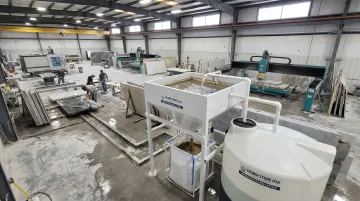
Shop floor layout and material handling: Examine how slabs and remnants move through the facility. Material damaged during handling or staging represents waste that proper A-frame storage, clear traffic flow, and designated work zones can prevent. Heavy granite slabs are particularly vulnerable to chipping and breakage when moved repeatedly or stored in congested areas.
Repurposing offcuts into smaller sellable products: Stone pieces too small for countertop work can be cut into samples, display pieces, mosaic components, or small accent products. This converts what would be disposal cost into either recovered revenue or customer goodwill through giveaway programs. The Natural Stone Institute's best practices identify creating smaller component products such as thin veneer and mosaics as a primary remnant reuse pathway.
Conclusion
Reducing material waste in a granite fabrication shop comes down to one thing: knowing exactly where waste originates — whether in planning decisions, shop management practices, or disposal habits — and targeting those origins directly.
Small improvements in layout planning add to gains from remnant utilization, which compound further when combined with disposal partnerships and water recycling. Over a year, that adds up.
The documented 38% waste rate means that for every $100,000 in material purchased, $38,000 becomes waste. Reducing that rate by even 5 percentage points returns $5,000 to the bottom line — before factoring in avoided disposal fees.
None of that progress happens without measurement. Without tracking yield per slab and disposal costs, shops can't identify which materials, job types, or operators drive the most waste. Start by measuring total material input versus finished output, then work backward to find the highest-impact reduction opportunities specific to your operation.
Frequently Asked Questions
What are the 5 R's of waste reduction?
The 5 R's — Refuse, Reduce, Reuse, Repurpose, Recycle — form a hierarchy for waste management. In granite fabrication, this means refusing oversized slab orders, reducing kerf waste through precise cutting, reusing remnants on smaller jobs, repurposing offcuts as samples or accent pieces, and recycling stone waste through aggregate partnerships with concrete or asphalt producers.
How to reduce construction and demolition waste?
Stone fabrication waste overlaps with C&D waste principles. Start with accurate digital templating to eliminate remakes and nesting software to maximize slab yield. Partnering with local asphalt or concrete suppliers who accept crushed stone can cut disposal costs by 89% compared to landfilling.
What are the 8 wastes of construction?
The Lean manufacturing framework identifies 8 waste types, four of which hit stone shops hardest: Defects (mis-cuts requiring scrap), Extra Processing (recutting from inaccurate templating), Inventory (excess slab stock and remnant accumulation), and Transportation (heavy slab handling that damages material and burns labor hours).
Can you take stone to the dump?
Yes, but landfills charge by weight — averaging $65.84 per ton nationally. Instead, connect with aggregate buyers or asphalt/concrete producers who often accept crushed stone at no cost, turning a disposal expense into a straightforward diversion opportunity.
What is the cheapest way to get rid of rubble?
Partnering with local asphalt or concrete aggregate companies is the most cost-effective route — they often collect material for around $7.50/ton versus $65+ for landfilling. Offering remnants to customers or contractors for landscaping projects is another no-cost option worth building into your workflow.